When AI Solved 372 Math Problems in One Day: Why Mathematicians Are Angry, Not Celebrating

OpenAI's one-day dump of 372 math solutions triggered outrage over how mathematical knowledge is transmitted between generations.
OpenAI's LLM produced solutions to 372 open mathematical problems in a single day, triggering widespread pushback from the mathematical community. Terence Tao's open letter identified the core tension: traditionally, a proved conjecture sparks talks, workshops, collaborations, and generational learning — a knowledge-transmission mechanism that AI's wholesale solution dump destroys. Technically, many proofs are in Lean formal code running to millions of lines, making genuine human understanding nearly impossible. The bin packing problem and integer multiplication lower bound illustrate how AI solutions are often brute-force computational searches lacking elegant structure — though reframing (e.g., mapping planar solutions to a torus) sometimes reveals hidden order. The episode mirrors a dilemma already gripping software engineering: when AI consumes entry-level work, how do fields cultivate deep understanding in new practitioners?
Some called it a "mathematical apocalypse" — mathematics had been "solved." But mathematicians around the world aren't celebrating. They're pushing back, even expressing anger. That might sound absurd: isn't solving problems exactly what mathematicians do? Why would they be upset that problems got solved?
The answer lies in who solved them and how. This time, it was a large language model (LLM) — specifically an OpenAI model — that produced solutions to 372 open mathematical problems in a single day. This was described as equivalent to roughly 80% of all major mathematical discoveries compressed into one burst. And the mathematical community's reaction reflects an anxiety far deeper than "problems got solved."
How It Unfolded: From Terence Tao's Open Letter to 372 Solutions
To understand the controversy, you have to start with the open letter published by mathematician Terence Tao. He observed that LLMs' mathematical capabilities had surged dramatically over the past few months, to the point where they could solve major long-standing open problems across multiple fields. But he also warned: AI companies treating "solving math problems" as a benchmark to chase is harmful to mathematics as a discipline and to the mathematical community — because the goals of AI companies are severely misaligned with the goals of the mathematical community.
The letter gathered widespread signatures from mathematicians. After earlier controversies around Navier-Stokes related developments, discontent with OpenAI was already running high in the mathematical community. OpenAI's response was theatrical: faced with collective dissatisfaction, it chose to "dump" 372 solutions onto the mathematical community all at once — as if the problem had been that only one solution was provided. Even more striking was the claim that the model solved these problems "one-shot."
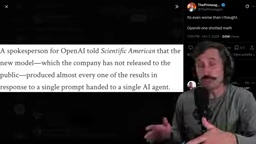
It's worth noting that not all solutions came with formal proofs. According to the video, roughly a hundred or so of the 372 problems had Lean-verified formal proofs; the rest simply asserted that the proof holds. The list itself even had obvious numbering errors — a system capable of cracking decades-old unsolved problems couldn't even keep its numbers in order. That detail alone is a telling signal.
The Navier-Stokes equations are a system of partial differential equations describing viscous fluid motion, and one of the Clay Mathematics Institute's Millennium Prize Problems — with a $1 million reward that remains unclaimed. The central unsolved question is whether smooth initial conditions in three dimensions always produce globally smooth solutions (i.e., no finite-time singularities). The problem spans pure mathematics and fluid mechanics and is directly connected to the mathematical nature of turbulence. The mention of "Navier-Stokes related developments" intensifying mathematical community frustration with OpenAI implies AI claimed progress in this direction, though the reliability and significance of that progress was disputed. This provides the tense backdrop for OpenAI's subsequent "dump" of 372 solutions: the mathematical community hadn't yet digested the previous controversy when an even larger wave hit.
The Two Real Reasons Mathematicians Are Angry
Tao identified the first core issue: in traditional mathematics, when a long-standing conjecture is proved, it triggers a cascade of subsequent activity. The prover is invited to give talks and engage with experts; workshops are organized; new collaborations and follow-on problems emerge; younger and senior mathematicians alike are drawn into the area. Through this process, the proof gets absorbed, refined, and contextualized — eventually entering textbooks and nourishing the next generation of mathematicians.
This is an intergenerational transmission mechanism. Mathematics advances through a relay race of understanding passed from one generation to the next. When AI sweeps all the problems off the board in a single day, what gets destroyed is exactly this mechanism. There's no gradual accumulation of excitement, no generation of new understanding — just the terminal feeling that "everything has already been solved." Which raises the question: if everything can be solved instantly, what's the point of learning any of it?

The second reason is more technical. These proofs are often written in the proof language Lean, running to millions of lines of code. Lean's purpose is to produce machine-verifiable proofs — for example, defining a theorem, taking two natural numbers A and B, and stepping through rewrite rules until reaching the tautology "B+1 = B+1," thereby proving the original proposition. This machine-friendly language happens to be an ideal vehicle for LLMs generating proofs at scale. LLMs are good at generating vast amounts of code, and Lean is well-suited to receive it.
Lean is an interactive theorem prover developed by Microsoft Research, part of the "formal mathematics" toolchain. It requires every step of reasoning to be written as machine-verifiable code: defining basic axioms, declaring theorems, then deriving conclusions step by step through a strict type system until the program reports "proof complete." Unlike ordinary mathematical papers, Lean proofs don't rely on human readers' intuition to judge whether a leap in reasoning is valid — every step must conform to formal syntax. This strictness makes Lean proofs nearly impossible to fake, but it comes with a side effect: even if the underlying idea is elegant and concise, translating it into Lean code often inflates it to tens of thousands or even millions of lines, filled with low-level type definitions and auxiliary lemmas. For mathematicians, reading such a proof requires both domain expertise and fluency in Lean syntax — a steep cost. This is why "Lean-verified" does not equal "understood by the mathematical community."
The Bin Packing Problem: Is Mathematics Just "Compute-Intensive"?
One case repeatedly cited in the video is the bin packing problem: fitting a number of 1×1 unit squares into the smallest possible region. People expect each solution to carry some kind of "magic" — a formula, an order, a beauty. But the optimal solution from the LLM looks completely chaotic, wedging squares into tiny gaps by brute force, yet fitting perfectly in the end. This means the optimal solution genuinely exists — but finding it requires staggering amounts of computation.
This suggests a deeply unsettling implication: what if all of mathematics is fundamentally like this — so computationally constrained that at some point, humans simply cannot perform optimal mathematics?
Another landmark example is the lower bound for integer multiplication. The accepted fastest bound was long believed to be n log n, but OpenAI's result shows it's not strictly n log n — it's a slightly faster bound with a long string of nines attached. This is like the speed of light in physics not being a "nice integer." The universe does not care about human aesthetics.
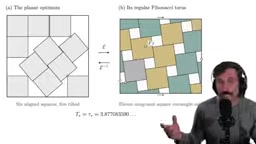
Bin packing is a classic problem family in combinatorial optimization. The most common one-dimensional version: given a set of items of varying sizes, how do you pack them into the fewest fixed-capacity bins? It's NP-hard, meaning that as the problem scales, exhaustively checking all arrangements becomes computationally infeasible. The two-dimensional planar version mentioned here — fitting 1×1 squares into the smallest possible area — belongs to the same family. The existence of an optimal solution is easy to prove, but finding it requires searching an astronomically large configuration space. This is why the AI's solution looks like "chaotically jamming pieces together" — it's using computational power to enumerate configurations no human could check by hand, finding a locally precise optimal arrangement never before seen. This raises a more fundamental philosophical question: if the "optimal solution" is inherently orderless, what does it even mean to "understand" it?
A Change of Perspective Can Make Ugly Answers Beautiful
But there's a twist. Researchers pointed out that the seemingly chaotic planar bin packing optimal solution, when "rolled" onto a torus and expressed as a Fibonacci arrangement, corresponds to the same optimal value — and the torus version is uniform, repeating, and beautiful. In other words, OpenAI may have computed the answer, but a more beautiful and more obvious solution always existed. We were just looking at it through the wrong lens.
This is what makes mathematics fascinating. The Archimedean spiral is nearly intractable in Cartesian coordinates, but in polar coordinates the equation simplifies to something as clean as y = mx + b. The Fourier transform works the same way in signal processing. Change the coordinate system, change the perspective, and a hard problem can instantly collapse into a simple one.
What happened with the integer multiplication "ugly number" is even more interesting. It's like the four-minute mile — before Roger Bannister broke it on May 6, 1954, people believed it was the limit of human capability, and once broken, runners kept going faster. The integer multiplication result worked similarly: reviewer Doug Colquitt verified and improved the exponent savings parameter by 2^75, then a few hours later by another factor of 570 million, then 500,000 more — the bound kept compressing, from 54 nines down toward 5 nines, even pointing toward a runtime close to n·√(log n), which would be practically useful.
This shows that proving "it can run this fast" doesn't mean being stuck with some absurd irrational number. There may well be an elegant bound — we just haven't found the right perspective yet.
A torus is the surface obtained by gluing opposite edges of a rectangular plane — imagine rolling a sheet of paper into a cylinder, then bending the cylinder to join its two ends. Points that appear randomly scattered on a flat plane often form uniformly periodic structures when mapped onto a torus. The Fibonacci sequence is deeply connected to the golden ratio and appears naturally in plant leaf arrangements and sunflower seed patterns, corresponding to the most uniformly distributed circular packing at a given density. When the "ugly optimal solution" for planar bin packing, when rolled onto the torus, recovers a Fibonacci-style uniform distribution, it shows that the two descriptions point to the same geometric reality — the Cartesian coordinate system was simply obscuring its inherent order. This is not unprecedented in mathematical history: the zeros of the Riemann zeta function look chaotic in the complex plane but align strictly on the critical line under specific transformations; prime distribution looks random on the integer line but follows precise asymptotic laws in logarithmic coordinates.
Mathematics Is Now Facing What Software Engineering Has Long Struggled With
The core controversy here is exactly what software engineering has been wrestling with for a while: when AI is consuming the work that beginners used to do every day, how does a field train the next generation? If everything can be solved, what's the point of doing it or learning it?

The stance taken by mathematicians offers a perspective worth borrowing: they don't just want to review proofs — they want to understand what those proofs are doing, and use that understanding to open up new possibilities. This is subtly different from software engineering's situation. In computing, everything ultimately has to deliver value to a customer. But the purpose of mathematics is precisely to develop new perspectives and define that elegant, ideal solution — not to produce an infinitely repeating string of 0.9999…
One particularly absurd detail: Reddit's r/math subreddit, on what might be one of the most seismic days in mathematical history — "372 open problems solved in one day and uploaded to GitHub" — had almost no discussion of it, and enforces strict restrictions on AI-related posts. Whatever one's position, avoiding the conversation seems like the wrong call.
For everyone still in the learning phase, the lesson from all this is consistent: even if your hands leave the keyboard more often than they did a few years ago, it's still worth taking the time to deeply understand concepts. Just as mathematics needs the next generation to truly understand it, every field needs people to pick up the baton of understanding — not just consume the outputs AI produces.
Related articles

Build a Reasoning Model from Scratch: An 11-Hour Open-Source Course Breakdown
Sebastian Raschka releases a free 8-episode, ~11-hour video course teaching you to build a reasoning model from scratch with Python and PyTorch—from a small Qwen3 model through Verifier, Inference Time Scaling, GRPO, and distillation, with open-source code on GitHub.

An 11-Hour Reasoning Model Course in Practice: How Small Models Learn to Think
Starting from Sebastian Raschka's 11-hour reasoning model course and HN buzz, this analyzes small-model training, legal text version control, Anthropic data policy, and product reliability reviews.

Lightpanda: A Headless Browser Built for AI and Automation
Lightpanda is a headless browser built from scratch in Zig for AI and automation, with 37,852 GitHub stars. This analysis covers its technical approach, design choices, and use cases.