When User Queries Are Vague, Why Do Deep Research Agents Fail?
Research reveals that query vagueness significantly weakens deep research agents' answer quality and search direction.
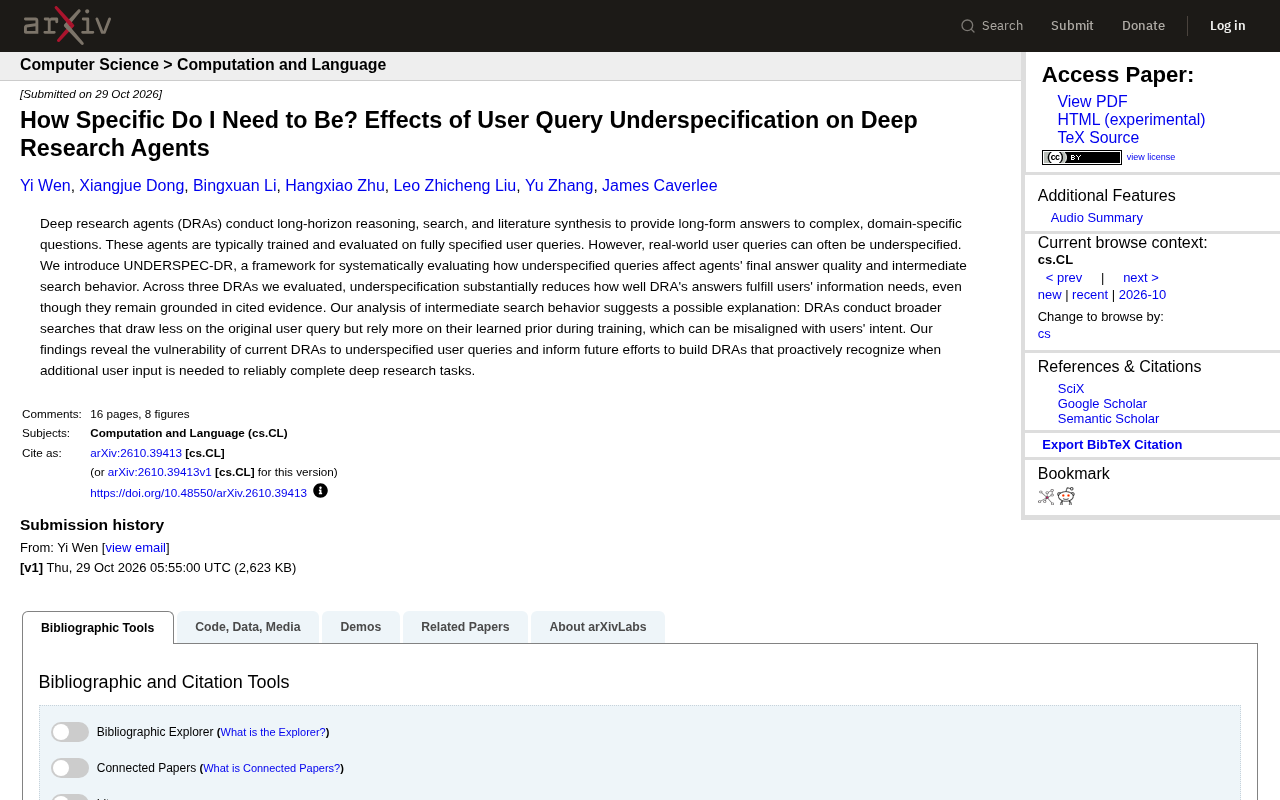
This study uses the UNDERSPEC-DR framework to evaluate how underspecified user queries affect Deep Research Agents (DRAs). Experiments on three DRAs show that vague queries significantly reduce how well answers meet users' true information needs; answers may remain citation-supported but miss the point, showing groundedness is not usefulness. Analysis of search behavior shows agents broaden searches but rely less on the original query and more on training priors, drifting from user intent. The study calls for DRAs that proactively detect uncertainty and request clarification.
Deep Research Agents (DRAs) can perform long-horizon reasoning, search, and literature synthesis, producing long-form answers to complex domain questions. However, these agents are typically trained and evaluated on fully specified user queries, whereas real-world user questions are often vague. A new study systematically evaluates the impact of query underspecification on agents' final answer quality and intermediate search behavior through the UNDERSPEC-DR framework, revealing the fragility of current DRAs.
How vague queries undermine answer quality
The research team evaluated three DRAs and found that when user queries are underspecified, the degree to which agent answers satisfy users' information needs drops significantly. Although the answers remain supported by cited evidence and appear "well-grounded," they do not actually hit the user's true intent. This means that answer "groundedness" does not guarantee usefulness—an agent may give a well-evidenced response that answers the wrong question.
This finding raises a warning for practical applications: users often do not provide complete, precise queries as in benchmarks, and agent performance under vague input is far from reliable.
Groundedness is a metric commonly used when evaluating retrieval-augmented or tool-calling systems; it refers to whether generated content can be directly supported by external evidence (such as retrieved web pages or document snippets). It measures "whether the answer is supported," not "whether the answer is useful." A response can attach real citations to every claim yet still miss the point overall—for example, the user asks "which option should I choose in scenario A," but the agent piles up evidence around an adjacent scenario B. This "supported but useless" failure mode shows that groundedness is only a necessary, not sufficient, condition for answer quality, and that evaluating DRAs requires measuring "whether user information needs are satisfied" separately from "whether citations support the claims."
Changes in search behavior: broader but more off-target
To explain the decline in answer quality, the researchers analyzed the agents' intermediate search behavior. The results show that when facing vague queries, DRAs conduct broader searches, but these searches rely less on the original user query and more on prior knowledge learned by the model during training. Such priors may conflict with the user's true intent, causing the search direction to drift.
In other words, when uncertain, agents tend to "freelance" rather than proactively clarify or narrow the search scope. This strategy may work within the training distribution, but in real-world scenarios it easily amplifies misunderstandings.
An underspecified query refers to a question in which the user does not provide the constraints necessary to complete the task, such as missing time range, region, target audience, comparison dimensions, or expected output format. It differs from "ambiguity" (where a word has multiple meanings): every word in an underspecified query is clear, but the overall information is insufficient to uniquely determine an answer. Real-world user questions commonly have this characteristic, while most benchmarks construct complete queries through manual completion or templating, thereby systematically overestimating agents' actual reliability. Identifying underspecification usually requires judging "what key slots are still missing to answer this question," which is also a prerequisite for clarification-seeking capability.
Implications for building more reliable DRAs
The study points out that future work needs to build DRAs that can proactively identify when additional user input is needed. Rather than forcing an answer to a vague query, agents should learn to ask users for clarification when necessary or narrow the scope through interactive questioning. This requires agents to have an awareness of their own uncertainty and mechanisms to dynamically adjust search strategies in long-horizon tasks.
The UNDERSPEC-DR framework provides a tool for systematically evaluating the impact of query vagueness and points the way for future research: making deep research agents reliable even under real, imperfect user input.
Clarification-seeking in human-computer interaction and dialogue systems refers to the system pausing execution when information is insufficient and asking targeted questions to fill in key constraints, rather than continuing based on guesses. For long-horizon research agents, this capability is especially important: every step of search and synthesis amplifies early misunderstandings, and the later clarification occurs, the higher the correction cost. Implementing clarification-seeking generally requires three components—detecting uncertainty (judging whether the current query lacks decisive information), generating high-information questions (asking in one go for the key slots that most reduce the answer space), and dynamically revising the search plan based on the answer. Related research also examines the timing and cost trade-offs of clarification: excessive questioning interrupts users, while never asking degrades into guessing, so calibrated confidence estimates are needed to trigger questions.
Key takeaways
- Query vagueness significantly reduces the degree to which DRA answers satisfy users' information needs, even when the answers remain supported by citations.
- Vague queries cause agents to search more broadly but rely more on training priors, drifting away from user intent.
- Future DRAs need the ability to proactively request clarification to handle underspecified queries in real-world scenarios.
One-line Summary
Research reveals that query vagueness significantly weakens the answer quality and search direction of deep research agents.
Paragraph Summary
This study systematically evaluates the impact of user query underspecification on Deep Research Agents (DRAs) through the UNDERSPEC-DR framework. Experiments on three DRAs show that when queries are vague, the degree to which agent answers satisfy users' true information needs drops significantly; although answers remain citation-supported, they exhibit a "well-grounded but off-target" state, showing that groundedness does not equal usefulness. Analysis of intermediate search behavior indicates that under vague queries, agents expand search scope but reduce reliance on the original query and rely more on training priors, causing search direction to drift from user intent. The study accordingly calls for building DRAs that can proactively identify uncertainty and request clarification when necessary, and notes that UNDERSPEC-DR provides a tool for future evaluation.
Related articles

DeepSeek Open-Sources DeepInfer: What Is an Inference Framework Actually For?
DeepSeek open-sources its inference framework DeepInfer under Apache 2.0, supporting DeepSeek V4.1 Flash offline inference. This article explains its request scheduling, FlashMLA/DeepGEMM compute optimization, DSPark speculative verification acceleration, and what it means for developers and ordinary users.

Open-Source AI Learning Agent: A Full Workflow Experience from Topology Graphs to Exam Generation
Explore an open-source AI learning agent: built on DeepSeek API, it constructs knowledge systems via topology graphs, with automatic document generation, notes, super documents, and exams. Learn about its Agent workflow and design highlights.

DeepSeek Whale Girl Open-Source MV Meme: AI Industry Coded Slang About Pivoting to Closed Source
Bilibili's DeepSeek Whale Girl rap MV uses fictional memes to tease the AI open-source vs. closed-source debate, with lyrics full of industry slang. This article explains the meme culture, the Whale Girl symbol, and the open/closed tension.