Why Do Your Research Ideas Always Feel Clunky? A ML Master's Student's Confusion and Breakdown

The elegance of ML research papers masks a chaotic process; first authors aren't uniquely gifted—the gap lies in problem-selection taste, iteration endurance, and collaborative feedback.
A 31-year-old incoming ML master's student is puzzled that his research ideas always feel clunky, questioning whether first authors are built different. The article points out that the elegance of finished papers masks the chaos and trial-and-error of the research process, and that most milestone works started just as clunky. First authors' edge comes more from taste in problem selection, iteration endurance, and collaborative feedback than from talent. Failures and surprises during reproduction are entry points to research problems; "novelty" should be broken down into concrete differences from recent work and measurable phenomena, and low-cost experiments should be used to quickly falsify ideas. ADHD's idea-generation strength needs to be paired with validation discipline. Research selects for persistence, not genius.
A Soon-to-Be Master's Student's Real Confusion
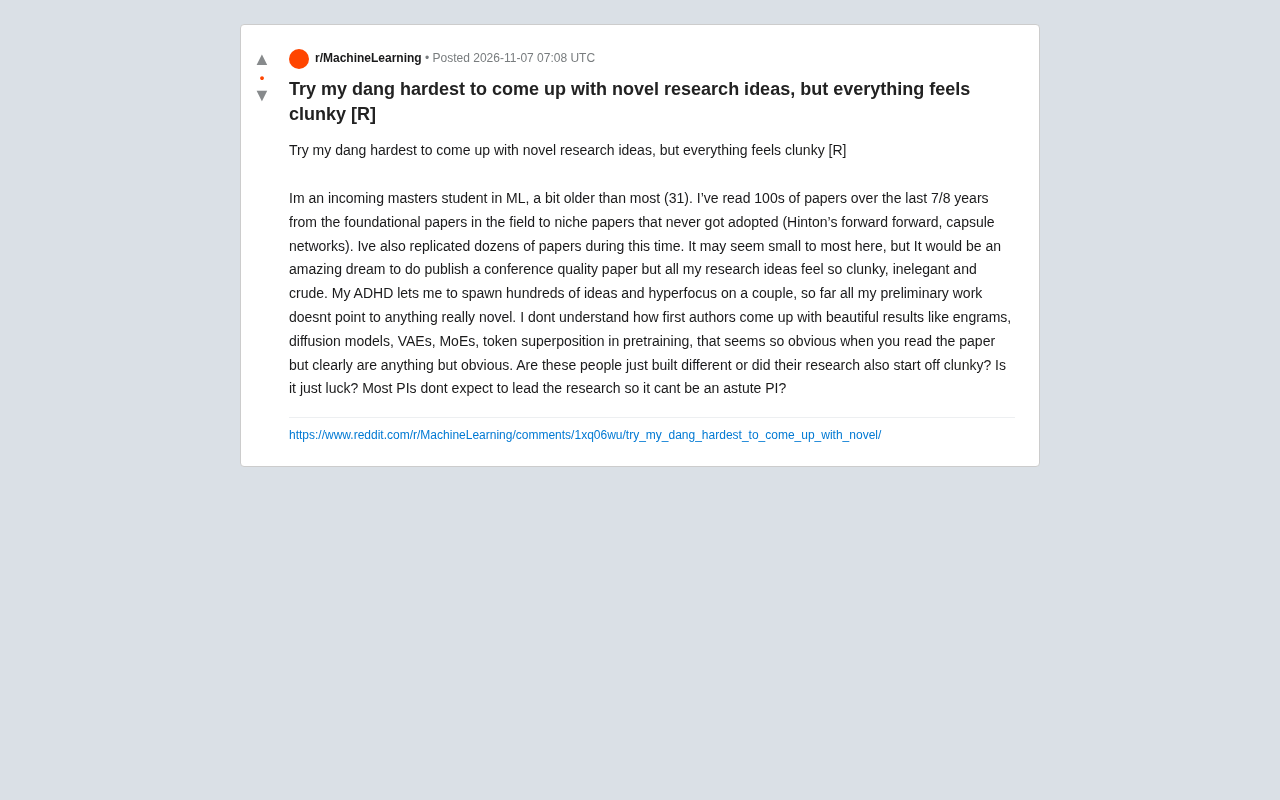
A 31-year-old incoming machine learning master's student posted on Reddit, confessing that over the past seven or eight years he has read hundreds of papers—from foundational works in the field to rarely-adopted niche efforts like Hinton's forward-forward and capsule networks—and has reproduced dozens of papers. His dream is to publish a conference-level paper, but every research idea he comes up with feels "clunky, inelegant, rough."
His ADHD lets him generate hundreds of ideas and hyperfocus on a few of them, but the preliminary work never points toward anything genuinely novel. He doesn't understand: how do those first authors come up with beautiful results like engrams, diffusion models, VAEs, MoE, and token superposition in pretraining—things that "read as obvious but are absolutely non-obvious to produce"? Are these people built different, or were their research starting points just as clunky? Is it luck?
This post touches on a truth rarely discussed openly in machine learning research: the elegance of the finished paper masks the chaos of the research process.
Elegant Results, Clunky Process
When you read a NeurIPS best paper, you see clear motivation, a concise method, and beautiful ablation studies. But almost no one shows you draft #17, the three hypotheses that got overturned, and the twist of "actually, we originally wanted to work on a different problem."
The idea behind diffusion models can be traced back to non-equilibrium processes in thermodynamics, but early attempts to connect noise injection with denoising did not go smoothly; the variational inference framework of VAEs is mathematically elegant, but making it actually work on images required a great deal of engineering detail; the concept of MoE isn't complicated, yet the stability of routing strategies once stumped quite a few teams. These works "read as obvious" because their authors compressed a messy process into a linear narrative.
In other words, the starting point of research is usually clunky. The difference is that seasoned researchers know how to iterate a clunky starting point into a publishable contribution, while novices tend to dismiss themselves before their ideas have become sharp enough.
Where the "Clunkiness" of Ideas Comes From
A common misconception is that a good idea should shine from the very beginning. In reality, research ideas are almost always vague in their early stages—you have an intuition, but you can't yet articulate why it matters, where the boundary with existing work lies, or what experiments could validate it. This vagueness gets misread as "the idea is no good."
Another source is comparison bias. You compare your own unformed 3rd-draft idea against someone else's final manuscript polished over two years, and of course the gap feels enormous. The poster is reading milestone works like Hinton's, VAEs, and diffusion models—these are the survivors filtered by the field, while failed and mediocre attempts never appear on his reading list.
First Authors Aren't "Built Different"
The question in the post is direct: are these authors built different? Based on public discussions in the research community, the answer leans toward no. When most prolific researchers describe their process, the keywords tend to be "massive trial and error," "long-term immersion," and "endless arguments with collaborators," rather than flashes of inspiration.
What truly creates the gap may not be the novelty of the idea itself, but a few more mundane things:
Taste in problem selection. Given the same "clunky" initial intuition, some people choose a problem with enough room to unfold, while others choose a small problem that's over once it's done. Taste comes from extensive reading and hands-on work, not talent.
Endurance in iteration. An idea going from "clunky" to "elegant" often requires multiple rounds of reformulation—formalizing a vague intuition, finding an experimental setup that distinguishes it from the baseline, then adjusting the narrative based on results. This process is tedious and offers no immediate feedback.
Collaboration and feedback. The post mentions that "most PIs don't expect to lead research," and this observation has merit, but the value of PIs and peers isn't in coming up with ideas for you—it's in helping you judge which direction is worth investing in and which experimental design has holes. Polishing ideas in isolation easily leads to a cycle of self-doubt.
ADHD Is a Double-Edged Sword
The poster mentions that ADHD lets him generate a large number of ideas and hyperfocus on a few. In early-stage research this is both an advantage and a burden: many ideas mean a large exploration space, but without a filtering mechanism, focus may be directed toward a direction with a low ceiling. Shifting some of the energy spent on "generating ideas" toward "fast, low-cost validation" may be a more practical strategy.
Survivorship bias refers to focusing only on successful samples while ignoring failed ones, leading to incorrect attributions about the causes of success. In machine learning research, the papers we read are mostly "survivors" filtered through peer review, while rejected, unpublished, or abandoned work never enters our reading lists. This bias makes people mistakenly believe that good ideas are inherently elegant and that the research process is naturally clear. In reality, behind every milestone work are numerous failed attempts and iterated versions that are never shown. Recognizing survivorship bias helps novice researchers understand that the confusion and clunkiness they experience are not signs of incompetence but the norm of the research process.
From Clunky to Publishable: Several Actionable Paths
Break "Novelty" into Smaller Judgments
"Is this idea novel enough" is too big and too hard a question to answer. You can break it down: how exactly does it differ from the three most recent related works? Does this difference correspond to a measurable phenomenon? If the answer is "the difference exists but can't be measured," then the problem may lie in the experimental design rather than the idea itself.
VAE (Variational Autoencoder) is a type of generative model whose core idea is to approximate the posterior distribution of data via variational inference and jointly train an encoder-decoder structure through reconstruction loss and a KL regularization term. Mathematically, it optimizes the evidence lower bound (ELBO), balancing reconstruction accuracy with the regularity of the latent space. However, early VAE-generated images tended to be blurry because pixel-level reconstruction losses (such as MSE) tend to average out uncertainty. Making VAEs truly "work" required perceptual losses, adversarial training, or more refined architecture design—engineering details that are often simplified in papers.
Diffusion models, inspired by non-equilibrium thermodynamics, gradually transform the data distribution into a simple noise distribution by adding noise step by step, then learn the reverse denoising process. Their elegant mathematical framework masks the difficulties in early practice, such as noise schedule design, trade-offs in sampling steps, and training stability issues. It wasn't until works like DDPM emerged that simplification and engineering optimization allowed them to shine in image generation. These examples show that the beauty of a theoretical framework does not automatically translate into an effective method—it requires a great deal of trial and error and hyperparameter tuning in between.
Accept That "Reproduction Is the Starting Point of Research"
The poster has already reproduced dozens of papers, and this is an often-underestimated asset. The unexpected failures encountered during reproduction, results that don't match the original paper, and places that require extra tricks to get running are often the entry points to new problems. Many influential works start precisely from "why does this simple method fail under certain settings."
Replace Idle Speculation with Low-Cost Experiments
Whether an idea is clunky is hard to judge on paper. Rather than repeatedly polishing it in your head, use the smallest possible experiment to falsify it. A small experiment that yields a signal in a day carries more information than a week of agonizing. The poster's preliminary work "doesn't point to anything genuinely novel"—this itself is valid information: the problem may be that the experiments are too preliminary to expose the idea's true potential.
Find the "Clunky but Correct" Middle Ground
Works like engrams and token superposition read elegantly, but their core insights can often be stated in one sentence. Pursuing "elegant to read" is not the starting point; pursuing "a clear core insight" is. First make the idea logically sound—elegance is a matter of later writing and presentation.
ADHD (Attention-Deficit/Hyperactivity Disorder) is not uncommon among researchers, with core features including difficulty regulating attention, hyperactivity, and impulsivity. In research, ADHD may manifest as divergent thinking and frequent jumps between ideas, but it can also bring hyperfocus and creative associations. The key is to establish an externalized filtering mechanism: quickly turn ideas into minimum viable experiments and judge value by data rather than subjective feeling. At the same time, use tools like checklists and time-boxing to manage executive function weaknesses, and combine divergent strengths with validation discipline to avoid idea overflow with sparse output.
Research Doesn't Select for Genius—It Selects for Persistence
Back to the original question in the post: are these people built different? A description closer to the truth might be—they went through equally clunky starting points, but they didn't stop at the clunky stage. Survivorship bias in the research community lets us see only finished products, not the self-doubt along the way, and what this 31-year-old incoming master's student is experiencing is precisely the stage that almost every researcher has gone through but that rarely makes it into papers.
For ADHD researchers, combining the strength of idea generation with the discipline of rapid validation may be more feasible than pursuing "elegant ideas from the start." Clunkiness is not a signal of failure—it's usually evidence that the research hasn't been iterated enough yet.
Related articles
 Tech Frontiers
MuJoCo: An Analysis of DeepMind's Open-Source General-Purpose Physics Simulator
An in-depth analysis of Google DeepMind's open-source physics simulator MuJoCo: high-performance C++ kernel, MJCF modeling format, contact solving principles, MJX GPU acceleration, and robot reinforcement learning use cases.
 Tech Frontiers
Claude API Quick Start: The Official Quickstarts Project Collection
Anthropic's official claude-quickstarts project collection helps developers quickly build deployable apps with the Claude API. Nearly 20k stars, Python-based, great for beginners and prototyping.
 Tech Frontiers
AI Agents Connecting Directly to APIs: Which Calls Can Be Safely Allowed?
AI agents can call any API, but the real challenge is deciding which calls can be safely allowed. This article analyzes allowance decisions from three dimensions—intent matching, least privilege, and controllable impact—and argues that the control layer should sit outside the agent, combined with audit traceability to build a trustworthy API call governance mechanism.