Will GitHub Die? Open Source Maintainer Burnout and the Collaboration Crisis in the AI Era

Open source and academia share a verification crisis: knowledge production accelerates while human review is already overloaded.
Starting from open source maintainer burnout, the article points out that a few core people behind each repository are being overwhelmed by pull requests, with code growth exceeding human review capacity; GitHub's "death" is really the functional failure of its trusted collaboration hub. Using math journal peer review as a cautionary tale, it shows that no verification system is worse than a strained one; the Poincaré conjecture's years of line-by-line community verification confirm the need for deliberate slowness. AI worsens the crisis and drains intrinsic motivation. The way out is not acceleration but sustainable verification mechanisms.
The Invisible Pillar of Open Source Collaboration: People Are Being Crushed
The success of the open source movement relies heavily on a simple fact: behind every repository stands one or a handful of people who genuinely take responsibility for managing it. They review code, respond to issues, and merge pull requests—they are the axis on which the community turns. But according to the discussion on the Lex Fridman podcast, these people are being overwhelmed by a flood of pull requests, both psychologically and practically—the pace of code growth has exceeded what human review can bear, maintainers are exhausted, and a sense of helplessness pervades the entire open source community.

This predicament is not unique to GitHub. The discussion mentions that the archiving platform Archive faced similar challenges as it evolved. When the volume of code submissions swells at a rate the platform cannot sustain, people begin to predict GitHub's "death." Death here does not mean servers shutting down, but rather the functional failure of its role as a trusted collaboration hub—when no one has the energy to seriously review every contribution, the quality and trust foundation of the code on the platform begins to loosen.
A Cautionary Tale from Academic Publishing: Journals Collapsed Long Ago
The burnout of open source maintainers has long played out in academic publishing. According to the views expressed on the show, mathematics journals were already under extremely severe pressure before AI appeared: more and more people produce knowledge, write papers, and submit to journals, while the number of reviewers is limited and equally exhausted, yet they are still asked to invest enormous effort to understand and verify profound theorems.
The discussants offer a thought-provoking judgment: a system worse than this one is having no system at all. Because the epistemology of mathematics—how we arrive at truth—is inherently deliberately slow, careful, and precise. Speed is not a virtue; trustworthiness is.
The Poincaré Conjecture: Verification Takes Longer Than Discovery
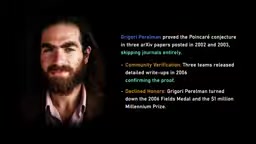
Perelman's solution to the Poincaré conjecture is a perfect case for understanding this point. He posted his papers on a preprint platform, the world was shaken, and he was subsequently invited to give lecture tours at Stony Brook, NYU, Princeton, and elsewhere. As described, he would often give three-hour improvised explanations: the first hour on what he had done, and the next two hours with the audience asking page by page—"Lemma 412 on page 247, I don't understand how this step follows"—and he would return to the blackboard and demonstrate in detail for half an hour.

The entire proof initially existed only in his head; the written record was communication done to the best of his ability, and the rest of the work had to be taken up by the community: line by line, deeply, precisely re-checked, ultimately reaching consensus—"Yes, this is a true proof of the Poincaré conjecture." This process consumed years and a large amount of manpower. Providing the solution is only the first step; the verification process must be deliberately slow and community-driven.
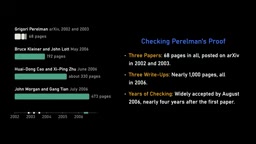
The Poincaré conjecture is a fundamental proposition in topology concerning the characterization of the three-dimensional sphere, proposed in 1904 by the French mathematician Henri Poincaré: if every closed curve on a closed three-dimensional manifold can be continuously contracted to a point (i.e., it is simply connected), is that manifold homeomorphic to the three-dimensional sphere? The question remained open for nearly a century and was listed as one of the seven "Millennium Prize Problems" by the Clay Mathematics Institute. From 2002 to 2003, Grigori Perelman published three papers on the preprint platform arXiv, offering a proof strategy using the Ricci flow method proposed by Richard Hamilton, and he subsequently declined both the Fields Medal and the Millennium Prize. Ricci flow is a geometric analysis tool that evolves a manifold's metric according to curvature; its difficulty lies in the singularities that may arise during evolution, and one of Perelman's key contributions was precisely the classification and control of singularity behavior. Because the proof was highly condensed and skipped a great many details, the community took years to complete the filling-in and verification—a process that itself became a model of "verification as research."
A preprint server is an online repository where academic papers are shared publicly before formal peer review; the most commonly used in mathematics and physics is arXiv, founded by Paul Ginsparg in 1991. Its emergence changed the rhythm of knowledge dissemination in the discipline: researchers can make their results public at the same time as, or earlier than, journal submission, priority is quickly established, and peers can follow up immediately. But a preprint is not the same as verified knowledge—it bypasses peer review, the quality gate, and its credibility depends on spontaneous community re-checking and subsequent formal publication. Perelman's proof first appeared as preprints and was only widely accepted after years of line-by-line verification by the community, which shows that preprints accelerate the dissemination of "discovery," not the completion of "verification"; the time gap between the two is precisely the structural bottleneck the article emphasizes.
AI Exacerbates Rather Than Creates This Crisis
Putting the open source and academic threads together reveals the same structural contradiction: the speed of knowledge production can increase exponentially, but the speed of knowledge verification is limited by human attention and mental endurance. The spread of AI programming tools and code generation capabilities will only further inflate the volume of code submitted to GitHub, pushing maintainers deeper into overload.
The analogy on the show is clear: the open source movement, like the academic environment, relies on people's intrinsic motivation. Once maintainers have their enthusiasm exhausted by endless pull requests, their choice is not to keep toughing it out but to exit—and this is precisely the failure mode that must be avoided. The kind of "just give up" outcome described by Terence Tao applies equally to the open source community.
Intrinsic motivation refers to an individual engaging in an activity for the sake of interest, curiosity, a sense of competence, or meaning itself, rather than for external rewards or punishments. Most of the work of open source maintainers is unpaid, and their sustained investment depends heavily on this intrinsic drive, as well as on social rewards such as reputation, reciprocity, and a sense of community belonging. Self-determination theory in psychology points out that intrinsic motivation is easily eroded by three types of factors: deprivation of autonomy, frustration of competence, and weakening of connection with others. A flood of low-quality pull requests happens to strike all three at once—maintainers are forced to handle tasks they do not care about, feel unable to cope with the review load, and lose meaningful interaction with contributors. This explains why overload often does not manifest as gradual wear but as "sudden exit": once intrinsic motivation falls below the threshold, the absence of external incentives leaves no reason to continue participating.
The Way Out Is Not Acceleration but Rebuilding Verification Mechanisms
The discussion does not offer a simple technological panacea, but the direction is clear: since the bottleneck lies in human verification capacity, any solution must be designed around how to make verification more sustainable. Possible approaches include more refined contribution tiering, clearer maintainer boundaries, and using AI to assist preliminary review rather than replace human judgment.
What is worth guarding against is the narrative that equates "more code" with "more prosperity." GitHub's true value lies not in how many repositories it hosts, but in whether it can sustain a community where people are willing to seriously review each other's work. When maintainers are no longer willing to take on this work, whether the platform exists or not no longer matters—because the soul of open source collaboration has already left first.
From the verification journey of the Poincaré conjecture to the review predicament of mathematics journals, and on to the collective burnout of GitHub maintainers, the three scenarios point to the same law: the health of a knowledge system depends on whether it is willing to leave room for slow and precise verification. In the AI era, the scarcest resource may not be computing power, but people who are willing and able to seriously read others' work.
One-line Summary
Open source and academia are both caught in a verification crisis: knowledge production is speeding up, but human review is already overloaded.
Paragraph Summary
Starting from the collective burnout of open source maintainers, the article points out that the few core people behind each repository are being overwhelmed by a flood of pull requests, that code growth has exceeded the carrying capacity of human review, and that the so-called "death" of GitHub is really the functional failure of its role as a trusted collaboration hub. The author uses the review predicament of mathematics journals as a cautionary tale, showing that the verification system has long been under pressure, but having no such system is worse; the proof of the Poincaré conjecture took years of line-by-line community re-checking, confirming that mathematical epistemology must be deliberately slow. AI programming tools further inflate submission volumes, exacerbating rather than creating this crisis, and will exhaust maintainers' intrinsic motivation, causing them to exit. The way out is not acceleration but rebuilding sustainable verification mechanisms, such as contribution tiering, clear maintainer boundaries, and using AI to assist preliminary review rather than replace judgment.
Related articles

Vibe Coding Full-Stack in Practice: AI Programming from Beginner to Enterprise Deployment
From Cursor to Claude Code, this Bilibili AI programming course uses four progressive projects to cover full-stack development, open-source secondary development, and team collaboration. The article analyzes the shock to frontend roles, the efficiency shift from 50 people to 5, and the methodology required for enterprise-grade projects.

David Blaine's Global Quest for Real Magic: From South Africa to Japan and India
David Blaine travels to South Africa, Japan, and India in his Do Not Attempt special, documenting Spinning drivers, black mamba rescuers, iaijutsu masters, and ascetics—exploring the boundary between magic and real human极限 challenges.

Is a Touchscreen MacBook Coming? Vergecast Reveals Apple Executive's Response
Vergecast podcast reveals a conversation between a reporter and Apple executive John Ternus about a touchscreen MacBook and Apple Pencil support. Ternus says iPad is the best device for a stylus, while the reporter bets MacBook will eventually support Apple Pencil.