William Gibson and the Trademark Battle Over "Cyberspace"

The trademark battle over William Gibson's "cyberspace" shows how hard it is to monopolize generic terms.
The article revisits how, after William Gibson coined "cyberspace" in 1982, multiple companies in the 1990s tried to register it as a trademark but were rejected by the USPTO. The rejections centered on two grounds: the word was widely used and lacked distinctiveness, and Gibson held prior rights as creator. Gibson never claimed trademark rights, and his indifference reinforced the word's public nature. The early case offers lessons for tech companies racing to trademark buzzwords like "metaverse" and "AI agents": generic descriptive terms are hard to monopolize, cultural influence can be separated from legal ownership, and building a unique brand identity is more sustainable than grabbing generic words.
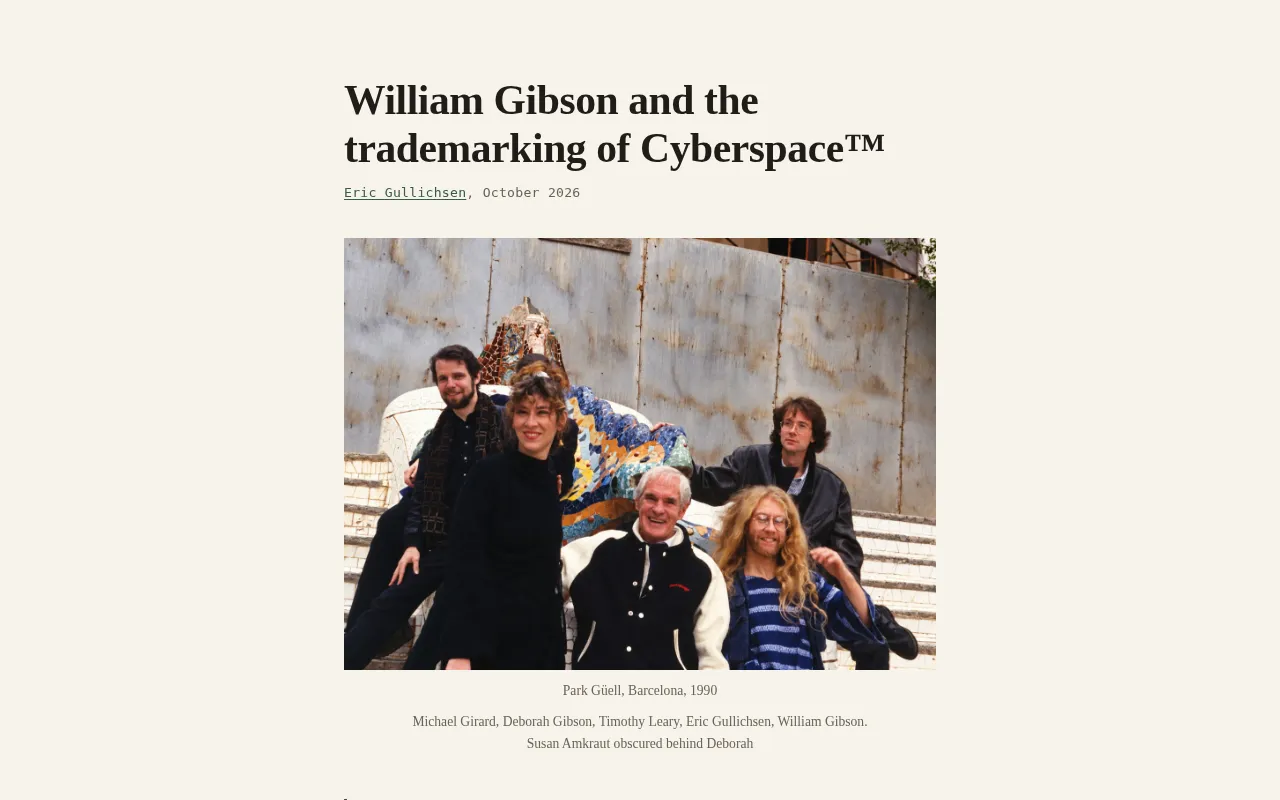
The word "cyberspace" was born almost simultaneously with modern internet culture, but its legal ownership is little known. Science fiction writer William Gibson coined the term in a 1982 novel, yet the trademark scramble surrounding it became a subtle footnote to the early commercialization of the internet.
How a Word Became a Cultural Symbol
Gibson didn't invent the "network," but he used "cyberspace" to describe a kind of collective hallucination of interactive space. The term quickly escaped the context of the novel and became a universal label for hacker culture, early internet forums, and commercial advertising. Its popularity far exceeded Gibson's own expectations.
The problem is this: when a word shifts from literary metaphor to public property, who has the right to register it as a private trademark? According to the original author's account, in the early 1990s, several companies attempted to register "cyberspace" as a trademark, covering software products, network services, and media content. Most of these applications were rejected or opposed by the United States Patent and Trademark Office (USPTO), for two main reasons: the word was already widely used and lacked distinctiveness; and Gibson, as its creator, held prior rights.
The Trademark Office's Logic: Descriptiveness and Genericide
The core of trademark law is identifying source. If a word is merely descriptive or a generic name, it cannot be monopolized. The trouble with "cyberspace" was that it was both descriptive (referring to networked space) and rapidly becoming generic (everyone was using it). USPTO examination records show that examiners repeatedly cited media usage frequency and dictionary inclusion to conclude that the word had entered the public domain.
One notable detail: Gibson himself did not actively seek a trademark. According to the original article, he was indifferent to the matter, believing the word belonged to everyone who used it. This inaction by the creator actually became an obstacle that trademark applicants had to overcome—if even the creator did not claim ownership, it was even harder for commercial entities to prove exclusive rights.
Trademark distinctiveness is a foundational concept in trademark law, referring to a mark's ability to distinguish the source of goods or services. U.S. trademark law categorizes marks into five types, from weakest to strongest: generic, descriptive, suggestive, arbitrary, and fanciful. Generic names cannot be registered at all, because they refer to an entire category of goods rather than a specific source; descriptive marks can only be registered after acquiring "secondary meaning" (i.e., consumers have come to associate them with a specific source). Common evidence examiners use to determine genericide includes dictionary definitions, media usage frequency, competitor usage, and consumer surveys. Once a word is deemed a generic name, in theory no entity can monopolize it, as doing so would deprive competitors of the linguistic tools to describe their own products.
"Prior rights" in trademark examination generally refers to legitimate rights already held by others before the filing date, including copyright, name rights, and portrait rights. As the creator of "cyberspace," Gibson's novel text is protected by copyright, but copyright does not extend to individual words themselves—a key intersection between copyright law and trademark law. When examiners cited the creator's attitude, they were considering it more from a public policy perspective: if even the inventor of the word did not claim exclusive use, it would be difficult for a commercial applicant to argue that the word serves to identify a specific source. This also raises a theoretical question: to what extent can a newly coined word become the subject of someone's "prior rights"? There is still no unified answer.
Why This History Is Worth Revisiting
Today, tech companies are eager to snap up newly coined words and popular memes, from the "metaverse" to "AI agents," and trademark battles are commonplace. The "cyberspace" case provides an early sample: there is an inherent tension between the public nature of cultural symbols and commercial exclusivity. The trademark office increasingly relies on "genericide" evidence in examination, which serves as a warning to companies trying to fence in buzzwords.
Another angle is creator rights. Gibson did not profit through trademarks, but his literary creation defined an entire cyberpunk genre. This suggests that cultural influence and legal ownership can be parallel lines. For content creators and open-source communities, this distinction is especially important—the value of a word's dissemination often exceeds locking it into a trademark register.
Implications for the Current AI Naming Craze
New terms are born every month in the AI field, and companies are racing to register model names and framework names as trademarks. Judging from the case logic of "cyberspace," if a word has already been widely used in the industry as a generic description before filing, the likelihood of successful registration is very low. Some developers in the original article's comment section mentioned that certain AI tool names were forced to change because they were too generic—echoing the cyberspace battle thirty years ago.
A more pragmatic strategy might be: rather than fighting for trademarks on generic words, build a unique brand identity and product experience. Gibson's example shows that cultural definition does not need a legal certificate to back it up.
"Genericide" is a typical path by which trademarks lose distinctiveness. Historically, words like aspirin, escalator, and USB drive have all undergone the transition from registered trademark to generic name. The key to determining genericide is not how many people use the word, but whether the relevant public still perceives it as a mark of a specific source. For new terms in the AI field, the risk is that the tech community tends to use the same word broadly for a category of capabilities (such as "agent" or "copilot"); once such usage is widespread enough before filing, the trademark office may find it lacks distinctiveness. Companies seeking to avoid genericide usually need to consistently pair the brand name with a generic descriptor in marketing and monitor generic usage within the industry.
Conclusion
The trademark story of "cyberspace" has no dramatic courtroom showdown—it's more a matter of common-sense judgment in administrative examination. But it reveals a persistent contradiction: when language becomes public infrastructure, any attempt to privatize it will encounter resistance. For today's tech professionals, this history is both an introductory lesson in trademark law and a rethinking of openness versus exclusivity.
Related articles

AI Game Development in Practice: Designing Levels with the Four-Step Method and Pacing Curves
AI game development lesson 10: design levels with the four-step method (teach, practice, combine, test) and a 1-5 pacing curve, plus sightline guidance and safety zones—implement Animatable Body 2D moving platforms and generate ASCII sketches for 1-2 Underground Cavern and 1-3 Guard Hall.

AI Game Development in Practice: Two-Phase Boss State Machines and Death Heatmap Tuning
AI game development lesson 10: implement a two-phase Boss with a state machine, guarantee fairness with color signals and a 0.4-second warning floor, locate difficulty cliffs with a death heatmap, and apply lightest-to-heaviest fixes one at a time, with an acceptance checklist and common pitfalls.

AI Game Development in Practice: Audio Buses and Building the Full UI Flow
AI game dev lesson 11 part 2: Godot's audio trio, audio buses and dB conversion, AudioManager's player pool and random pitch, autoload boundaries, the full UI flow from title to clear, fault-tolerant JSON saves, and pixel font anti-aliasing and integer-size rules.