Word-Level Explanations of Latin Text Reuse with Minimal Annotation

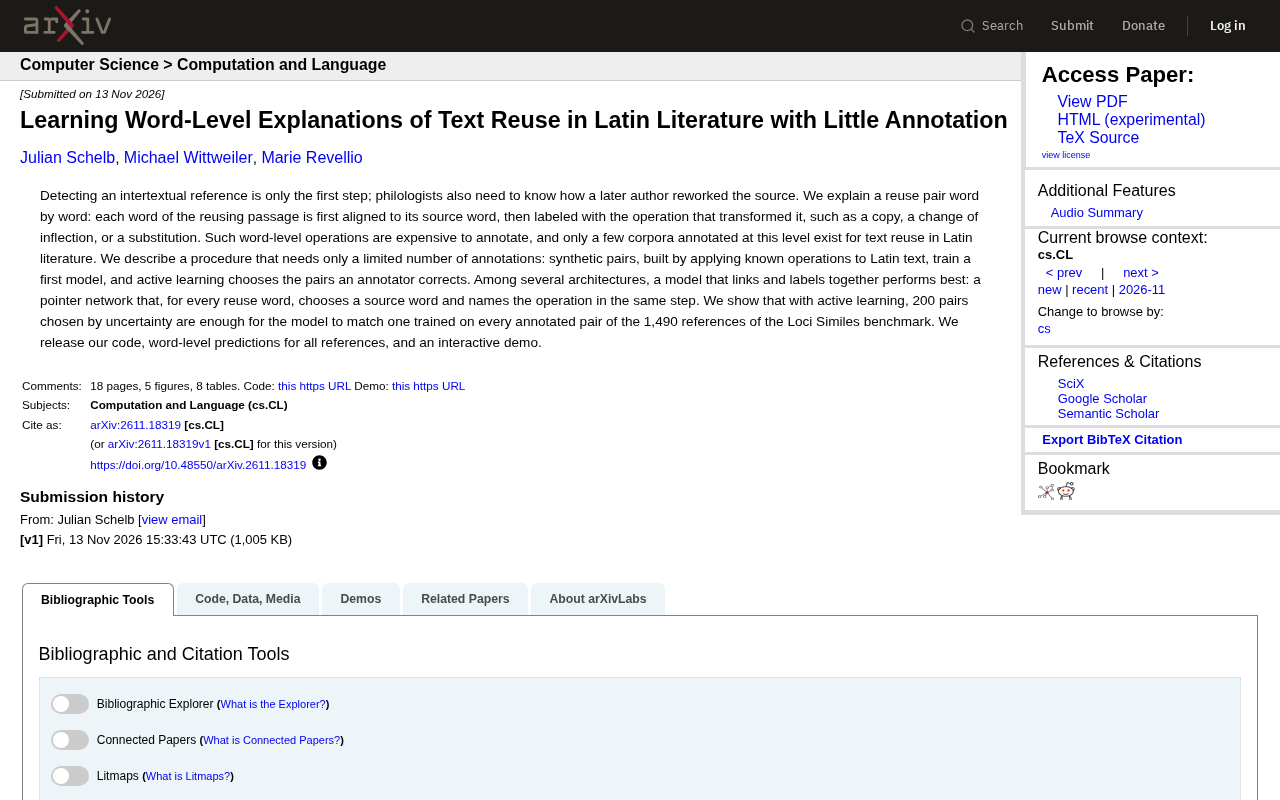
Synthetic data pre-training plus active learning: only 200 annotated pairs needed for word-level explanations of Latin text reuse.
This paper explores achieving word-level explanations of text reuse in Latin literature with limited annotation. It proposes training an initial model on synthetic reuse pairs generated via known operations, then using active learning to select high-uncertainty samples for annotation. A pointer network jointly performing linking and annotation performed best. On the Loci Similes benchmark's 1,490 citations, annotating only 200 pairs matches full training performance, reducing annotation cost to about one-seventh. Code, word-level predictions, and an interactive demo are released, offering a reference for low-resource languages.
Beyond Text Reuse Detection: The Challenge of Word-Level Explanation
In classical literary studies, detecting intertextual references between texts is only the first step. Linguists are more concerned with: how did the later author rewrite the source text? For example, did they directly copy a word, change its inflection, or perform a substitution? This word-level explanation of operations is crucial for understanding literary transmission, but annotation is extremely costly—currently only a very small number of corpora in Latin literature have word-level annotations.
According to related research, a reuse pair requires word-by-word alignment and annotation of operation types, which is both time-consuming and requires specialized knowledge. Therefore, how to train a high-performance model with minimal annotation has become a key issue in this field.
Text Reuse refers to identical or highly similar passages between different texts, often manifesting as quotation, imitation, or rewriting in classical literature. Detecting reuse typically relies on lexical overlap or sequence alignment algorithms, but detection only answers "whether related," not "how related." Word-level explanation requires aligning each word in a reuse pair and annotating the specific operation type, such as copy (verbatim reproduction), inflection (word form change with the same root), substitution (replacement with a synonym or different word), etc. This fine-grained annotation can reveal the specific techniques by which authors rewrite source texts and is key to understanding literary transmission and language evolution. However, annotation requires classical language experts to judge word by word, making it extremely costly and thus a bottleneck in the field.
Method: Combining Synthetic Data and Active Learning
To address the annotation bottleneck, researchers proposed a pipeline that requires only limited annotation. First, synthetic reuse pairs are generated by applying known operations (such as copy, inflection, substitution) to Latin texts, and an initial model is trained on this data. Subsequently, an active learning strategy is adopted, where the model selects the most uncertain samples for manual correction.
This paradigm of "synthetic pre-training + active learning" effectively reduces dependence on manual annotation. Among comparisons of multiple architectures, a pointer network that jointly performs linking and annotation performed best: for each reused word, the model simultaneously selects the source word and names the operation type in the same step.
Active Learning is a semi-supervised machine learning strategy whose core is to let the model actively select the most informative unlabeled samples for the current model to be manually annotated. Common selection strategies include uncertainty sampling (e.g., selecting samples with the lowest prediction probability or highest entropy) and diversity sampling. When the annotation budget is limited, active learning can significantly reduce the amount of annotation needed to reach target performance. In this paper, the model first obtains initial capability through synthetic data pre-training, then computes uncertainty on real reuse pairs, prioritizing annotation of samples the model is most "unsure" about, thereby maximizing performance improvement with minimal manual annotation.
Pointer Network is a type of sequence-to-sequence model whose output is not a probability distribution over a fixed vocabulary but a pointer to a position in the input sequence. This structure is naturally suited for tasks that require "copying" or "selecting" segments from the input, such as text summarization, entity alignment, and word-level alignment. The pointer network used in this paper simultaneously performs two actions for each reused word: pointing to the corresponding source word in the source text (linking) and predicting the operation type (annotation). Joint modeling of linking and annotation avoids the error propagation problem in pipeline methods, and experiments also show that its performance is superior to separate architectures.
Experimental Results: 200 Annotated Pairs Rival Full Training
The research team evaluated on 1,490 citations in the Loci Similes benchmark. Results show that by actively selecting the 200 most uncertain reuse pairs for annotation, model performance matches that of a model trained on all annotated data. This means annotation cost can be reduced to about one-seventh of the original without loss of performance.
The study also released code, word-level predictions for all citations, and an interactive demo, providing a reproducible foundation for future research. This achievement not only advances Latin text reuse analysis but also provides a reference for similar tasks in other low-resource languages.
Loci Similes is a benchmark dataset for text reuse detection in Latin literature, containing approximately 1,490 known instances of citation or imitation, each annotated with the reuse relationship between source and target texts. This benchmark provides a standardized testbed for evaluating word-level explanation models. This paper compares different architectures and training strategies on it, using performance trained on all annotated data as an upper bound, and verifies that active learning with only 200 annotated pairs can reach this upper bound, thereby quantifying the improvement in annotation efficiency.
Multi-Source Verification and Limitations
Currently, this information mainly comes from a single source (RSS summary), lacking independent reproduction or third-party commentary. Although the experimental design is rigorous, distribution differences between synthetic data and real text may affect generalization ability. Future work requires more cross-corpus validation.
Conclusion
Word-level explanation of text reuse is a frontier direction in computational literary studies. Through the clever combination of synthetic data and active learning, researchers have greatly reduced annotation requirements, opening a new path for Latin literature and broader historical text analysis.
One-line Summary
Synthetic data pre-training plus active learning: only 200 annotated pairs needed to achieve word-level explanations of Latin text reuse.
Paragraph Summary
This paper explores how to achieve word-level explanations of text reuse in Latin literature with limited annotation. The study proposes first generating synthetic reuse pairs using known operations (copy, inflection, substitution) to train an initial model, then using active learning to select high-uncertainty samples for manual annotation. Among multiple architectures, a pointer network jointly performing linking and annotation performed best. On 1,490 citations in the Loci Similes benchmark, annotating only 200 pairs matches full training performance, reducing annotation cost to about one-seventh. The study also released code, word-level predictions, and an interactive demo, providing a reference for similar tasks in low-resource languages.
Related articles
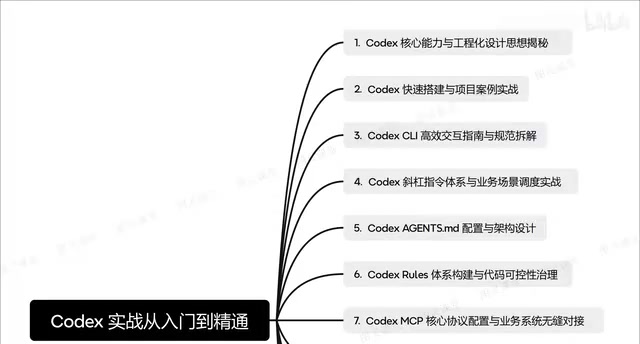
Codex in Practice: From Installation and Configuration to Multi-Agent Collaboration
Based on a Bilibili Codex course overview, this guide maps the full path of AI coding assistants from installation and agents.md context design to CLI commands, MCP integration, and multi-agent collaboration.
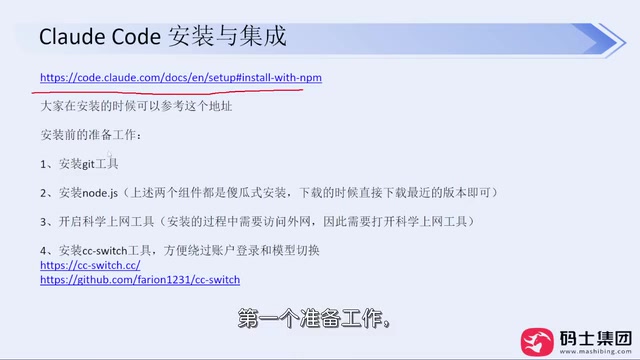
Claude Code Installation and Model Switching Guide for Users in China
How can developers in China install Claude Code reliably? This article compiles a Bilibili creator's hands-on solution: install via NPM, skip official login, use CC Switch to configure API Keys and freely switch between DeepSeek, Kimi, and other models to avoid account bans.

AI Supply Chain Security: What Canary Tokens Reveal
Starting from a Hacker News discussion, this article analyzes the role of canary tokens in AI supply chain security: how they detect abnormal access to model weights, training data, and credentials, as well as coverage blind spots and cost constraints during implementation.