Work Agents: From Models to Systems — How Agents Reliably Complete Digital Work

The paper proposes a system-level view of work agents covering composition, capabilities, optimization, and evaluation.
This paper redefines work agents from a work-centric, system-level perspective, arguing that their essence is a combination of foundation model and runtime harness rather than a single model. It characterizes work conditions through work persistence and openness, classifies digital work into five forms, identifies five core capability families (some dependent on the harness), and proposes three optimization paths—model, harness, and joint optimization—emphasizing that joint optimization is often underestimated. Evaluation should focus on verifiable outcomes rather than intermediate steps. Three future directions are discussed: continuous delegation, adaptation to open environments, and the interplay between execution and capability improvement.
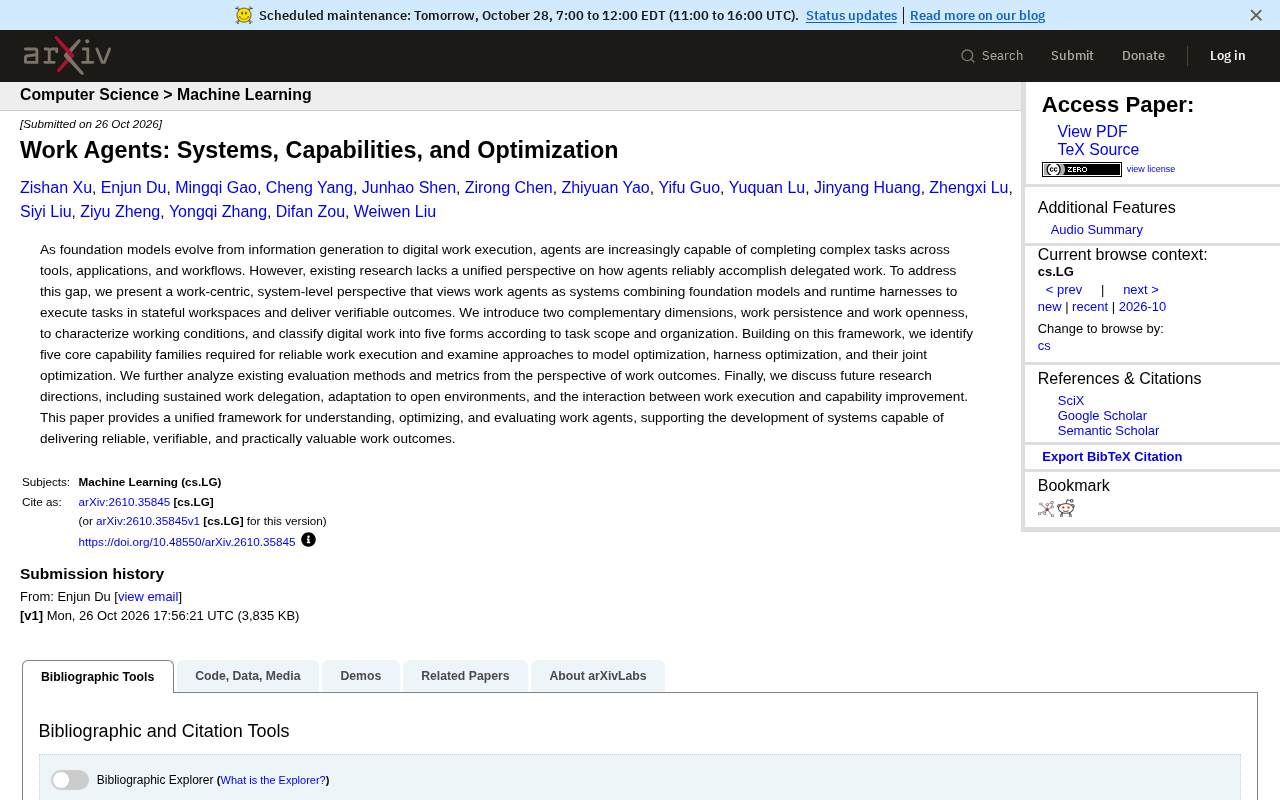
Foundation models are moving from "generating information" toward "executing digital work," with agents beginning to complete complex tasks across tools, applications, and workflows. But a key question has yet to be systematically answered: on what basis can an agent reliably complete the work entrusted to it? A paper taking a work-centric, system-level perspective attempts to fill this gap, defining a work agent as a combination of "foundation model + runtime harness" that executes tasks in a stateful workspace and delivers verifiable results.
Redefining Work Agents: Not Just Models, but Systems
The paper's core argument is that understanding an agent as a single model is a misreading. A true work agent is a system: the foundation model provides reasoning and generation capabilities, while the runtime harness handles tool invocation, state management, error recovery, and result validation. Only through their combined operation can tasks be advanced within a stateful workspace.
The value of this perspective lies in shifting the focus of discussion from "how powerful the model is" to "how the system reliably delivers." When tasks span multiple tools and applications, reliability comes from the synergy between model and harness, not from piling up any single component. This also explains why the same model performs noticeably differently under different harnesses.
Two Dimensions Characterizing Work Conditions
The paper proposes two complementary dimensions to describe an agent's work conditions: work persistence and work openness. The former measures the temporal continuity of a task—whether it is a one-off response or requires long-term state maintenance and continuous advancement; the latter measures the openness of the environment—whether it is a closed, controllable toolset or an open environment requiring adaptation to unknown changes.
These two dimensions form a coordinate system for understanding work difficulty. The higher the persistence and the greater the openness, the higher the demands on the system's state management, adaptability, and verification mechanisms.
Stateful workspace refers to the environment in which an agent executes tasks, one that requires continuous maintenance and updating of state. Unlike stateless single-turn question answering, a stateful workspace requires the system to remember previous operation results, current task progress, and environmental changes, and to decide the next action accordingly. For example, an agent completing an expense reimbursement process across multiple applications needs to track uploaded receipts, filled-in form fields, and pending approval steps. State management is the core challenge of a stateful workspace: lost or inconsistent state leads to task failure, while excessive state may introduce noise. The runtime harness typically maintains state through external storage, session memory, or workflow engines, enabling the model to maintain coherence across long-horizon tasks.
Five Forms of Digital Work
Based on task scope and organization, the paper divides digital work into five forms. The significance of this classification is that different forms impose different capability requirements, and measuring all agents with the same evaluation criteria is unreasonable. The classification provides a common language for subsequent capability analysis and evaluation design.
Runtime harness is the execution framework built around the foundation model, responsible for managing all interactions between the agent and the external environment. It typically includes tool invocation interfaces (translating the model's intent into concrete API requests or operation instructions), state management (maintaining task context, memory, and intermediate results), error handling and retry mechanisms (recovering when tool calls fail or return anomalies), and result validation (confirming whether outputs meet task requirements). The design quality of the harness directly determines performance differences of the same model across different systems: a well-designed harness can compensate for the model's shortcomings in planning or error correction, while a crude harness can significantly degrade a strong model's performance. Therefore, understanding work agents requires attention to both model capabilities and harness engineering—neither can be neglected.
Five Core Capability Families Required for Reliable Work Execution
Building on the above framework, the paper identifies five core capability families required to reliably complete work. Although the original text does not elaborate on each capability in detail, the direction is clear: these capabilities cover the full chain from task understanding and tool use to state maintenance and result validation.
Notably, these capabilities are not all borne by the model. Some depend on harness design—such as state tracking, execution monitoring, and result validation, which are essentially system-level engineering problems. This further corroborates the argument that "an agent is a system."
Three Optimization Paths: Model, Harness, and Joint Optimization
The paper examines three optimization paths: model optimization, harness optimization, and joint optimization of the two.
Model optimization focuses on improving the foundation model's own capabilities; harness optimization improves the runtime environment so that the same model can complete work more reliably; joint optimization concerns the matching and synergy between the two. In practice, joint optimization is often overlooked—teams tend to concentrate resources on the model side while underestimating the harness's impact on final work outcomes. By discussing all three in parallel, the paper effectively suggests that improvements in reliability are distributed throughout the system and one should not fixate solely on the model.
Joint optimization refers to adjusting the foundation model and runtime harness simultaneously so that they match each other in capabilities and constraints, rather than optimizing each independently. Its core insight is that the model's optimal behavior depends on the tool interfaces, state representations, and feedback signals provided by the harness, while the harness design should also account for the model's inherent preferences and limitations. For example, if the model excels at generating structured output, the harness can design stricter parsing and validation rules; if the harness can provide clear error messages, the model can more easily recover from failures. Joint optimization is often underestimated because teams tend to divide by function, with model teams and engineering teams working in isolation, leading to suboptimal overall system performance. The paper emphasizes all three in parallel precisely to remind practitioners that improvements in reliability lie at the interface between model and harness and require co-design.
Evaluating Agents from the Perspective of Work Outcomes
Evaluation methods are likewise re-examined. The paper analyzes existing evaluation methods and metrics from the perspective of "work outcomes," rather than looking only at intermediate steps or single-turn performance. This is consistent with the system definition of "delivering verifiable results": an agent's value is ultimately reflected in whether the work is reliably completed, not in what it says during the process.
This orientation has direct reference value for practical selection. When evaluation focuses only on model benchmark scores, system-level reliability differences are masked; anchoring on work outcomes is what reflects real-world deployment performance.
Verifiable outcome means that the work results delivered by an agent can be independently inspected, confirmed, or measured, rather than being merely procedural descriptions or intermediate steps. For example, a correctly filled-in form, a successfully deployed code change, or an accurately completed transaction record all constitute verifiable outcomes. In contrast, explanations, plans, or reasoning chains generated by the agent during the process, while helpful for understanding its behavior, cannot replace validation of the final outcome. Evaluation methods anchored on verifiable outcomes require clearly defined success criteria and inspection mechanisms, which typically require designing automated or semi-automated verification processes combined with domain knowledge. This evaluation orientation is closer to real deployment scenarios, because in actual work, the delegating party cares about whether the task is reliably completed, not how the agent describes its own process.
Future Directions: Continuous Delegation, Open Environments, and Capability Evolution
Finally, the paper discusses three future research directions: continuous work delegation, adaptation to open environments, and the interplay between work execution and capability improvement.
The third direction is particularly worth pondering: agents accumulate experience while executing work—can this experience in turn improve their capabilities? There is a feedback loop between work execution and capability improvement, which may be a key feature distinguishing work agents from traditional tools.
Overall, the unified framework provided by this paper connects system composition, work conditions, capability requirements, optimization paths, and evaluation methods, offering a common language for understanding, optimizing, and evaluating work agents, and pointing the way toward building systems that deliver reliable, verifiable, and practically valuable outcomes.
One-line Summary
The paper proposes a system-level perspective for understanding work agents, covering composition, capabilities, optimization, and evaluation frameworks.
Paragraph Summary
Taking a work-centric, system-level perspective, the paper redefines work agents, arguing that their essence is a combination of foundation model and runtime harness rather than a single model. It proposes two dimensions—work persistence and work openness—to characterize work conditions, and divides digital work into five forms. On this basis, it identifies five core capability families required for reliable work execution, noting that some capabilities depend on the harness rather than the model itself. Optimization paths are divided into model optimization, harness optimization, and joint optimization, with emphasis that joint optimization is often underestimated. Evaluation methods should start from work outcomes, focusing on verifiable results rather than intermediate steps. Finally, it discusses three future directions: continuous delegation, adaptation to open environments, and the interplay between work execution and capability improvement, providing a unified framework for understanding, optimizing, and evaluating work agents.
Related articles

Fifty Years Studying Power: Robert Caro's Writing and Insights on Power
Robert Caro reflects on 50 years studying power: Lyndon Johnson's persuasion and leverage, Robert Moses's transformation from idealist to ruthless builder, the dilemmas of large-scale construction, and his methods of compressing themes and solitary focus in biography writing.

Can a $20,000 Robot Do Your Chores? The Test Results Are Surprising
A YouTube test video shows how a $20,000 robot responds to commands like washing dishes, turning off lights, taking out trash, and feeding the dog. This article analyzes its real capability boundaries, the state of voice interaction technology, and how far household robots are from mainstream adoption.
The Complete Guide to Running AI Models Locally: Inference Engines and Tool Stack Explained
A systematic breakdown of the complete local LLM tool stack: from PyTorch and GGML compute libraries to llama.cpp, vLLM, SGLang inference engines and Ollama, LM Studio wrapper layers, with benchmark data on performance differences and selection logic.