WorkBuddy: A Step-by-Step Guide from LLMs to Agent Platforms

A Tencent WorkBuddy learning system from zero to hands-on, covering the four-layer structure, FDE, and scenarios.
The article introduces a beginner-oriented WorkBuddy learning system. WorkBuddy is Tencent's AI office workbench that understands natural language, plans tasks, processes files, generates documents and spreadsheets, and creates PPTs. It presents a four-layer framework: LLMs as the foundation, Harness as the engineering control layer, agents as LLM plus Harness, and WorkBuddy as an agent platform. FDEs bridge the last mile to business implementation. The ten-lesson course covers installation, connectors, expert skills, automation, remote control, and hands-on scenarios, with a path from platform usage to Harness customization and FDE deployment.
Why Is WorkBuddy Worth Learning?
There are plenty of WorkBuddyAd tutorials on the market, but many only cover features without explaining the underlying principles, or showcase results without a complete walkthrough. Beginners finish them without knowing where to start—let alone how to actually put it to use. While preparing a course, a Bilibili creator deliberately spent a month researching various tutorials from a beginner's perspective. Recognizing this pain point, they consolidated the core knowledge points, combined them with real-world cases, and refined a learning system that takes you from zero to practical application.
WorkBuddy is an AI office workbench launched by Tencent—and it's more than just a chat tool. It can understand natural language instructions, plan tasks autonomously, and, within authorized scope, process local files, generate documents and spreadsheets, create PPTs, and even assist in developing applications. This means AI no longer just answers questions—it actually does work for you. The course covers website, mini-game, and mini-program development, PPT generation, spreadsheet processing, image-to-video, and other application scenarios, so the knowledge lands in practice.
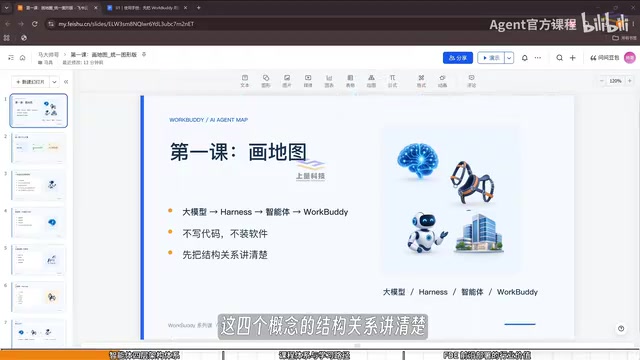
The Four-Layer Structure: A Framework for Understanding AI Implementation
To truly make good use of WorkBuddy, you first need to understand how four concepts relate structurally: large models, Harness, agents, the WorkBuddy platform, and FDE forward deployment.
At the very bottom is the large model, which handles language understanding, logical reasoning, and content generation—DeepSeekAd and ChatGPT belong to this layer. But a large model on its own is like a wild horse that can't be ridden without training. You need to give it a saddle, reins, and a whip so it can brake and accelerate. These "tack" are the Harness (the English word literally means horse tack), i.e., the engineering control layer.
What exactly does Harness refer to? For example, context management and memory (still remembering what was said in turn 19 after 20 rounds of conversation), tool invocation (adding Skills), task loops (judging based on circumstances and looping to verify completion), and permission control (e.g., Doubao has an expert mode and a regular chat mode). Only when this layer is done well can AI truly deliver value.
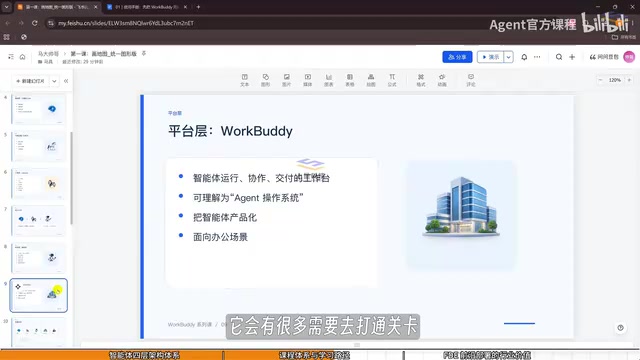
A large model equipped with a Harness is equivalent to an agent that can work reliably. Going one level up, agent platforms like WorkBuddy integrate a large number of agents that can solve various complex problems and collaborate—equivalent to large-scale coordinated operations rather than fighting alone.
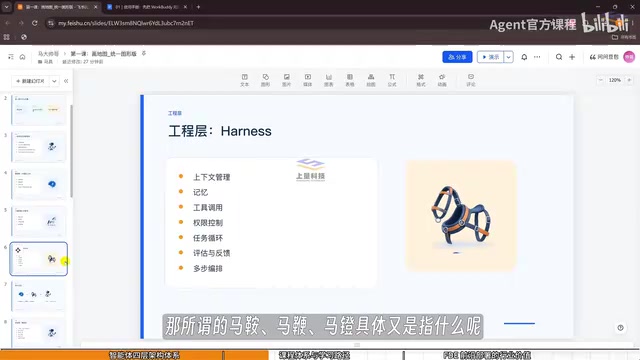
Agent is one of the most central paradigms in the current AI field. It refers to a system that uses a large language model as its "brain" and grants the model autonomous action capabilities through external tools, memory, planning, and other mechanisms. Unlike traditional "question-and-answer" chatbots, agents can break down complex goals, execute multiple steps, call APIs, read and write files, and self-correct based on feedback during execution. The industry often summarizes an agent's key capabilities as three elements: planning, memory, and tool use—which correspond exactly to the modules of the Harness described in this article. Platforms like WorkBuddy are built precisely on the agent concept, orchestrating multiple agents together to form a "team" that can handle complex tasks. Understanding agents helps you grasp the intermediate-layer logic from model to product.
FDE Engineers: Bridging the Last Mile
From large models to Harness to agents to platforms, there are many hurdles and connection points that need to be bridged along the way—and that's the job of the FDE (Forward Deployed Engineer). FDEs need two capabilities: first, technical understanding—knowing the underlying principles and having a toolkit on hand; second, communication skills—being able to quickly structure a company's business, tailor solutions to its needs, and invoke tools to close the gaps.
According to the creator's observations, FDEs are currently in very high demand, with both big and mid-sized companies competing for them, because this is a necessary stage as large models move into various industries. Searching for related positions on Boss shows salaries already reaching hundreds of thousands to over a million. Of course, not everyone needs to become an FDE engineer, but learning WorkBuddy lets you use it to handle many work tasks: teachers can create PPTs, prepare lesson notes, and review homework; lawyers can screen for risk points and find legal support. At a higher level, you can customize your own Harness tack and专属 agents, moving further toward the FDE direction.
FDE (Forward Deployed Engineer) is a role first popularized at enterprise software companies such as Palantir and, in recent years, introduced into the AI industry with the wave of large-model implementation. Its core positioning is as an "on-site" engineering and business bridge: on one hand, it must go deep into customer sites to understand real business processes and data; on the other, it must be able to write code, call model APIs, and build prototypes to turn general-purpose large-model capabilities into usable industry solutions. Unlike traditional pre-sales or implementation engineers, FDEs usually need strong full-stack engineering skills and product thinking, and must be able to iterate quickly amid ambiguous requirements. Currently, major domestic companies and AI startups are all competing for this type of composite talent, and salaries are indeed at a high level—reflecting the scarcity of the "last mile" of AI implementation.
Course System and Learning Path
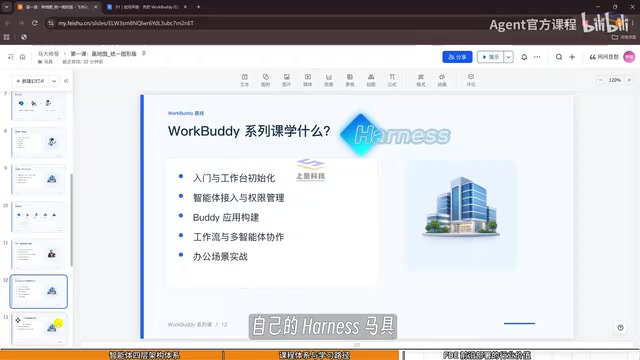
This WorkBuddy series consists of ten lessons, covering everything from installation to connectors, expert skills, automation, rapid communication, remote control, and more, all explained in detail. Customizing it to your current work and life scenarios can genuinely save time and boost efficiency. There are also second, third, and fourth series to follow, which can be found in the knowledge base.
If you want to study Harness and FDE in greater depth, the creator recommends reading Cybernetics by Qian Xuesen (the creator refers to him as "前学孙," likely a typo). After listening to it, your understanding of the related theories will fall into place with a clarifying effect. After finishing WorkBuddy, the course will go deeper into how to customize Harness agents, how to complete the last mile of integrating AI with industry in the FDE direction, and finally share how to use AI for commercial projects.
Hands-On Scenarios: From Idea to Result
The hands-on section takes you from scratch to building websites, mini-games, and mini-programs, generating PPTs, processing spreadsheets, and exploring applications like image-to-video. The course also provides the WorkBuddy Green Book, courseware, study notes, and a material resource pack to support systematic learning. The creator hopes this won't be just a feature-explanation course, but a learning system that gradually takes you from zero to practical application.
The learning path can be planned as follows: first learn the WorkBuddy platform and master using it to solve real-world scenario problems; then learn Harness-related content; then FDE deployment and the commercial flywheel. This path balances tool usage and underlying principles, and suits learners at different levels of depth.
Key Concepts at a Glance
- Large model: The foundation of language understanding and generation, such as DeepSeek and ChatGPT.
- Harness (horse tack): The engineering control layer, including context management, tool invocation, task loops, permission control, etc.
- Agent: Large model + Harness, capable of executing tasks reliably.
- WorkBuddy: An agent platform that integrates a large number of agents to collaborate on complex problems.
- FDE: Forward Deployed Engineer, bridging the last mile from large models to business implementation.
The value of this tutorial lies in explaining seemingly esoteric concepts clearly through analogies, enabling beginners to build a framework and then gradually go deeper through hands-on practice. If you also want AI to truly do work for you, you might as well start with WorkBuddy.
One-line Summary
A Tencent WorkBuddy learning system from zero to hands-on, covering the four-layer structure, FDE, and scenario applications.
Paragraph Summary
The article introduces a WorkBuddy learning system aimed at beginners. WorkBuddy is an AI office workbench launched by Tencent that can understand natural language instructions, plan tasks autonomously, process files, generate documents and spreadsheets, and create PPTs. The article proposes a four-layer framework for understanding AI implementation: large models are the foundation, Harness is the engineering control layer (horse tack), an agent is a large model plus Harness, and WorkBuddy is a platform integrating a large number of agents. FDE forward-deployed engineers are responsible for bridging the last mile from large models to business implementation, and market demand is strong. The course consists of ten lessons covering installation, connectors, expert skills, automation, remote control, and hands-on scenarios such as websites, mini-games, PPTs, and spreadsheets. The recommended learning path is to first master platform usage, then go deeper into Harness customization, and finally explore FDE deployment and commercialization.
Related articles

Private Key Set to 4? CA's Elementary Mistake Leaves TLS Exposed
CA eMudra set private keys to tiny values like 4, making TLS certificates brute-forceable. A Computerphile video demonstrates the full process from extracting public keys to forging certificates, and explores the fragility of the PKI trust chain.

How Gen Turns Data into Decisions with ChatGPT Work
In an OpenAI user case, business leader Gen shares how ChatGPT Work turns data into decisions: within hours of launch, teams can judge whether integrations and onboarding flows work, shifting decision iteration from hundreds of trial-and-error attempts to a fast feedback loop.

ChatGPT vs. Claude In-Depth Comparison: Strong at Coding but Weak at Research — How to Bridge the Gap?
A user considers switching from ChatGPT to Claude, finding Claude stronger at coding but shallower at research. We analyze the differences and share tips to make Claude's research deeper.