WorkBuddy In-Depth Analysis: How a Domestic AI Agent Gets Work Done Automatically

Comparing Q&A-style AI with the WorkBuddy agent, showcasing the advantages of automatic task execution and localization features.
Based on a Bilibili creator's course video, the article uses a real-world comparison to reveal the limitation of traditional Q&A-style AI (such as Doubao)—it can only provide operating steps but cannot directly execute local tasks—and demonstrates how WorkBuddy as an AI agent automatically completes batch PPT-to-PDF conversion and archiving. It compares WorkBuddy and Codex across installation and deployment, ecosystem adaptation, pricing strategy, and plugins and skills, highlighting the former's localization advantages for domestic users, such as one-click installation, WeCom connectivity, free credits, and a Chinese skill marketplace. It also introduces the accompanying 178-episode zero-basics practical course and materials, and finally offers a rational perspective on the claim that "AI will disrupt all industries," reminding readers to note the course's promotional nature and evaluate tool fit based on their own workflows.
Traditional AI tools mostly stay at the Q&A level—they can offer suggestions but can't actually take action. In a recent course on Bilibili, a creator used a real-world comparison to vividly demonstrate the core gap between Q&A-style AI and AI agents that execute tasks automatically, and systematically introduced the capabilities and advantages of WorkBuddy, a domestic tool. This article, based on the course content and combined with industry observations, analyzes the practical value of AI agents.
The Limitations of Traditional AI: Can Teach but Can't Do
In the video, the creator simulated a common workplace scenario: batch-converting all PPT files in a desktop work folder to PDF and automatically archiving them. When using Doubao, even with very clear instructions, it could only return detailed operating steps and could not directly read or modify local files. This is because traditional Q&A-style AI has no local computer operation permissions—it is essentially a Q&A consultant that can only provide ideas, while actual execution still requires manual work.
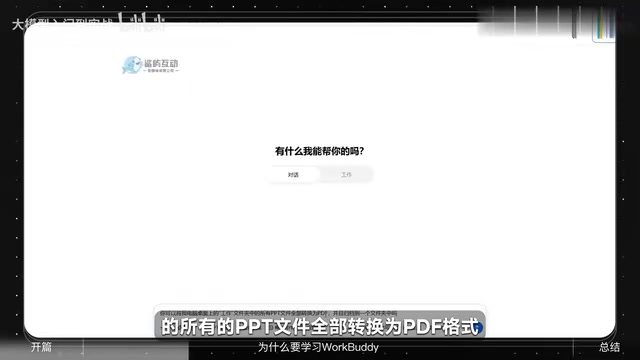
This limitation is especially obvious in the workplace. Many repetitive, batch-processing tasks consume a lot of time, and traditional AI is powerless against them. The creator pointed out that all industries will be disrupted by AI, but the key lies in whether AI can truly "take action."
AI Agents: From Conversation to Automatic Execution
Given the same instruction, WorkBuddyAd can automatically identify the requirement, create an archive folder, and complete format conversion—all without manual intervention. In the video demonstration, the task was completed within seconds, and the organized results were precise, requiring no secondary cleanup.
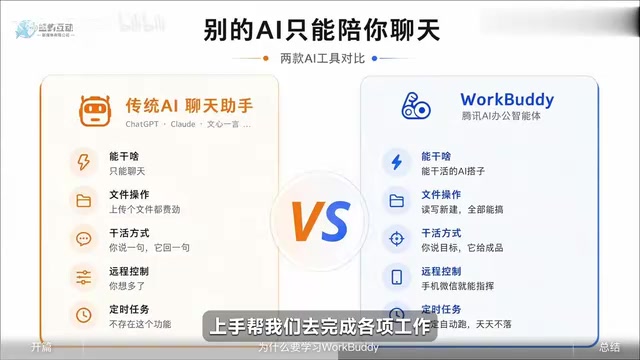
Programs that can directly control a computer and execute tasks are called AI agents. The creator summarized the shift in usage pattern as: upgrading from conversing with AI to issuing instructions to AI and having AI execute automatically. WorkBuddy, Codex, and the previously popular "Lobster Agent" all belong to this category.
AI Agent refers to a software system capable of perceiving its environment, making autonomous decisions, and executing actions to achieve goals. Unlike traditional Q&A-style AI that only generates text responses, agents typically possess tool-calling capabilities (such as reading and writing files, operating software, and accessing the network) and complete multi-step tasks through planning, memory, and reflection mechanisms. Their core architecture generally includes: a task decomposition module (breaking user instructions into executable steps), a tool interface layer (connecting to local or cloud applications), an execution engine (actually invoking tools and processing results), and a feedback loop (adjusting subsequent actions based on execution results). Products like WorkBuddy and Codex encapsulate these capabilities so that non-technical users can use natural language to drive computers to complete batch file processing, message replies, and other operations. The practical value of an agent depends on the richness of its tool ecosystem and execution reliability—which is also the key to differentiation among products.
WorkBuddy vs. Codex: Clear Localization Advantages
The creator compared WorkBuddy and Codex across four dimensions and concluded that the former is more suitable for domestic users:
- Installation and deployment: WorkBuddy supports one-click download and installation with no environment configuration required; Codex requires circumventing internet restrictions and environment configuration skills, raising the barrier to entry.
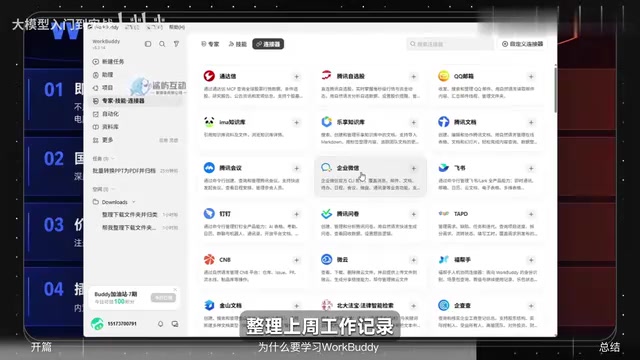
- Ecosystem adaptation: WorkBuddy uses connectors to authorize calls to domestic office software. For example, after connecting to WeCom, it can automatically reply to messages, organize customer communication content, and generate weekly reports; Codex relies on overseas ecosystems and has limited support for domestic software.
- Pricing strategy: WorkBuddy grants 2,000 credits upon registration and 100 credits daily, which is sufficient for light office use; Codex costs $20 and is more suitable for high-frequency, heavy users.
- Plugins and skills: WorkBuddy supports one-click deployment and a Chinese skill marketplace, allowing one-click invocation of expert roles (such as a Xiaohongshu operations expert); Codex is based on the open-source ecosystem, offering high freedom but requiring programming skills.
The video also mentioned that WorkBuddy's interface layout and operation logic are basically consistent with Codex, but it is better adapted to the domestic environment, requires no special network configuration, and has low hardware requirements.
Connector is a bridge through which AI agents interact with external software or services, typically implemented via API authorization or plugins. In WorkBuddy's case, connectors allow the agent, after user authorization, to access domestic office platforms such as WeCom, thereby reading messages, sending replies, organizing communication records, and generating weekly reports. The design of connectors directly affects an agent's capability boundaries: the more applications supported, the richer the automation scenarios; the simpler the authorization mechanism, the lower the user barrier to entry. Compared with Codex, which relies on overseas ecosystems, WorkBuddy reduces network environment and configuration costs by pre-installing connectors for mainstream domestic office software, better fitting local workplace workflows. It is important to note that connector security and permission management are equally important, and users should pay attention to authorization scope and data privacy protection.
Learning Path and Resources
The creator spent nearly three months polishing a practical WorkBuddy course covering installation, basic operations, skill building, industry cases, and automation workflows—178 episodes in total—emphasizing that it is accessible with zero programming background. Accompanying materials include a detailed manual (with industry case breakdowns, Skill customization methods, and implementation workflows), 12 commonly used Skills, and workplace practice cases.
The creator suggests that learners watch and practice according to their own industries, avoiding letting the tool sit idle in their bookmarks. The course emphasizes a hands-on orientation, with the goal of gradually handing repetitive work over to AI.
Industry Impact and a Rational Perspective
In the video, the creator put forward the judgment that "all industries will be disrupted by AI," and cited examples of colleagues who get promoted quickly because of high reporting efficiency, fast analysis reports, and high-quality video editing, implying that the efficiency gap brought by AI tools is widening workplace competitiveness. This view is consistent in direction with industry expectations for AI agents, but "disrupting all industries" is the creator's personal judgment and lacks specific data support—readers may stay attentive but need not accept it wholesale.
From a product positioning perspective, WorkBuddy lowers the barrier to using agents and is especially suitable for workplace professionals without technical backgrounds. However, it should be noted that the video content has a course-promotion nature, and some comparisons (such as pricing and ecosystem adaptation with Codex) are based on specific usage scenarios, so actual experience may vary depending on needs. The core value of AI agents lies in automating repetitive tasks, and users should evaluate tool fit based on their own workflows.
Related articles

T3 Code: The Open-Source AI Coding Assistant's Comeback Story
T3 Code is an open-source AI coding assistant that unifies subscriptions like Codex and Claude, with powerful remote control and parallel task management.

Never Elected, Yet Ruled New York for 30 Years: The Ultimate Case Study in the Mechanics of Power
Robert Caro's biographies reveal how unelected Robert Moses ruled New York for 30 years through legal drafting and public authorities, and how Lyndon Johnson built leverage as a "powerless" Senate Majority Leader. Unpacking the underlying logic of accumulating and sustaining power.

The CPython 3.10 Recursion Trap and Synthetic Recovery in TokenGuard, an LLM Circuit Breaker
TokenGuard's author recounts a recursion crash caused by OrderedDict.pop in CPython 3.10 and introduces v0.3.0's Loop Nudge synthetic recovery, inline DLP scanning, and other new LLM agent circuit-breaker capabilities.