WorkBuddy Solopreneur in Practice: How AI Digital Employees Restructure Startup Costs
A solopreneur company isn't passive income—it's replacing team execution with AI systems while humans keep decision-making and taste.
The article deconstructs the "one-person company": one person plus an AI system, where humans handle only decisions and taste while AI executes research, content, products, customer service, finance, and automation. Traditional three-person teams cost 28,500 yuan/month in fixed expenses versus 1,800 for a solopreneur—stretching the trial-and-error window over tenfold. It also covers WorkBuddy's seven role-mapped capabilities, four forms (content, e-commerce, product, service), and a 90-day roadmap.
What a Solopreneur Company Really Is: Not Passive Income, but a Structural Revolution
The concept of a "one-person company" isn't new, but it has only truly become viable in recent years. This WorkBuddyAd tutorial series on Bilibili opens with a clear-eyed definition: one person + one AI system = one company. Breaking it down: you're the only human in the organization—no employees, no partners, no commuting. Research, content, products, customer service, finance, automation—all the work that traditionally required a team—is handled by the AI system.
What do you keep? Only two things: decision-making and taste. What to do and what not to do, how to allocate money, how to control risk—that's decision-making. Whether something looks good, whether the copy hits the mark, whether product details are polished—that's taste. AI can give you ten topic ideas, but choosing which one is your job. AI can generate a hundred pieces of copy, but setting the tone for which one to use is your job. Execution can be outsourced; judgment cannot.
The tutorial author emphasizes that a solopreneur company is not passive income, not a resignation letter, and certainly not a path to financial freedom just by watching. Its value lies in "not needing sleep"—when a customer inquires at 1 AM, the AI drafts a reply based on the scripts you've built up, flags the thorny questions, and you spend five minutes the next day reviewing and hitting send. Your competitors are asleep; your system isn't.
Cost Structure Comparison: The Ledger from 28,500 to 1,800
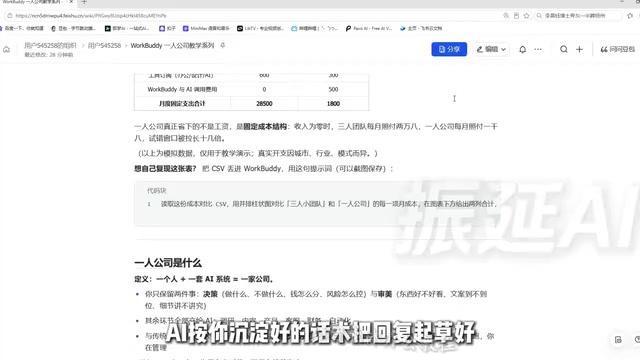
The most hardcore part of this tutorial is laying out and calculating the cost structure of a solopreneur company versus a traditional team. Traditional e-commerce shop: operations staff at 6,000/month, designer at 6,000, customer service at 6,000—three people totaling 18,000. Social insurance and housing fund employer contributions add roughly 30% of labor costs, another four to five thousand. Shared office space for three workstations at 3,000, computer and furniture amortization at 1,500, tool subscriptions at 600. Fixed expenses of 28,500 yuan/month—before earning a single cent of revenue.
The same business, run by one person plus an AI system, has fixed monthly expenses of 1,800 yuan. The difference isn't wages—it's structure. A three-person team pays 28,000/month even with zero revenue; a solopreneur pays 1,800. This means the trial-and-error window is stretched out more than tenfold. The tutorial's judgment is blunt: most startup failures aren't because the direction was wrong, but because the money ran out before the direction could be validated.
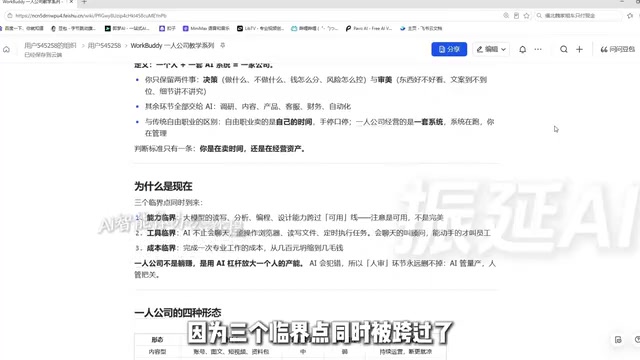
Why now? The tutorial identifies three thresholds: capability threshold—large models' reading, writing, analysis, coding, and design abilities have crossed the "usable" line, with output that just needs minor tweaks; tool threshold—AI isn't just for chatting anymore; it can operate browsers, read and write files, and execute tasks on schedule. Something that can chat is a consultant; something that can act is an employee; cost threshold—the cost of completing a professional task has shrunk from hundreds of yuan to mere cents. Testing a product idea used to cost 3,000 yuan for someone to build a landing page, plus 5,000 for ads to gauge feedback. Now it might be the cost of a coffee plus two hours. Testing is cheaper, iteration frequency goes up, and hit rate goes up.
Social insurance and housing fund employer contributions: In China, companies don't just withhold the employee's portion of social insurance and housing fund—they must also contribute additional amounts for pension, medical, unemployment, work injury, and maternity insurance, plus the housing fund. Typically, the employer's share is about 30%-40% of the employee's salary base, varying by city and insurance type. This is a hidden fixed cost that must be paid even in months with zero revenue.
Trial-and-error window: The length of time a founder has to validate products and test the market before running out of capital. The lower the fixed expenses, the more attempts and the more time the same startup capital can support. A solopreneur company reduces monthly fixed expenses from 28,500 to 1,800 yuan, meaning the same money can test more than ten times as many directions—significantly improving the odds of survival before finding a viable business model.
WorkBuddy's Seven Roles: From Chat Box to Digital Employee
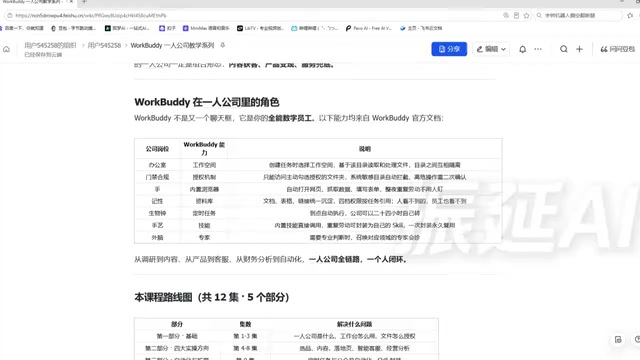
The tutorial maps WorkBuddy role by role against company positions, all capabilities drawn from official documentation:
Office—workspace mechanism. When creating a task, you select a workspace; the AI reads directories and processes files based on that space, with directories isolated from each other. Access control and compliance—authorization mechanism. It can only access folders you've actively checked and authorized; system-sensitive directories are automatically blocked, and high-risk operations require secondary confirmation. Hands—built-in browser. It can open pages and scrape data, fill out forms; repetitive work like competitor monitoring can run all day and all night.
Memory—knowledge base. Documents, spreadsheets, and web links are stored with four tiers of permissions and referenced as needed. What you can't see, your employee can't see either—permissions are aligned. Biological clock—scheduled tasks. It executes on time. Craft—skill system. Built-in skills can be called directly; repetitive work can be packaged into your own skills—essentially distilling a veteran employee's craft into standard operating procedures. External brain—expert system. When professional judgment is needed, it summons experts from the relevant domain for consultation.
With all seven roles connected, the entire chain of a solopreneur company—from market research to content generation, product development, customer service, financial analysis, and automated operations—is covered by a single tool. The tutorial also presents the flip side: files scattered across the desktop, making every search for materials feel like archaeology; unclear authorization leaving AI either afraid to act or acting wrongly; asking the same question a hundred times a day because experience hasn't been captured; repetitive work shouldered by human brute force because no one thought to package skills.
Skill packaging: In AI Agent tools, a Skill is a module that packages a set of prompts, operational steps, and decision logic into a reusable, callable unit. Built-in skills are official preset general capabilities, while custom Skills allow users to solidify specific workflows (e.g., "scrape competitor prices daily and generate a weekly report") into standard operating procedures that can then be triggered with one click or executed on schedule—no need to re-describe the requirements each time. This essentially turns personal experience into system assets, avoiding repetitive work.
Four Forms and Selection Logic: Determine Form by Assets
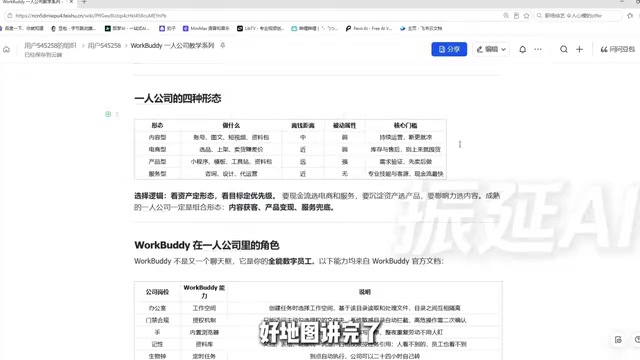
The tutorial divides solopreneur companies into four forms. Content-based: running accounts, articles, short videos, resource packs, monetizing through ad revenue and brand deals. Fastest to start—one phone is enough. The barrier is the ability to keep producing; stop updating and you're done. E-commerce-based: product selection and listing to earn margins, closest to results. The pitfalls are inventory and after-sales; the play is small-batch product testing rather than stockpiling. Product-based: mini-programs, templates, tool sites, resource packs—build once, sell many times. Strongest passive income characteristics. The right approach is to sell first, then build—only produce after someone pays. Service-based: consulting, design, managed operations. Still fundamentally trading time for money, but with the fastest cash flow—the source of a solopreneur's first pot of gold.
The selection logic in eight words: determine form by assets, determine priority by goals. Want cash flow—choose e-commerce or services. Want to build products—choose products. Want influence—choose content. The mature combination: content for customer acquisition, products for monetization, services for a safety net.
The tutorial also distinguishes a solopreneur company from freelancing: freelancing is essentially senior wage labor—selling your own time. A design gig pays 500; you can take at most 4 per day; stop working and income stops. A solopreneur company operates a system—the system runs while you manage. Set standards, templates, and processes; AI produces drafts and you oversee taste. Output multiplies tenfold. The test is simple: are you selling time or managing assets?
90-Day Roadmap and Expectation Management
The tutorial provides a five-part roadmap: the fundamentals section covers figuring out what to do, how to use the workspace, and how to authorize files; four practical tracks cover product selection, content, landing pages, intelligent customer service, and business analysis; automation and expansion covers scheduled tasks, WeChat Official Account automation, and Skill packaging; the wrap-up provides a 90-day roadmap; resource recommendations cover Skills and expert centers suited to solopreneur companies.
The author calls automation and accounting the watershed—if you can't do the math, you won't know which business is making money, and all your effort is wasted; if you can't automate, you'll trap yourself in repetitive work and never scale. Three expectation management points: a solopreneur company isn't passive income—it's using AI leverage to amplify one person's output. The work is just as much; it's just that a team that doesn't draw a salary doesn't complain. The first three months will likely be unprofitable—that's called the validation period, and it's normal. All WorkBuddy operations can be reproduced step by step, but business-level judgment can't be replaced by AI—that's the boss's only job. The tutorial's case data is all simulated, so feel free to practice; after practicing, run through it again with your own real problems.
One-line Summary
A solopreneur company isn't passive income—it's using an AI system to replace team execution while humans retain only decision-making and taste, dramatically lowering the cost of trial and error.
Paragraph Summary
The article breaks down the true meaning of a "one-person company": one person plus an AI system, where humans handle only decision-making and taste while research, content, products, customer service, finance, and automation are all executed by AI. Through cost comparison, a traditional three-person team has fixed monthly expenses of 28,500 yuan versus just 1,800 for a solopreneur—stretching the trial-and-error window more than tenfold. The article also introduces WorkBuddy's seven role-mapped capabilities (workspaces, authorization, browser, knowledge base, scheduled tasks, skills, expert system), the selection logic for four forms (content, e-commerce, product, service), and a 90-day roadmap with expectation management—emphasizing that the first three months are a validation period, with AI handling volume and humans handling quality control.
Related articles
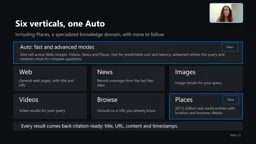
Microsoft WebIQ: Verifiable Real-Time Web Grounding for AI Agents
Microsoft WebIQ gives AI Agents real-time, citable web grounding across web, news, images, videos, and Places—164ms P95 latency, 50% fewer tokens, Scopes source control, and MCP integration.
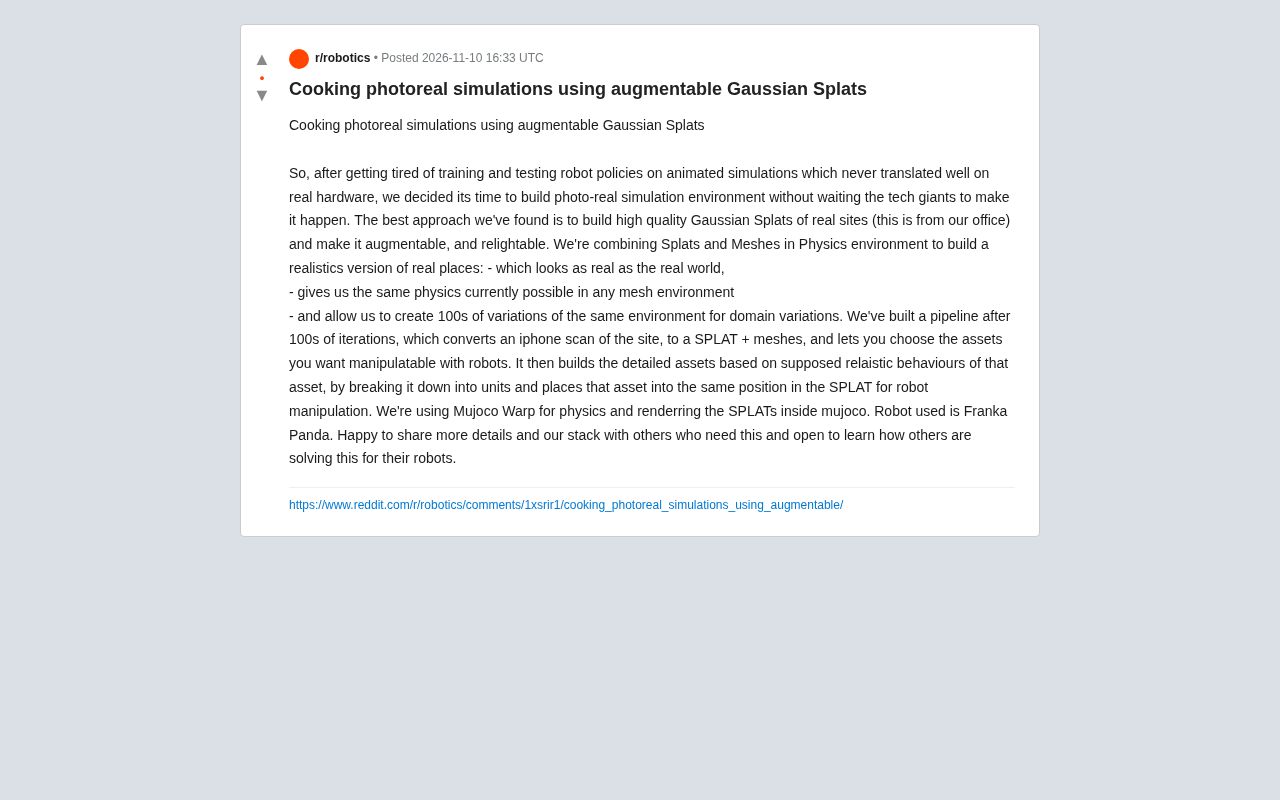
Augmentable Gaussian Splatting: Building Photorealistic Simulation Environments for Robot Training
Team combines Gaussian Splatting with meshes to build photorealistic robot simulation environments, integrating MuJoCo Warp physics and Franka Panda for augmentable, relightable real-site simulation.

Gemini 4 Carbon Released: The Leap from Gemini 3 to Gemini 4 in Under a Year
Google releases Gemini 4 Carbon, less than a year after Gemini 3. In the official demo, Carbon reverse-engineered the Theme Park binary, added a new DeepMind-themed ride, and ported it to the web in one shot.