WorkBuddy Tutorial: A Complete End-to-End Guide to Building an AI-Powered One-Person Company from 0 to 1
How AI tool WorkBuddy turns the one-person company from concept into an executable system, covering cost structure, form selection, and seven role functions.
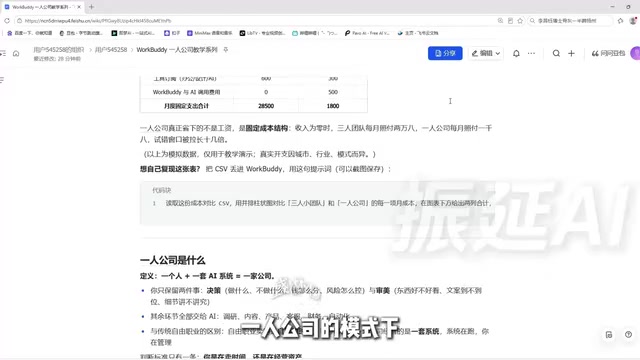
Based on the 128-episode WorkBuddy tutorial on Bilibili, this article breaks down the implementation path for a one-person company (OPC). The core lies in the change in fixed cost structure: a three-person team costs about 28,500 yuan per month, while one person plus an AI system costs only about 1,800 yuan, stretching the trial-and-error window more than tenfold. A one-person company is essentially operating a system rather than selling time; humans retain decision-making and taste while AI handles execution such as research, content, and customer service. The four forms (content, e-commerce, product, service) should be chosen based on assets and goals, with a mature combination being content for acquisition, products for monetization, and services as a safety net. WorkBuddy, as a digital employee, covers seven roles—office, access control, hands, memory, biological clock, craft, and external brain—enabling full-chain automation, but the human review step cannot be removed. The first three months are a validation period, and not making money is normal.
The Essence of a One-Person Company: A System, Not Freelancing
The concept of a one-person company (OPC) is nothing new, but it has only truly become viable in recent years. This WorkBuddyAd tutorial on Bilibili, which took three months to produce, breaks down across 128 episodes how to use AI tools to complete a closed loop from business model to monetization path. Based on the core viewpoints of that tutorial and combined with an overview of WorkBuddy's official capabilities, this article presents a reproducible implementation path.
The tutorial opens by pouring cold water on the idea of a "one-person company": it is not passive income, not a resignation letter, and certainly not something you watch today and become financially free from tomorrow. One-person company = one person + one AI system = one company. There are two keywords in this equation that need to be examined separately.
"One person" means there is only one human in the organization—no employees, no partners, no commuting. "One AI system" refers to research, content, product, customer service, and financial automation—work that originally required team division of labor—now being handled by AI. What do you keep? Only two things: decision-making and taste. What to do and what not to do, how to allocate money, how to control risk—that is decision-making. Whether something looks good, whether the copy is on point, whether product details are refined—that is taste. Everything else is outsourced to AI.
There is a particularly easy-to-confuse concept here: the difference between a one-person company and freelancing. Freelancing is essentially high-level contract work—you are still selling your own time. A design mockup earns 500, and you can take at most four orders a day; when your hands stop, your income stops. A one-person company operates a system: the system runs while you manage it, the system accumulates while you harvest. Doing the same design work, a freelancer's ceiling is four orders, while a one-person company's approach is to set standards, templates, and processes—AI produces drafts, you oversee the taste, and capacity can increase tenfold. The test is simple: are you selling time, or operating assets?
Why Now? Three Tipping Points Crossed Simultaneously
The concept of a one-person company is not new, so why has it only become truly viable in recent years? The tutorial identifies three tipping points.
Capability tipping point: Large models' reading, writing, analysis, programming, and design capabilities have crossed the "usable" line. Note: usable, not perfect—copywriting, analysis, image generation, and coding produced by AI can already be used directly, or used after minor edits.
Tool tipping point: AI is no longer just for chatting—it can operate browsers, read and write your files, and execute tasks on schedule. Something that can chat is called an advisor; something that can take action is called an employee.
Cost tipping point: The cost of completing one professional task has been compressed from hundreds of yuan to a few cents. In the past, if you wanted to test a product idea, the minimum cost was 3,000 yuan to hire someone to build a landing page, plus another 5,000 yuan on ads to see feedback. Now that test might cost the price of a coffee plus two hours of your time. When testing becomes cheap, the number of tests you dare to run goes up, and so does your hit rate.
The tutorial did the math: a three-person team (operations + design + customer service) costs about 18,000 yuan per month in labor, and with social insurance, housing fund, workspace, equipment amortization, and tool subscriptions, fixed expenses come to about 28,500 yuan. One person plus one AI system, by contrast, has fixed monthly expenses of about 1,800 yuan. The difference is not wages—it is structure. A change in fixed cost structure means the trial-and-error window is stretched more than tenfold—most startup failures are not because the direction was wrong, but because the money ran out before the direction was validated.
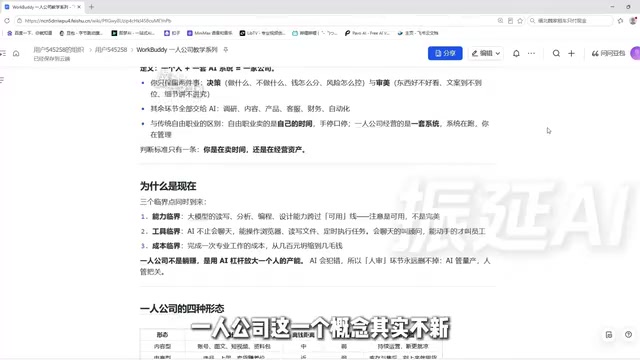
The large model capability tipping point usually refers to models reaching or exceeding human average performance on multiple benchmarks, especially in tasks such as natural language understanding, code generation, and image creation. For example, GPT-4 ranked in the top 10% on a simulated bar exam, while early GPT-3.5 was only in the bottom 50%. This leap turned AI output from a "toy" into a "tool" that users can adopt directly or put into production with minor modifications, without starting over from scratch. The arrival of the capability tipping point means a one-person company can hand core production links to AI, while humans only need to focus on decision-making and taste.
Four Forms: Determine Form by Assets, Determine Priority by Goals
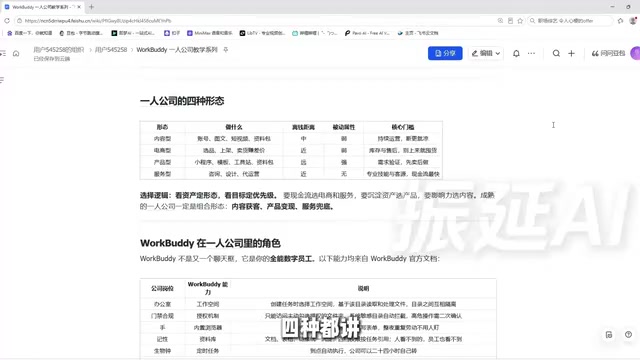
The tutorial divides one-person companies into four forms—this is the map for choosing a direction.
Content-based: Build accounts, articles, short videos, and resource packs, monetizing through traffic programs, advertising, and sponsored deals. Fastest to start—a single phone is enough to get going. The barrier is not the platform; it is whether you can sustain output.
E-commerce-based: Select products, list them, and sell for margin—closest to results, earning on every order. The pitfalls are inventory and after-sales, so the one-person e-commerce play is small-batch product testing, not stockpiling inventory.
Product-based: Mini-programs, templates, tool sites, resource packs—build once and sell many times, with the strongest passive income characteristics. The pitfall is demand validation; the correct approach is to sell first and build later—produce only after someone has paid.
Service-based: Consulting, design, and agency operations—essentially still trading time for money, but with the fastest cash flow, making it the source of a one-person company's first pot of gold.
The four forms have no hierarchy. The selection logic is eight words: determine form by assets, determine priority by goals. What you know, what you have, and who you know are your assets; whether you want cash flow or assets is your goal. For cash flow, choose e-commerce and services; to accumulate products, choose product-based; for influence, choose content-based. A mature combined form is often: content for customer acquisition, products for monetization, services for a safety net.
WorkBuddy's Seven Roles: More Than Just a Chat Box
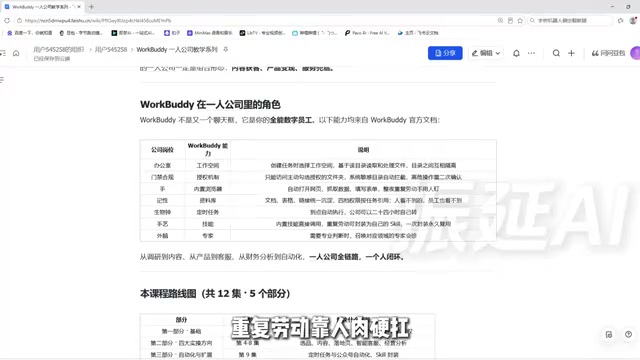
What role does WorkBuddy play in a one-person company? The tutorial's answer is clear: it is not a chat box—it is an all-capable digital employee. A chat box can only talk; it can take action. Mapped to company positions, WorkBuddy covers seven roles.
Office (workspace mechanism): When creating a task, select a workspace, and it reads directories and processes files based on that space. A digital employee has its own office; directories are isolated from each other and do not wander into one another.
Access control and compliance (authorization mechanism): The official wording is "can only access folders you actively check and authorize; system-sensitive directories are automatically blocked; high-risk operations require secondary confirmation." This employee is very honest—it will not rummage through drawers, nor will it take your seal and stamp everything in sight.
Hands (built-in browser): It can open web pages, scrape data, and fill out forms on its own. For repetitive work like competitor monitoring and data collection, it can work all day and all night.
Memory (knowledge base): Documents, spreadsheets, and web links can all be stored in it, with four permission tiers, referenced by task when needed. There is a clever setting: materials that people cannot see, the employee also cannot see—permissions are aligned.
Biological clock (scheduled tasks): Executes on time on its own without you watching—the company can run 24 hours a day by itself.
Craft (skill system): Built-in skills can be called directly; repetitive work can be encapsulated into your own skills and managed centrally in the skill marketplace. This is equivalent to distilling a veteran employee's craft into standard operating procedures—encapsulate once, use forever.
External brain (expert system): When encountering problems requiring professional judgment, you can summon experts in the corresponding field for consultation.
Connecting the seven roles, from market research to content generation, product development, customer service, financial analysis, and automated operations—WorkBuddy covers the entire chain of a one-person company all by itself. This is the confidence behind "one person plus one system equals one company."
The workspace isolation mechanism is the foundational design by which WorkBuddy ensures data security and task independence. Each workspace has its own independent file directory and permission boundary; files from different projects do not interfere with each other—similar to assigning each digital employee a separate office. After specifying a workspace when creating a task, AI can only access authorized files within that space, and system-sensitive directories (such as the system drive and user home directory) are automatically blocked. This isolation not only prevents data cross-use but also reduces the risk of misoperation, keeping things clean and compliant even when multiple tasks run in parallel.
The Flip Side You Must Face: AI Makes Mistakes
The tutorial repeatedly emphasizes one step that can never be removed: human review. AI handles mass production; humans handle quality control. A one-person company does not replace people with AI—it treats AI as a team that does not need sleep, does not need social insurance, and is on call at all times, while you are the team's only boss.
The negative scenarios are worth self-checking against: files scattered in every corner of the desktop, so finding materials each time feels like archaeology; unclear authorization, so AI either dares not act or acts wrongly and you are left with lingering fear; the same question asked a hundred times a day because experience has not been distilled into the knowledge base; repetitive work carried by brute human force because it never occurred to you that it could be encapsulated into a skill. These pitfalls will be filled one by one in later lessons—first get to know the workbench clearly, then sort out workspaces and file authorization; only with a solid foundation can later work stand firm.
The human review step refers to the process in which humans perform quality checks, fact-checking, and compliance judgment after AI generates content or executes operations. Because large models have "hallucinations" (generating plausible but untrue information) and logical biases, relying entirely on AI can lead to accumulated errors. In a one-person company, human review should focus on key decision points: final confirmation of contract terms, financial data, and external copy. A "mass AI production + human spot-check" model is usually recommended; for high-risk tasks (such as legal or medical advice), full review is mandatory, while for low-risk tasks (such as social media posts), it can be appropriately relaxed to balance efficiency and accuracy.
Expectation Management: Three Sentences and a Roadmap
The tutorial closes with three sentences for expectation management. First, a one-person company is not passive income—it uses AI leverage to amplify your personal capacity; the work is just as much, except the team that does not draw a salary does not complain about being tired. Second, the first three months will most likely not be profitable—this is the validation period, which is normal, so do not panic. Third, all WorkBuddy operations in the course can be reproduced by following along, but AI cannot replace you in business-level judgment—that is your only job as the boss.
The course roadmap has five parts: fundamentals (figuring out what to do, how to use the workbench, how to authorize files), four practical directions (product selection, content, landing pages, intelligent customer service, business analysis), automation and expansion (scheduled tasks and automation, Skill encapsulation), implementation summary (a 90-day executable roadmap), and resource recommendations (Skills and expert centers suitable for one-person companies). The tutorial specifically reminds that parts two and three are the watershed—most one-person companies do not end because they have no business; they end because they cannot do the books or cannot automate. If you cannot do the books, you do not know which business is making money; if you cannot automate, you trap yourself in repetitive work and can never scale.
The value of this tutorial is not in teaching you how to click a particular button, but in breaking "one-person company" down from a vague concept into an executable structure: cost structure, role structure, form selection, and the boundaries of tool capabilities. For anyone who wants to use AI leverage to amplify personal output, this is an operation manual worth reading and doing along with.
Skill encapsulation is the process of turning repetitive workflows into reusable modules. In WorkBuddy, users can package a series of operations (such as data scraping, format conversion, and email sending) into a Skill and set trigger conditions or scheduled execution. An encapsulated Skill is like a standard operating procedure (SOP): defined once, used forever, and shareable or reusable in the skill marketplace. For a one-person company, Skill encapsulation can significantly reduce the time cost of repetitive work—for example, encapsulating "daily competitor price monitoring" as a scheduled Skill lets AI complete it automatically and generate a report, freeing human effort to focus on high-value activities.
Related articles
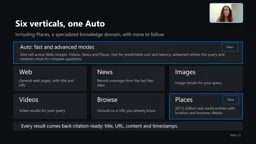
Microsoft WebIQ: Verifiable Real-Time Web Grounding for AI Agents
Microsoft WebIQ gives AI Agents real-time, citable web grounding across web, news, images, videos, and Places—164ms P95 latency, 50% fewer tokens, Scopes source control, and MCP integration.
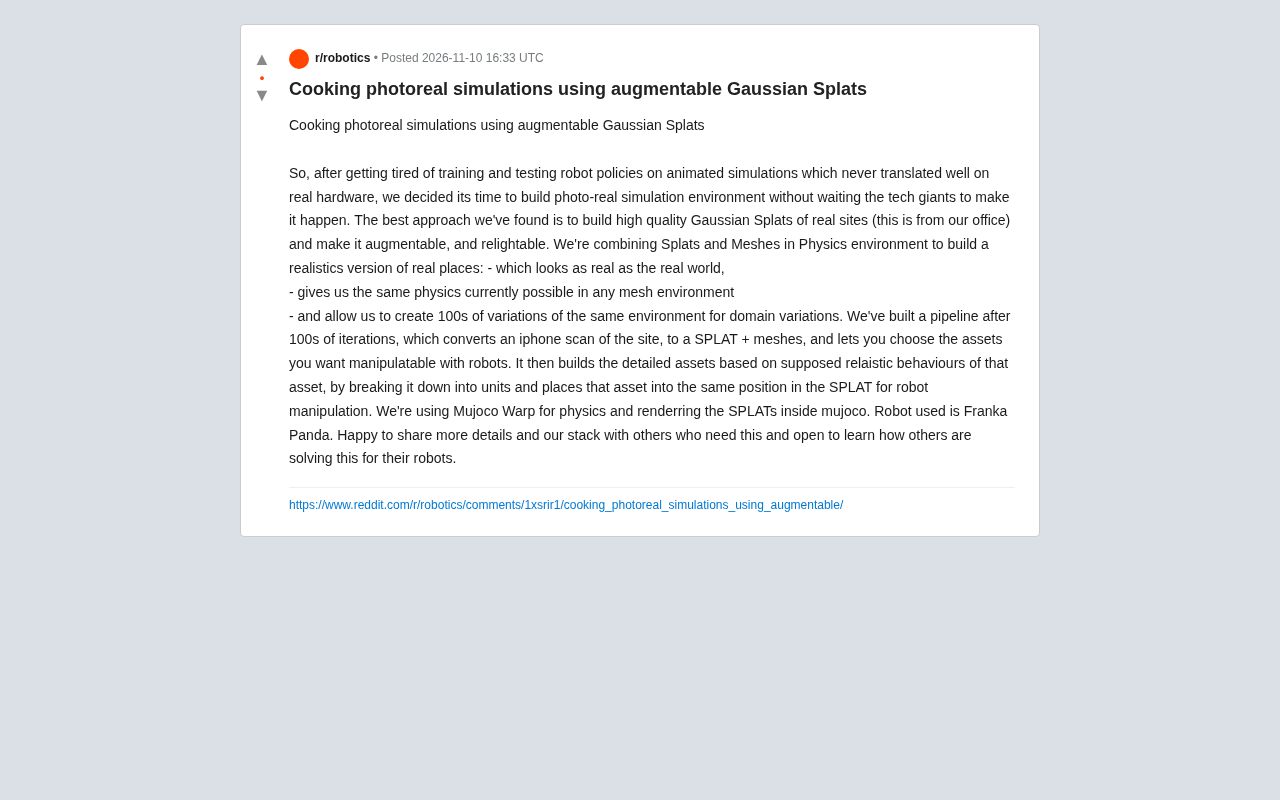
Augmentable Gaussian Splatting: Building Photorealistic Simulation Environments for Robot Training
Team combines Gaussian Splatting with meshes to build photorealistic robot simulation environments, integrating MuJoCo Warp physics and Franka Panda for augmentable, relightable real-site simulation.

Gemini 4 Carbon Released: The Leap from Gemini 3 to Gemini 4 in Under a Year
Google releases Gemini 4 Carbon, less than a year after Gemini 3. In the official demo, Carbon reverse-engineered the Theme Park binary, added a new DeepMind-themed ride, and ported it to the web in one shot.