Xbox's First COO Departs Just Months After Taking Office, Ending 21-Year Microsoft Career

Xbox's first COO, Helen Chiang, left Microsoft just months after taking office, ending a 21-year career.
Helen Chiang, the first COO of Microsoft's Xbox division, left just months after taking the newly created role, ending her 21-year Microsoft career. Chiang had long led Minecraft, expanding the IP from a single game into a cross-platform super IP, and was promoted to Xbox COO to strengthen operational integration. Her rapid departure leaves the organizational adjustment's strategic intent in flux. The article argues that Xbox's operational complexity has risen under Game Pass and cross-platform publishing, and the new COO role lacks organizational inertia, leaving the function in a vacuum that may affect Minecraft-Xbox coordination. Microsoft has not announced a successor.
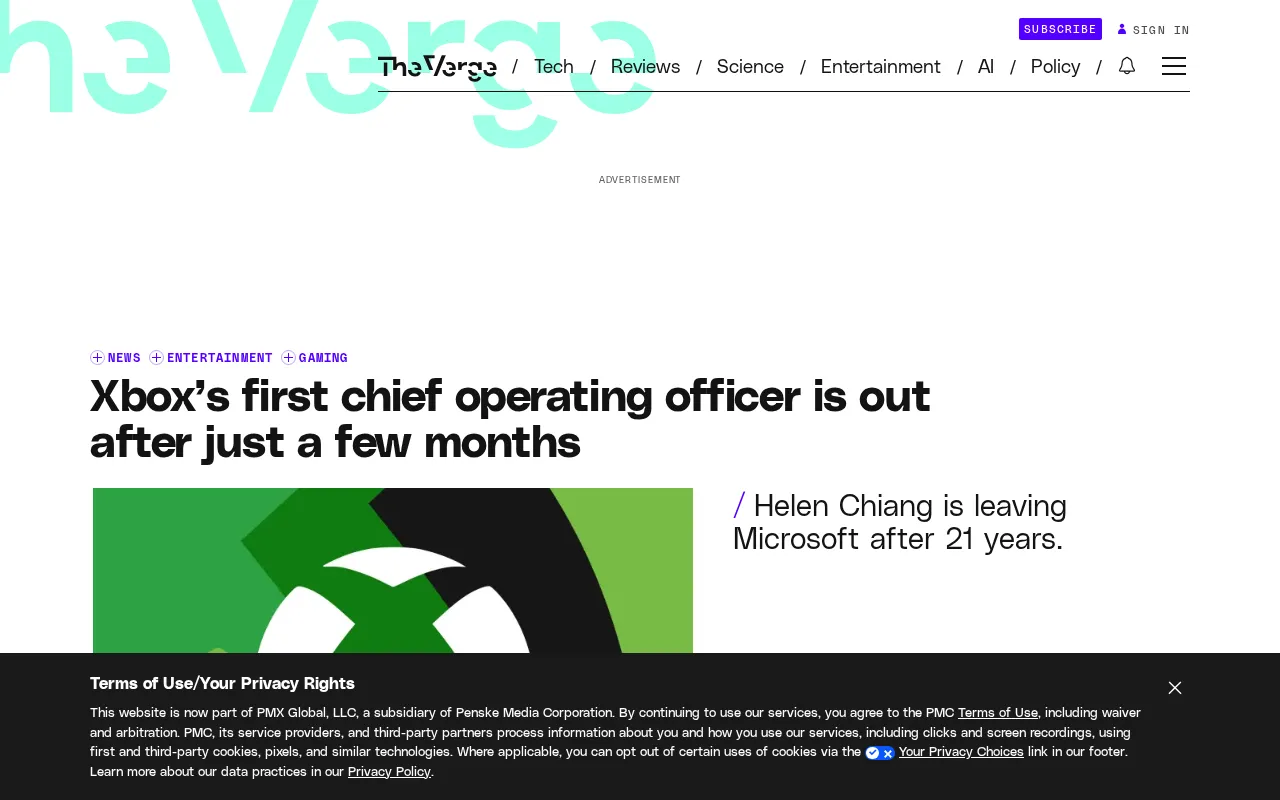
Microsoft's Xbox division is seeing another round of executive turmoil. According to an internal memo obtained by The Verge, Helen Chiang, Xbox's first Chief Operating Officer (COO), left Microsoft today, just months after taking on the newly created role.
From Minecraft Chief to Xbox COO: A Brief Promotion
Chiang spent 21 years at Microsoft, and she is best known as the head of Minecraft. Under her leadership, Minecraft expanded from a single game into a cross-platform, cross-media super IP. It was based on this track record that Microsoft promoted her to the newly created position of Xbox COO, intending to strengthen operational integration across the Xbox business.
However, this appointment failed to translate into a long-term, stable management structure. The COO position itself was a product of Xbox's organizational restructuring, and Chiang's rapid departure means the strategic intent behind the role shifted before it could take root.
Minecraft's Unique Position as a Microsoft Asset
Minecraft was acquired by Microsoft for $2.5 billion in 2014, and it was not confined to the Xbox ecosystem afterward; instead, it continued to launch on competing platforms such as PlayStation, Nintendo Switch, and mobile, forming a rare cross-platform super IP. Its business model also expanded from a buy-to-play model to an education edition, marketplace revenue sharing, derivative content, and licensed merchandise. Because of this, the head of Minecraft needs to handle content creation, platform partnerships, and community operations simultaneously, and this kind of composite management experience was an important consideration in Microsoft's decision to promote her to Xbox COO. Only by understanding this background can one see why the departure of a game IP head would be viewed as a direct blow to Xbox's operational integration.
The Xbox Integration Challenge Behind the Executive Change
Xbox has continued to restructure its business in recent years, and operational complexity has risen significantly, from the Game Pass subscription model to a cross-platform publishing strategy. The COO role was created with the intention of having a dedicated person coordinate business operations and divide responsibilities with the content and creative side. Chiang's departure exposes the fragility of this structural design at the implementation level: a newly created position lacks sufficient organizational inertia to support it, and once the core person leaves, the function faces a vacuum.
For Microsoft, the departure of a 21-year veteran is not only a personnel loss, but may also affect the pace of coordination between the Minecraft and Xbox businesses. Microsoft has not yet announced a successor for the COO position.
How Game Pass and Cross-Platform Publishing Raise Operational Complexity
Game Pass is Microsoft's subscription gaming service, where users pay monthly for access to an ever-updating game library; its operations involve third-party licensing negotiations, first-party content scheduling, cloud gaming infrastructure, and tiered pricing. A cross-platform publishing strategy means Xbox first-party games are no longer exclusive, but launch simultaneously on PC and rival consoles. With these two strategies combined, Xbox operations are no longer just linear management of hardware shipments and game releases; they require coordinating subscription revenue, content costs, platform partnerships, and user retention across multiple threads. This is the underlying logic for creating the COO position and separating operational coordination from content creativity, and it also explains why a vacancy in that role quickly amplifies organizational coordination pressure.
The Tension Between Short-Term Turmoil and Long-Term Strategy
Frequent executive changes often go hand in hand with strategic wavering. Xbox is currently in a critical period of transitioning from hardware sales to content and services, and any management instability will be interpreted by outsiders as a signal of unclear direction. Whether Chiang's departure means the COO role design itself will be reevaluated is worth continued attention.
For observers of organizational change in the gaming industry, this personnel change offers a window: when companies try to solve old problems with new positions, the contest between organizational inertia and talent retention is often more decisive than the role design itself.
One-line Summary
Xbox's first COO, Helen Chiang, left Microsoft just months after taking office, ending a 21-year career.
Paragraph Summary
Helen Chiang, the first Chief Operating Officer of Microsoft's Xbox division, left just months after taking on the newly created role, ending her 21-year Microsoft career. Chiang had long served as head of Minecraft, leading the IP's expansion from a single game into a cross-platform super IP, and was promoted to Xbox COO to strengthen business operations integration. However, her rapid departure means the strategic intent of this organizational adjustment shifted before it could take root. The article argues that Xbox's operational complexity has risen significantly under its Game Pass subscription and cross-platform publishing strategies, and the newly created COO position lacks organizational inertia to support it; with the core person gone, the function faces a vacuum that may affect coordination between the Minecraft and Xbox businesses. Microsoft has not yet announced a successor.
Related articles

Hermes Agent Beginner's Guide: A Self-Evolving AI Assistant
Hermes Agent beginner's tutorial: how to install and use the 41.7K-star self-evolving AI Agent. We break down its learning loop, three-tier memory, and Skill self-improvement, compare it with Claude Code and OpenClaw, and include WSL installation steps.

RAG Interview Essentials: Breaking Down the Full Offline Indexing and Online Retrieval Pipeline
A complete breakdown of the RAG retrieval-augmented generation workflow: offline document loading, chunking, vectorization, and indexing; online query rewriting, vector retrieval, reranking, and generation, plus core interview points and system optimization directions.

AI Large Models for Absolute Beginners: Principles and API Calling in Practice
From AI's evolution to large model training principles and core concepts like Token, Temperature, and Top-P, this article explains system prompts, Function Call, RAG, and memory with hands-on examples and four API call scenarios—ideal for beginners.