Xmind 2027 Launches: Mind Mapping Evolves into an AI Thinking Partner

Xmind 2027 reshapes mind mapping into a shared visual thinking space for people and AI, with local material research and MCP integration.
Xmind 2027 launched on Product Hunt with 119 upvotes and ranked 2nd for the day. Its core proposition is to transform mind mapping from a "canvas for recording ideas" into a shared visual collaboration space for people and AI. Main capabilities include Xmind Agent, which can use users' local documents and existing mind maps to conduct research, develop ideas, and weigh possibilities through dialogue; and MCP integration, which brings the structured context carried by mind maps into mainstream AI workflows such as ChatGPT and Claude while emphasizing user control. The article argues that its differentiating advantage is visual structure, which is better suited than linear documents for exploring ideas that have not yet taken shape. However, official information does not disclose supported format ranges, local index implementation, or performance. Agent output quality, cross-model context consistency, and how to distinguish idea ownership after AI rewriting still need to be verified through actual use.
Mind mapping tools are undergoing a shift in positioning—from a "canvas for recording ideas" to a "collaborator in the thinking process." Xmind 2027 launched on Product Hunt and received 119 upvotes, ranking 2nd for the day. Its official tagline states the ambition directly: "Your mind map is now an AI thinking partner."
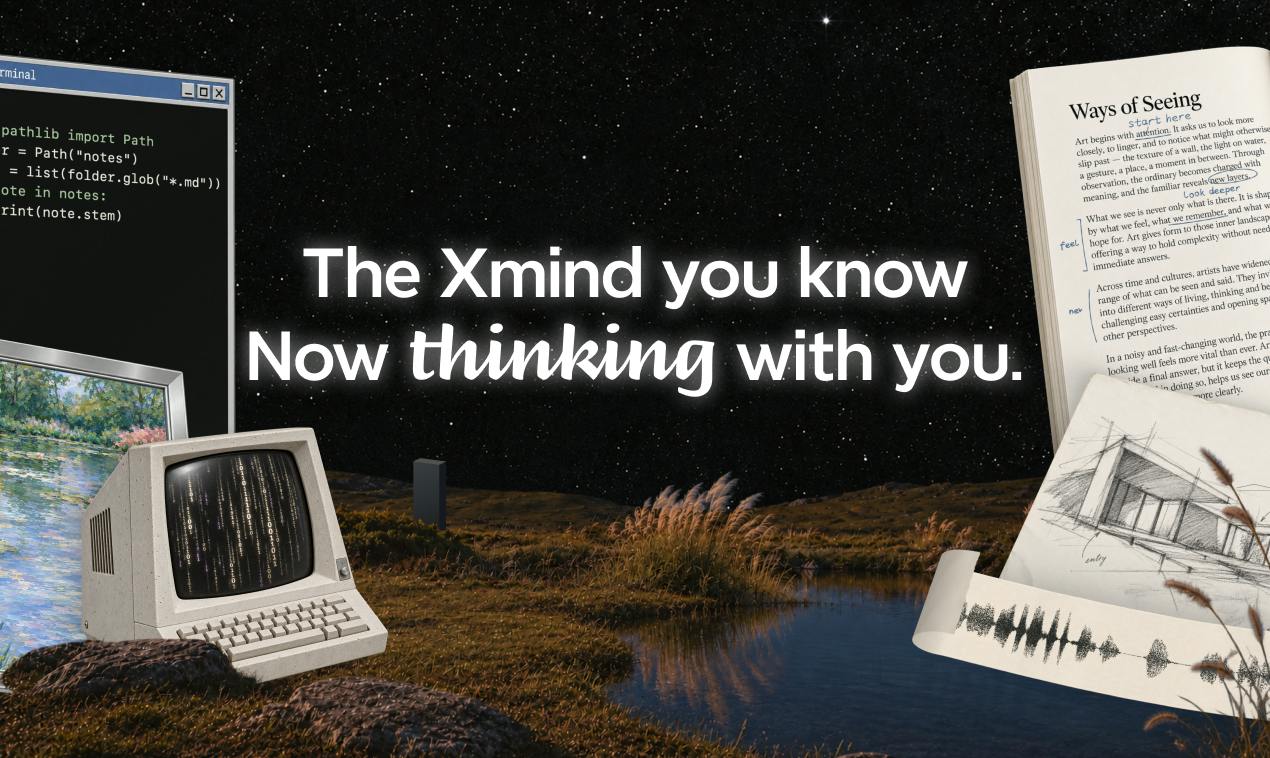
From Canvas to Conversation Space
Xmind 2027's core proposition is built on one judgment: information is increasingly easy to obtain, while understanding and judgment are becoming scarcer. The product's solution is to provide people and AI with a shared visual space—not to have AI output a conclusion in a chat box, but to let it advance ideas with you on the same map.
This positioning is fundamentally different from the common "AI generates a mind map for me." Generative mind maps solve a one-off output problem, while a shared space emphasizes continuous collaboration: ideas have positions and relationships on the map, and AI's operations also occur within the same structure, so users can see at any time how a line of thinking is being developed.
Xmind Agent: Research with Local Materials
Xmind Agent is the main capability entry point of this update. According to the official description, it can use the user's local documents and existing mind maps to conduct research, develop ideas, and weigh different possibilities through dialogue. As thinking progresses, the mind map itself also continues to evolve.
For knowledge workers, this design addresses a real pain point: inspiration is often scattered across local notes, old projects, and unfinished mind maps, while general-purpose AI chat tools cannot see this context. Limiting retrieval to the user's own material library makes outputs closer to personal context and also avoids the concern of uploading sensitive documents to public services (at least at the product narrative level).
However, the official information does not disclose the range of document formats supported by the Agent, how the local index is implemented, or performance when handling large volumes of material—these details determine whether it can truly take on the role of a "research workstation."
There is a key difference between local material retrieval and general large models, namely the RAG (Retrieval-Augmented Generation) approach. The parameters of large language models do not contain the user's own notes, old projects, or private documents, so direct questions often yield only generic answers. RAG retrieves relevant snippets from a user-provided private material library before generation, then supplies these snippets as context to the model so that outputs are anchored in real, traceable materials. This mechanism usually also involves local index construction (splitting documents into chunks and converting them into vector or keyword indexes), similarity retrieval, and context assembly. Index quality and chunking strategy directly affect the relevance of answers. Understanding this helps assess the product positioning of Xmind Agent: it is not trying to build a stronger general model, but to limit retrieval to the user's personal context, making outputs closer to personal accumulated knowledge and reducing dependence on public services.
MCP: Bringing Mind Map Context into Mainstream AI Workflows
Another notable capability of Xmind 2027 is integration with MCP (Model Context Protocol), which brings the context carried by mind maps into ChatGPT, Claude, and users' existing AI workflows.
The significance of this step is breaking down tool boundaries. In the past, a mind map was a closed container: content could not get out, and external AI could not get in. Through MCP, structured thinking in a mind map can become input for other models, and conversely, results from external conversations can flow back onto the map. The official messaging particularly emphasizes that "you remain in control"—at a stage when AI is intervening in content production at scale, control ownership is one of the product promises users care about most.
From an industry perspective, MCP is becoming a de facto connection layer between AI applications, and more and more productivity tools are choosing it as their capability outlet. Xmind's participation shows that the mind mapping category is also moving toward this ecosystem rather than building a closed plugin system of its own.
MCP (Model Context Protocol) was proposed and open-sourced by Anthropic at the end of 2024, aiming to provide a standardized way for AI models to connect with external data sources and tools. In the traditional integration model, every AI product that wants to connect to a data source or tool must separately develop a customized plugin or API integration. MCP abstracts this connection with a unified client-server architecture: an external tool only needs to implement an MCP server once, and any model or client that supports MCP can call it, greatly reducing duplicate development costs caused by ecosystem fragmentation. A number of mainstream AI vendors and productivity tools have announced support for the protocol, gradually making it a de facto connection layer across models and applications. For tools like mind maps, MCP integration means that users' mind map content no longer needs to be copied, pasted, or exported before it can be used by AI; instead, it can be directly read and written by models as structured context.
Product Positioning and Competitive Landscape
On Product Hunt, Xmind 2027 is categorized under Productivity, Notes, and Artificial Intelligence. This combination itself shows that it no longer defines itself as a pure drawing tool.
Facing knowledge management products such as Notion, Obsidian, and Heptabase that are also increasing their AI capabilities, Xmind's differentiating advantage is visual structure. Linear documents are suitable for consolidating conclusions, while graph structures are better for exploring ideas that have not yet taken shape—when AI participates, nodes and connections on the map naturally become anchors for discussion. This is an interaction form that document-based products find difficult to replicate.
What to Watch
The product narrative is clear, but several questions remain to be verified through actual use: How good and traceable is the content generated by the Agent based on local materials? Is cross-model context consistency stable after MCP integration? And when a mind map is heavily rewritten by AI, how can users distinguish "their own ideas" from "AI's additions"?
Visualizing the thinking process and letting AI collaborate within it is a product choice with a clear direction. Whether Xmind 2027 can deliver on the phrase "thinking partner" depends on these engineering details, not just the tagline.
One-line Summary
Xmind 2027 reshapes mind mapping into a shared visual thinking space for people and AI, with support for local material research and MCP integration.
Paragraph Summary
After launching on Product Hunt, Xmind 2027 received 119 upvotes and ranked 2nd for the day. Its core proposition is to transform mind mapping from a "canvas for recording ideas" into a shared visual collaboration space for people and AI. Main capabilities include Xmind Agent, which can use users' local documents and existing mind maps to conduct research, develop ideas, and weigh possibilities through dialogue; and integration with the MCP protocol, bringing structured context carried by mind maps into mainstream AI workflows such as ChatGPT and Claude while emphasizing that users remain in control. The article argues that its differentiating advantage is visual structure, which is better suited than linear documents for exploring ideas that have not yet taken shape. However, official information does not disclose supported format ranges, local index implementation, or performance. Agent output quality, cross-model context consistency, and how to distinguish idea ownership after AI rewriting still need to be verified through actual use.
Related articles

VERS: Editing Activation Explanations to Halve Reasoning Model Tokens
VERS guides reasoning models by editing activation explanations, cutting 45.8% of tokens on GSM8K with only a 0.82 pp accuracy drop and transferring to larger models, but losing accuracy on competition problems.

Finding Errors Is Not Enough: Selective Model Escalation for Entity-Targeted Sentiment Analysis
This study explores selective model escalation for entity-targeted sentiment analysis, comparing data collection ordering, uncertainty-driven re-examination, and model routing—finding that minority-class priority only helps at very small data volumes, the oracle upper bound far exceeds actual gains, and escalation must be tailored to each dataset.

WAS-PO: Using Whitened Advantages to Solve the Correlation Trap in Multi-Reward Reinforcement Learning
WAS-PO paper proposes whitening advantages to correct correlation bias in multi-reward RL: when rewards are correlated, naive weighted summation effectively applies Σ^{1/2}w instead of w. Experiments show training reward improves steadily, but held-out accuracy does not improve in sync, and under two rewards it actually falls behind.