Yatko: The Smart Tool That Downloads the Right GitHub Binary in One Click

Replace github.com with yatko.app to auto-detect your system and download the right binary instantly.
Yatko is a lightweight tool by an indie developer that solves a long-ignored UX problem on GitHub: finding the right binary on a Releases page. Simply replace `github.com` with `yatko.app` in any repo URL, and Yatko detects your OS and CPU architecture (x86_64 or ARM64) to serve the correct file from the latest Release. One universal link replaces multi-platform download guides for maintainers, and eliminates technical guesswork for end users. As a third-party GitHub-dependent service, it does face challenges around match accuracy, security trust, and the risk of GitHub eventually building this natively.
A Developer Pain Point That's Been Ignored for Too Long
For anyone who regularly downloads software from GitHub, hunting down the right binary is a frustratingly familiar ritual. You navigate to a project's Releases page, face a long list of files named things like linux-amd64, darwin-arm64, and windows-x86_64, figure out your own OS and CPU architecture, then pick the correct file from a dozen options.
For developers, this might take a few seconds. For everyday users, it's enough friction to turn them away entirely. Yatko (yatko.app) — which recently ranked #6 on Product Hunt — targets exactly this detail that GitHub has long overlooked. Its tagline says it all: "The download button GitHub forgot to add."
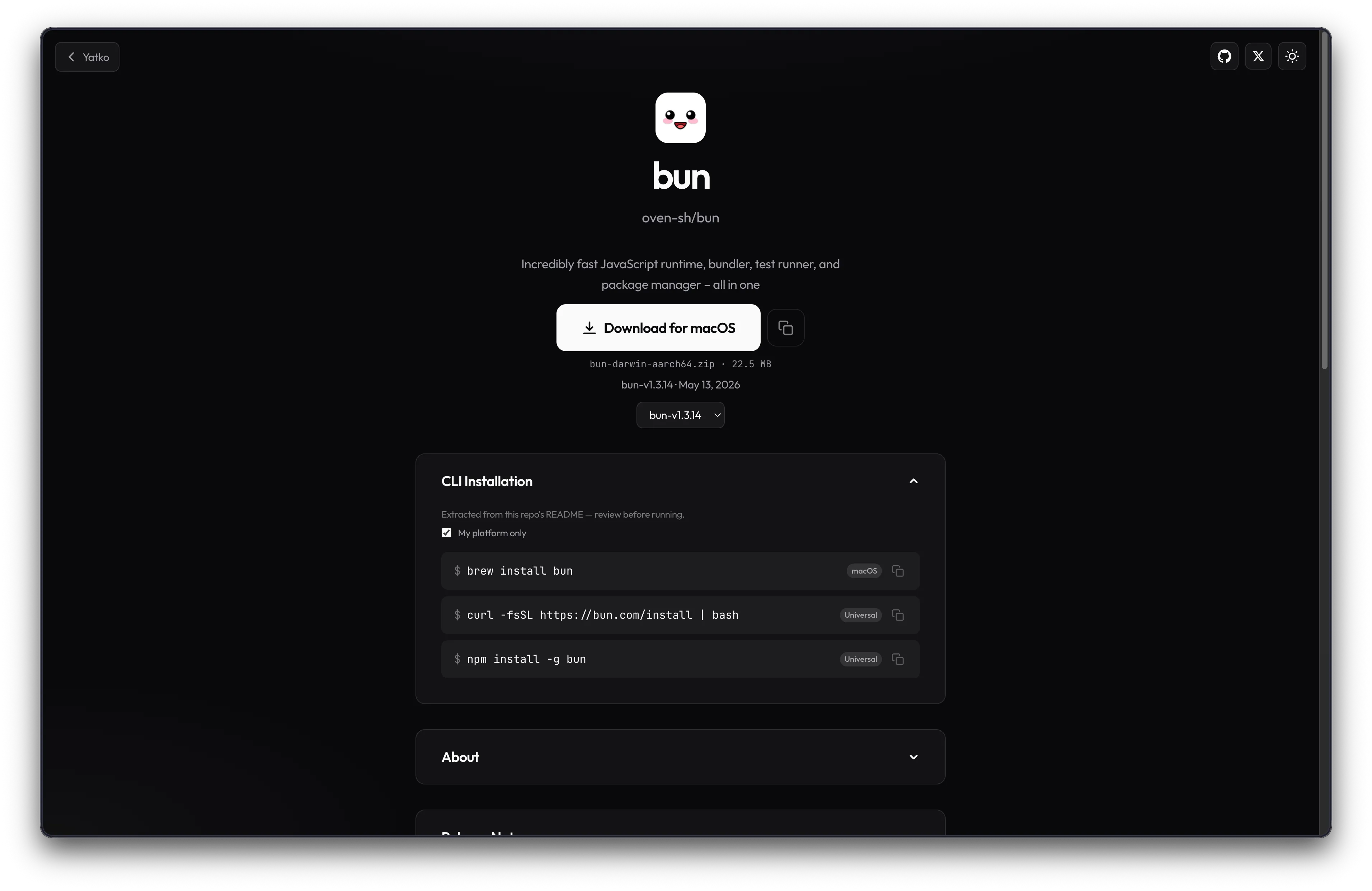
What Yatko Does: Smart Downloads via a Simple Domain Swap
Just Replace the Domain — That's It
Yatko's core mechanic is elegantly simple. It transforms a standard github.com/owner/repo repository URL into a clean download link — just swap github.com for yatko.app, and a single click delivers the binary that matches your system.
This "domain swap" approach follows a pattern already familiar in the GitHub tooling ecosystem. Replacing github.com with github.dev opens the online editor; other services surface code statistics. Yatko applies this same interaction model to downloading — one of the most common use cases — with virtually zero learning curve.
Automatic OS and CPU Architecture Detection
Yatko's real value lies in its intelligent detection. When a user opens a Yatko link, it automatically identifies their operating system (Windows, macOS, Linux) and processor architecture (x86_64, ARM64, etc.), then selects the best-matching file from the project's latest Release and serves it directly.
This means the same Yatko link delivers the macOS build to Mac users and the Windows build to Windows users. Distributors only need to share one universal link — no need to maintain separate download URLs for each platform or write lengthy installation instructions.
Who Does It Actually Help?
Open Source Maintainers Tired of Documentation Overhead
Open source maintainers often have to list platform-specific download instructions in their READMEs or tell users to "visit the Releases page and pick your version." This creates documentation overhead and raises the barrier for new users. With Yatko, maintainers can place a single, universal download link in their project homepage, docs, or social media posts — and users get the right file automatically, without even noticing.
Non-Technical Users Confused by Architecture Labels
For users who don't know their CPU architecture or can't tell amd64 from arm64, Yatko eliminates the confusion entirely. It transforms what was a "technical judgment call" into a simple "click to download" experience — meaningfully lowering the barrier to using open source software and expanding the potential user base.
The Product Philosophy Behind the Simplicity
Yatko was built by independent developer Anurag Vallur and is categorized under Developer Tools and GitHub. As a product, it's a textbook example of "small but mighty" — no feature bloat, just one thing done exceptionally well: hiding all the complexity of asset selection behind a single link.
Tools like this tend to resonate deeply in developer communities because they zero in on friction points that seem trivial but happen every single day. While Yatko's Product Hunt vote count isn't record-breaking, it confirms the pain point is real. GitHub's years-long failure to address this experience gap is precisely what gives third-party tools like Yatko room to exist.
A Few Things Worth Knowing Before You Use Yatko
As a third-party service built on top of the GitHub ecosystem, Yatko comes with some inherent limitations:
- Match accuracy varies by project: Yatko must continuously parse GitHub's Release structure, and asset naming conventions differ wildly across projects — so automatic matching may not always be perfect.
- Trust and security considerations: Downloading binaries through a third-party domain requires trusting Yatko's intermediary process — a concern that applies to any proxy-style download tool and shouldn't be taken lightly.
- Platform risk: If GitHub ever officially adds a smart download button, tools like Yatko would lose most of their reason to exist. That said, Yatko's very existence is itself a pointed reminder of a blind spot in a major platform's product thinking.
Conclusion: A Clean Tool Focused on One Real Problem
Yatko is a classic gap-filler product. It doesn't come with a grand technical narrative — it simply addresses a real, longstanding crack in the experience between open source developers and their users. In a world where developer tools keep getting more complex, there's something genuinely refreshing about a tool that strips everything back and solves exactly one problem well.
If you regularly distribute or download software from GitHub, the trick is worth remembering: swap github.com for yatko.app — and save yourself the next trip down the Releases page rabbit hole.
Related articles

world2vec: Building Mechanistic World Models with Latent Dynamics Learning
world2vec proposes a reward-free method for learning mechanistic world models via latent dynamics, faithfully reproducing systems over long horizons with at least an order of magnitude fewer parameters than DreamerV3, TD-MPC2, and LeWM, and achieving accurate system identification on 71 attractor benchmarks.

A New KL-DRO Paradigm: Adaptive Scenario Generation Around a Learned Density Model
KL-DRO research proposes centering the KL ball on a learned density model instead of the empirical distribution, with adaptive scenario generation guiding sampling toward the worst case. Experiments show lower cost under distribution shift when records are scarce and the model can extrapolate, with comparable in-distribution cost.

ODE Samplers for Discrete Diffusion Models: Exponential Residual Flows Accelerate Generation
Discrete diffusion models lack deterministic ODE sampling? This article introduces Exponential Residual Flows (ERFs), which introduce continuous residual variables per token to construct piecewise ODEs for deterministic sampling and support consistency distillation acceleration. Superior to prior methods on code and text generation tasks.