Zapier Agents vs n8n AI Agents: A Deep Dive into Four Real-World Workflows

Four workflows tested in one real business: Zapier is fast but imprecise, n8n slow but controllable—choose based on where you'll pay.
Based on Venture Void's test, Zapier Agents and n8n AI Agents ran the same four workflows in one real business: lead qualification, content repurposing, client onboarding, and invoice follow-up. The trade-off is clear: Zapier is fast to launch with smooth native integrations, but scoring is inconsistent, enrichment calls fail silently, and decisions are a black box; n8n takes longer to build but delivers deterministic scoring, explicit error branches, and transparent reasoning—recovering ~$6,000 in overdue revenue in 30 days. Neither handles multi-branch onboarding well. Agents fail regularly, so high-stakes flows need human checkpoints, logs, and fallbacks; full autonomy is still ~18 months away.
When Automation Starts to "Think," Tool Selection Becomes a Life-or-Death Question
According to Venture Void's assessment in a recent test video, most indie founders building automations in 2026 have already picked the wrong tool before they even start—based on brand recognition, a single YouTube thumbnail, or a Reddit post from someone who has never run a real revenue workflow. To reach a reliable conclusion, the test put Zapier Agents and n8n AI Agents through the exact same four agentic workflows in the same real business: lead qualification, content repurposing, client onboarding, and invoice follow-up.
The philosophies are completely different: Zapier positions Agents as an AI-native automation layer layered on top of 20+ years of integration ecosystem; n8n has been eating into the market since 2019 as an open-source workflow builder, embedding AI nodes with memory, tool calling, and conditional reasoning directly into the canvas. On the surface both can "act autonomously on your behalf," but each fails in different, predictable places.
Workflow One: Lead Qualification—Reliability Beats Speed to Launch
The flow starts with a Typeform form; the agent needs to read responses, cross-reference Clearbit data, score leads 1–10 based on budget signals, company size, and seniority, write a personalized first-touch email, and write to Airtable.
In Zapier Agents, the author built it in about 40 minutes using a natural-language brief, but problems surfaced quickly: the same lead profile was scored 6 and then 4 on two runs, raising consistency concerns; Clearbit enrichment calls silently failed 2 out of 12 tests, leaving incomplete Airtable records that went unnoticed; email copy was usable but templated.

The n8n version took about 3 hours to build—manually wiring AI nodes to the OpenAI model, connecting Clearbit via HTTP Request nodes, and writing JSON Schema for downstream nodes. But once built, behavior was deterministic: scoring was stable, Clearbit failures were flagged by an error branch that marked the record and alerted in Slack, and emails were more controllable because the prompts had no abstraction layer. On cost, Zapier's Professional tier runs about $109/month, n8n Cloud starts around $50/month, and self-hosting is just a ~$5 DigitalOcean droplet. The conclusion is clear: on the single dimension of reliability, n8n wins.
Clearbit enrichment refers to using a data enrichment service like Clearbit to automatically fill in structured fields—company size, industry, job title, funding status—based on an email or company domain. These API calls typically have rate limits, may return empty results, or may be temporarily unavailable, so workflows must distinguish "enrichment failure" from "the lead itself is missing fields." In agentic workflows, the key design is to give the enrichment step an explicit error branch: on failure, mark the record, write a log, and notify a human—rather than letting the agent guess or silently skip. Zapier's native integration wraps failures as invisible internal errors, while n8n's HTTP Request node lets you define custom status-code handling—this is precisely the technical reason the two diverge on reliability.
Workflow Two: Content Repurposing—Zapier Wins This Round
The flow triggers when RSS detects a new long-form article, extracts the full text, generates a Twitter thread, a LinkedIn carousel outline, three short-video hooks, and newsletter copy, then distributes to Buffer, Notion, and Google Docs.
This round, Zapier's multi-app orchestration was surprisingly smooth—native connections kept every step from breaking, and it was live in under an hour. Content quality was above average, usable with light editing; at the author's effective hourly rate of about $200/hour, saving 4–5 hours per article means each run is worth roughly $800–1,000.
n8n's content quality was higher because the author used a more complex prompt chain: summarize first, then match tone, then rewrite against existing writing samples in a vector database. The cost was a full day of building. For an indie founder writing only three pieces a month, that time math doesn't work. When a workflow leans heavily on SaaS integrations and speed to launch matters more than fine-grained control, Zapier Agents is genuinely competitive.
Workflow Three: Client Onboarding—Neither Tool Is Perfect
After a contract is signed in DocuSign, the agent needs to create a Notion workspace from a template, send a welcome sequence via ActiveCampaign, schedule a kickoff call with Calendly, create a project in Asana, and issue an invoice in FreshBooks.
Zapier Agents struggled with conditional logic: different service tiers map to different templates and email sequences, and the agent repeatedly took the wrong branch. The author spent more time debugging the agent's decisions than it would have taken to manually route with traditional Zaps. n8n handled the conditional branching cleanly with explicit IF nodes, but the FreshBooks integration required custom OAuth, which took 90 minutes to configure.
According to Venture Void's conclusion, multi-branch onboarding flows involving business logic are still better handled by deterministic traditional automation than by letting an AI agent make subjective judgments.

Custom OAuth refers to the process of registering your own app, configuring a callback URL, and handling authorization-code-for-token exchange and token refresh when the target service (e.g., FreshBooks) doesn't offer a ready-made connector. In n8n, this is usually done manually via the generic OAuth2 credential type and HTTP Request nodes, with time mainly spent understanding the provider's scopes and token lifecycle. By contrast, Zapier offers managed OAuth for major SaaS tools where users just click to authorize—but this also means that if a service isn't in its catalog, or the permission granularity doesn't meet your needs, there's almost no workaround. This difference is key context for understanding the trade-off between "breadth of integration ecosystem" and "control over integrations."
Workflow Four: Invoice Follow-Up—Transparent Reasoning Decides the Winner
An overdue invoice triggers the agent, which needs to review communication history in the CRM, decide whether to send a gentle reminder, a formal notice, or escalate to a payment link with a deadline, and log the action and set follow-up tasks. This scenario truly belongs to the agentic domain: decisions depend on context rather than rules.
n8n wins decisively. The author connected AI nodes to two tools reading CRM history and invoice aging reports, and the reasoning process was fully transparent—you could clearly see why each client was judged as gentle or formal. In the first 30 days live, the flow recovered about $6,000 in overdue revenue, directly attributable to faster, more context-aware follow-up. Zapier Agents was also tried on this flow, but CRM reads were unreliable and the decision logic was a black box.

The author puts it bluntly: when money is on the line, being unable to audit why a decision was made is a real problem.
The Overlooked Commonality: AI Agents Fail—and Often
Neither tool escapes the same reality: agents hallucinate tool calls, misread ambiguous inputs, and hit API rate limits without graceful recovery. In an indie business, a failed agent flow isn't a minor annoyance—it's a missed lead, an unsent invoice, a client who never got the welcome email and now doubts your professionalism.
According to the test's assessment, every agentic workflow you ship needs human review checkpoints, error logs, and fallback paths—these are not optional. For high-stakes tasks, the promise of "fully autonomous, set-and-forget" is still about 18 months away. At this stage, you're building semi-autonomous workflows that augment decisions, not replace them.
Human review checkpoints (human-in-the-loop) mean pausing automated execution at key nodes in the workflow and waiting for human confirmation or correction before continuing. Common implementations include: inserting approval steps before sending external emails or creating invoices, setting confidence thresholds for high-risk actions, and configuring fallback paths after failure (e.g., downgrading to traditional rule-based routing or handing off to a human queue). In n8n this can be done with Wait nodes or webhook callbacks; in Zapier it relies on its approval-step or human-task features. The article stresses this isn't optional because agent failure modes—hallucinated tool calls, misread ambiguous inputs, inability to recover gracefully after rate limiting—often occur when no one is watching. Checkpoints exist to stop irreversible losses before they happen.
Conclusion: The Choice Depends on Which End You're Willing to Pay
- Non-technical background, scarce time, workflows all running on mainstream SaaS tools: choose Zapier Agents. Faster to deploy, more polished interface—at the cost of higher monthly fees and lower precision.
- Willing to invest upfront build time, need full control over prompts and logic, workflows involve real money and client relationships, and don't want to pay a SaaS premium indefinitely: choose n8n AI Agents. The learning curve is real, and so is the payoff.
The winner in 2026 isn't a particular tool—it's the indie founder who understands this trade-off and deploys deliberately, rather than copying last week's viral template.
Background Notes
An auditable decision chain in money-related automation means: the system must not only output the action "send formal notice," but also record the inputs that triggered that judgment (e.g., days overdue, number of prior communications, last promised payment date), the tools called and their return results, and a summary of the model's reasoning. n8n's AI nodes expose tool calls and reasoning steps in the canvas execution log, making every step traceable; Zapier Agents encapsulates decisions inside the agent, so users only see the final action. When a collection action could affect client relationships or spark disputes, being unable to explain "why we escalated this client" creates compliance and trust risks—which is why the author considers black-box decisions a fatal flaw in money scenarios.
One-line Summary
Four workflow types tested in the same real business: Zapier is fast but imprecise, n8n is slow but controllable—the choice depends on which end you're willing to pay.
Paragraph Summary
Based on Venture Void's hands-on test, the article runs Zapier Agents and n8n AI Agents through the same four workflows in one real business: lead qualification, content repurposing, client onboarding, and invoice follow-up. The conclusion is a clear trade-off: Zapier is quick to set up with smooth native SaaS integrations, but suffers from inconsistent scoring, silent enrichment failures, and an unauditable black-box decision process; n8n takes longer to build but offers deterministic scoring, explicit error branches, and transparent reasoning—recovering about $6,000 in overdue revenue over 30 days in invoice follow-up. Neither tool handles multi-branch onboarding well, where deterministic traditional automation remains more reliable. The author stresses that agents fail regularly, so high-stakes flows must have human checkpoints, error logs, and fallback paths—fully autonomous promises are still about 18 months away.
Related articles

Why Does Self-Play AI Always Get Crushed by Cheap Units? An RTS Developer's Account of the Dilemma
An independent developer trained an RTS commander AI with pure self-play, only to find it dominated historical versions but was crushed by human players using cheap tier-1 units. This article analyzes the causes of self-play strategy collapse, explores solutions such as exploiters, diversity rewards, and reward design, and introduces the open Bot Kit and AI league plan.
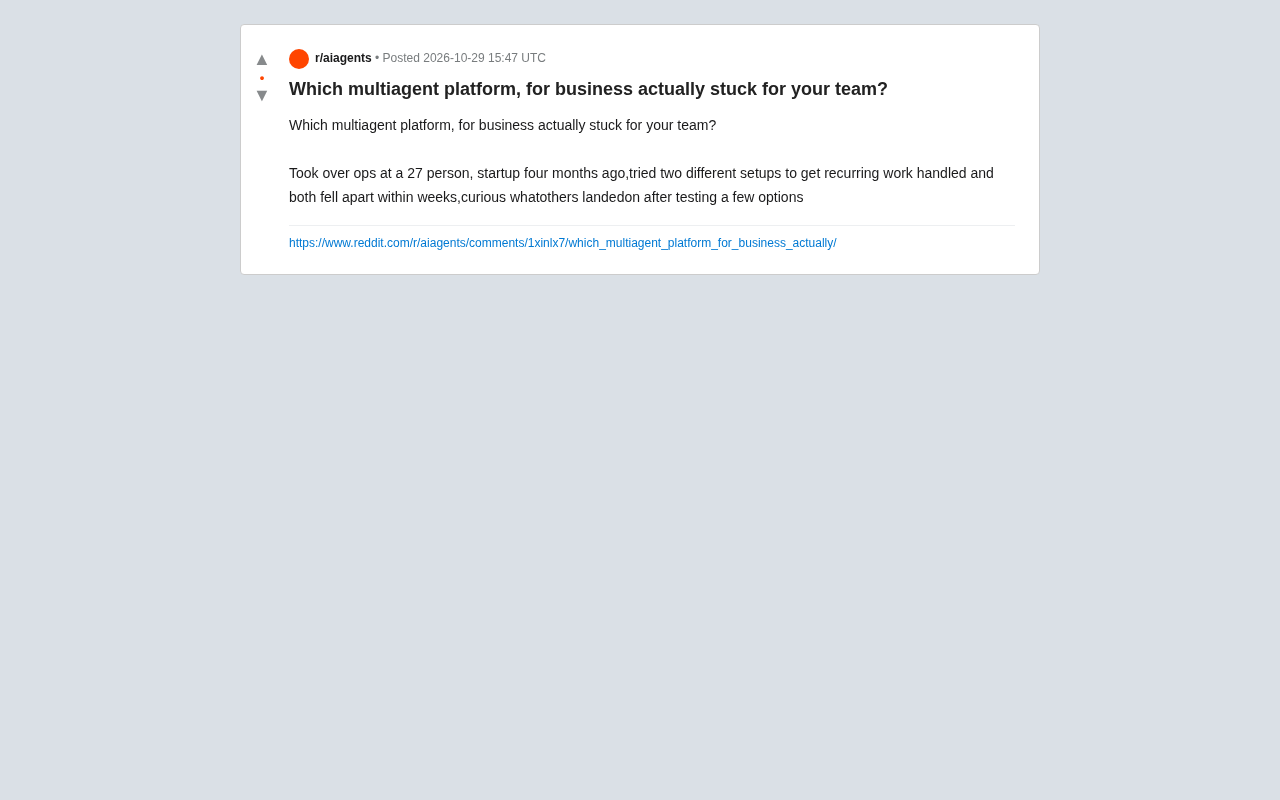
Which Multi-Agent Platform Wins? A Small Team's Battle Scars and Selection Considerations
A 27-person startup's ops lead tried two multi-agent platforms in four months and both failed. This article analyzes why small-team deployments break down, and offers selection guidance on integration depth, observability, and progressive rollout.

Thrive Holdings Takes ADT Private in $7.6 Billion Deal
Thrive Holdings acquires ADT for $7.6 billion in an all-cash take-private deal expected to close in Q1 2027. Analysis of the deal structure, ADT's asset value, and impact on the smart home security industry.