Zed Editor Releases v1.24.4 Update
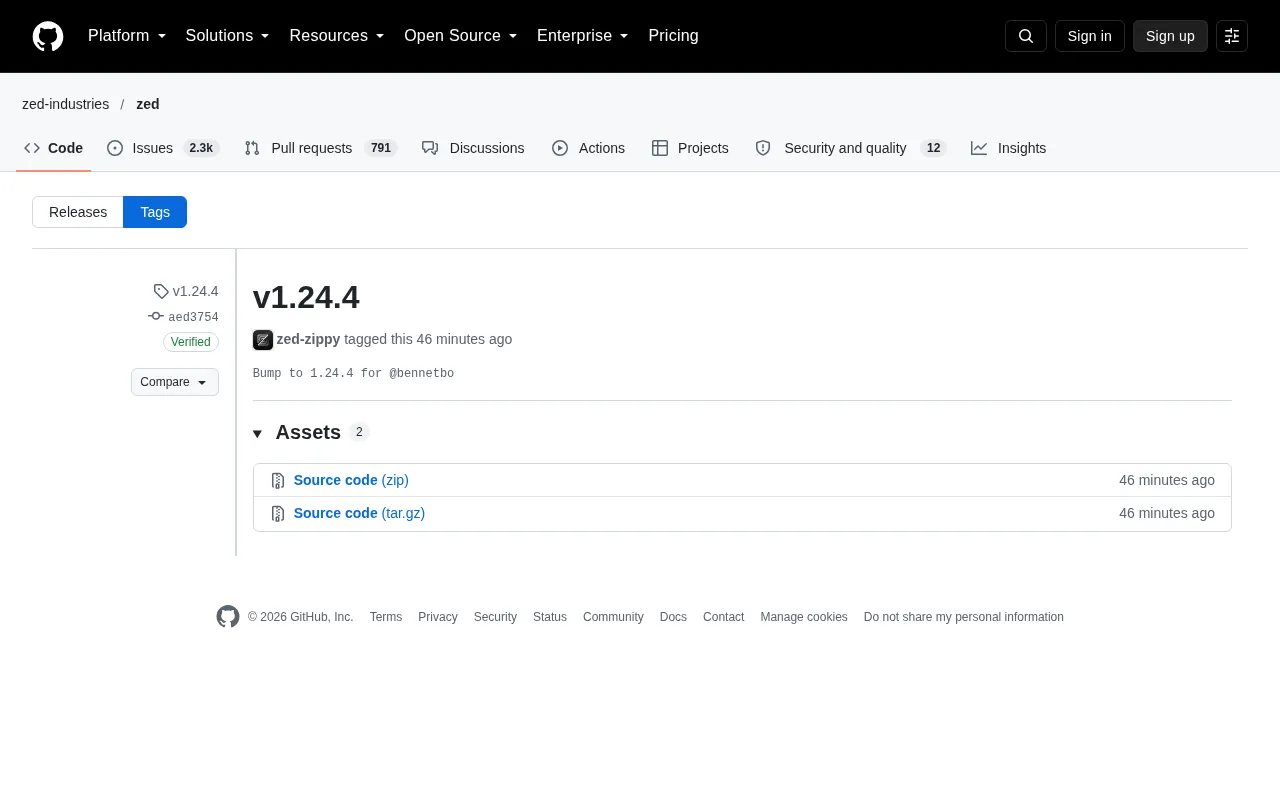
Zed editor releases v1.24.4 routine maintenance version, led by @bennetbo.
Zed editor released version v1.24.4, led by developer @bennetbo, with the commit message "Bump to 1.24.4," representing a maintenance release that increments the version number. The version was tagged on October 20 with commit hash aed3754 and has passed GitHub signature verification with GPG key ID B5690EEEBB952194, indicating an officially certified legitimate release. The article notes that a small patch number increment usually means bug fixes, performance optimizations, or minor improvements rather than major feature changes. Although specific technical details have not been fully disclosed, the regular release cadence reflects active project maintenance, and developers are advised to keep the editor updated for better stability and experience.
Version Update Overview
The Zed editor recently released version v1.24.4, led by developer @bennetbo. According to the GitHub commit history, this update is a routine version iteration with the commit message "Bump to 1.24.4," representing a maintenance release that increments the version number.
Semantic Versioning and Patch Number Increment: The version number format adopted by Zed roughly follows the Semantic Versioning (SemVer) approach, namely major.minor.patch. An increment of the patch number (the third digit) typically corresponds to backward-compatible bug fixes, security patches, or internal maintenance changes, without introducing breaking API changes or major new features. Therefore, the small jump from v1.24.3 to v1.24.4 generally indicates a release focused on stability and issue fixes, consistent with the article's characterization as a "routine version iteration" and "maintenance release."
Update Content and Background
According to GitHub tag information, version v1.24.4 was tagged on October 20, with a commit hash of aed3754. This commit has a GitHub-verified signature with GPG key ID B5690EEEBB952194, indicating that it is an officially certified and legitimate release.
One detail worth noting: a small increment in version number usually means the update may include bug fixes, performance optimizations, or minor feature improvements rather than major feature changes. For Zed editor users, such maintenance updates help improve the stability and experience of daily use.
Commit Hash and Git Identifiers: In Git, each commit is uniquely identified by a SHA-1 (some repositories have migrated to SHA-256) hash value. For example, the aed3754 mentioned in the article is merely an abbreviated form of the full 40-character hash. Git uses short hashes by default when displaying logs, tags, or commit messages because they are sufficient to uniquely distinguish commits within the current repository while being easier to read and reference. The full hash allows precise checkout of a specific commit, tracing the source of code changes, or referencing the code snapshot corresponding to a particular version in issues and release notes.
GPG Signing and Commit Verification: Git supports cryptographic signing of commits and tags using GPG (GNU Privacy Guard), where the signature binds the commit content to the signer's private key. A verifier only needs the corresponding public key to confirm that the commit was indeed created by the key holder and that the content has not been tampered with after signing. GitHub marks verified commits as "Verified" in the interface and displays the key ID (such as B5690EEEBB952194). This mechanism helps prevent supply chain attacks and forged commits, and is a common security practice in modern open-source project release workflows.
Significance for Developers
As a modern code editor, Zed's rapid iteration pace reflects the development team's commitment to continuous product improvement. Although the specific technical details of this update have not been fully disclosed, the regularity of version releases indicates that project maintenance is active. Developers can follow up on detailed changelogs to learn about specific fixes and improvements.
For users who use Zed for daily development, it is recommended to keep the editor updated to the latest version to obtain the best performance and stability experience.
Related articles

Gemini 4 Carbon Tops Global Rankings as AI Productivity and Open-Source Ecosystems Surge
Google DeepMind's Gemini 4 Carbon tops global benchmarks, built for complex agents and system security. ByteDance launches Doubao Work integrated with Feishu, Anthropic's AI autonomously breaches 5 system-level attack chains, and ModelBest and Fudan open-source on-device multimodal and image generation models.

Overseas Creator Breaks Down N8n AI Agent Business Playbook: From Tooling to Monetization
An overseas creator breaks down the N8n AI agent business playbook: comparing Zapier, Make, and N8n, detailing four monetizable automation categories—lead capture, WhatsApp follow-up, booking, and content pipelines—plus agency pricing and a sales playbook.

Empacer: The Voice-First AI Assistant for Small Business Owners That Topped Product Hunt
Empacer is a voice-first AI assistant for small business owners: three-question setup, voice requests turned into customer replies, social posts, and invoices—all owner-approved. It won #1 Product of the Day on Product Hunt with 231 upvotes and 47 comments.