Zed Editor Releases v1.25.2 Update

Zed editor releases v1.25.2 maintenance version with bug fixes and minor improvements.
Zed editor released v1.25.2, a maintenance patch update submitted by @JosephTLyons with commit hash d25fa01, passing GitHub's GPG verification. As a semantic patch version, it mainly contains bug fixes and minor improvements; developers should check the official changelog for full details.
Zed editor has recently released v1.25.2, a maintenance update. According to the release information on GitHub, this version was submitted by developer @JosephTLyons and passed GitHub's verified signature.
Release Details
v1.25.2 was released on GitHub as a tag, with commit hash d25fa01. The commit was created by GitHub.com with a verified signature, GPG key ID B5690EEEBB952194. The release page shows the tag was marked by zed-zippy on October 21 at 20:01.
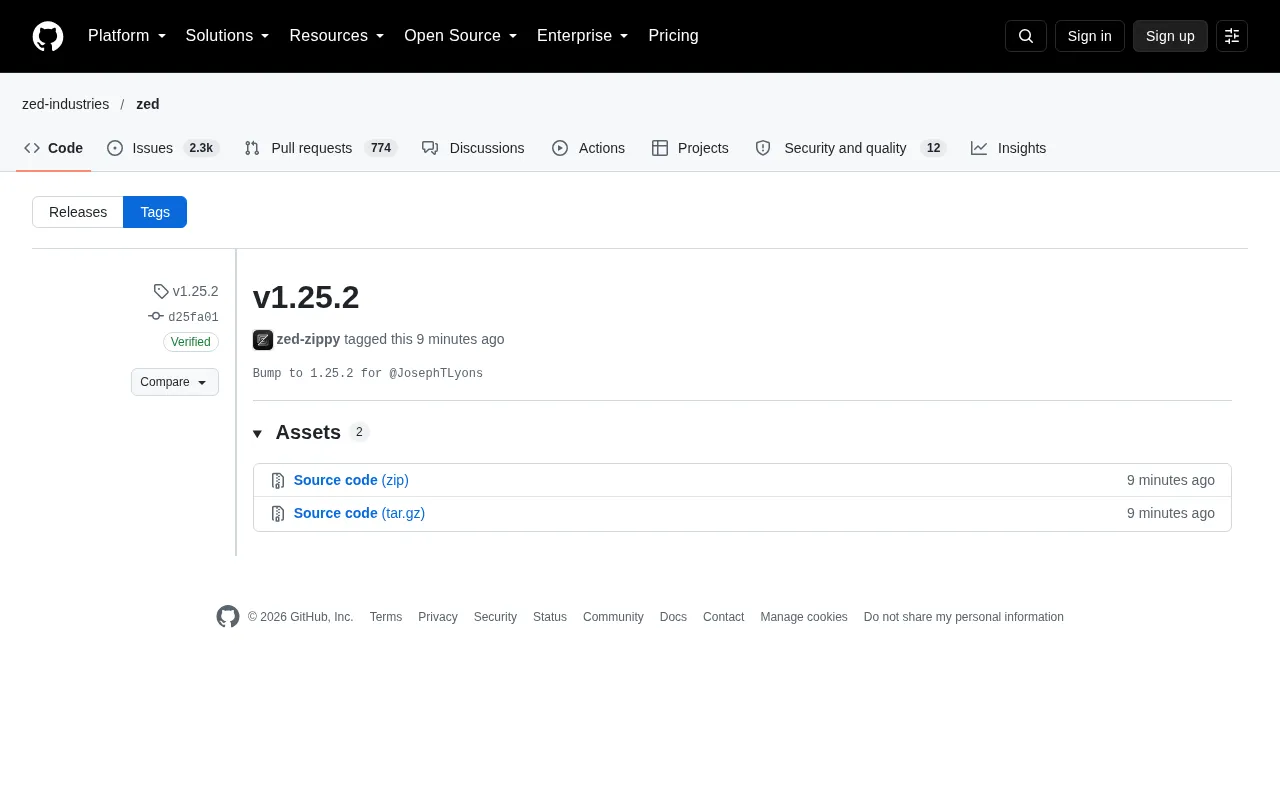
Git Tag is a reference in Git used to mark a specific commit, typically pointing to a release point. Unlike branches, tags do not move with new commits, making them suitable for identifying fixed versions like v1.25.2. GitHub's release feature is created based on tags and automatically displays the commit hash the tag points to (e.g., d25fa01).
Commit hash is the SHA-1 digest Git calculates for each commit's content, used to uniquely identify the code state. The seven-character short hash d25fa01 is an abbreviation of the full hash, sufficient to locate the commit in the repository.
GPG signature verification is GitHub's commit signature verification mechanism. Developers sign commits with a private key, and GitHub verifies with the corresponding public key, displaying a "Verified" badge upon success. The GPG key ID B5690EEEBB952194 mentioned here is used for this verification, confirming the commit was indeed created by GitHub.com and has not been tampered with.
Update Nature and Impact
Judging from the version number, v1.25.2 is a patch version, typically containing bug fixes, performance optimizations, or minor improvements rather than major feature updates. Given the limited original information, specific fixes are not detailed in the release notes.
For developers using the Zed editor, it is recommended to follow the official repository's changelog for the complete list of changes. Such maintenance releases are generally aimed at improving stability and user experience.
Semantic Versioning (SemVer) stipulates the version number format as "major.minor.patch". An increment in the patch number (such as the final 2 in v1.25.2) indicates that only backward-compatible bug fixes are included, with no new features or breaking changes introduced. This is consistent with the judgment in this article that the version is a maintenance update. Zed adopting such a versioning strategy helps users anticipate upgrade risks: patch versions can usually be updated safely.
Release Notes are the change records provided by a project on its release page, typically listing fixed issues, new features, and known issues. When release notes are missing or brief, users can use GitHub's commit history or comparison view (e.g., v1.25.1...v1.25.2) to view all commits between two releases, thereby obtaining the complete list of changes.
Summary
Zed v1.25.2 is a small maintenance release, reflecting the project's continuous iterative maintenance. Users can obtain the latest version through the GitHub release page.
One-line Summary
Zed editor releases v1.25.2 maintenance version with bug fixes and minor improvements.
Paragraph Summary
Zed editor has released v1.25.2, a maintenance patch update. This version was submitted by developer @JosephTLyons with commit hash d25fa01 and passed GitHub's GPG signature verification. The release page shows the tag was marked by zed-zippy on October 21. Judging from the semantic version number, v1.25.2 mainly contains bug fixes, performance optimizations, or minor improvements rather than major feature updates. Since the release notes do not detail specific fixes, developers are advised to follow the official repository's changelog or commit history for the complete list of changes. Overall, this version reflects the project's continuous iterative maintenance, aimed at improving stability and user experience.
Related articles

world2vec: Building Mechanistic World Models with Latent Dynamics Learning
world2vec proposes a reward-free method for learning mechanistic world models via latent dynamics, faithfully reproducing systems over long horizons with at least an order of magnitude fewer parameters than DreamerV3, TD-MPC2, and LeWM, and achieving accurate system identification on 71 attractor benchmarks.

A New KL-DRO Paradigm: Adaptive Scenario Generation Around a Learned Density Model
KL-DRO research proposes centering the KL ball on a learned density model instead of the empirical distribution, with adaptive scenario generation guiding sampling toward the worst case. Experiments show lower cost under distribution shift when records are scarce and the model can extrapolate, with comparable in-distribution cost.

ODE Samplers for Discrete Diffusion Models: Exponential Residual Flows Accelerate Generation
Discrete diffusion models lack deterministic ODE sampling? This article introduces Exponential Residual Flows (ERFs), which introduce continuous residual variables per token to construct piecewise ODEs for deterministic sampling and support consistency distillation acceleration. Superior to prior methods on code and text generation tasks.