Zipline Valued at $21.5 Billion: Walmart Doubles Down on Drone Delivery

Zipline raises $1.5B at a $21.5B valuation and expands its Walmart partnership, signaling drone delivery's move toward commercial scale.
Zipline has raised $1.5 billion at a $21.5 billion valuation while expanding its drone delivery partnership with Walmart. The article argues this marks drone delivery's shift from technology demos to large-scale commercial deployment. The capital bet centers on a replicable delivery network: denser takeoff and landing points and more mature routes mean lower marginal costs per flight. Walmart's expanded bet reflects drones' value in covering the last few kilometers with flexible fulfillment in remote and congested scenarios. Airspace approvals and route permit pacing become key competitive variables. The article cautions that valuations reflect expectations, not reality—facility siting, weather reliability, and idle capacity remain hurdles, and whether funding converts into actual network expansion speed is most worth tracking.
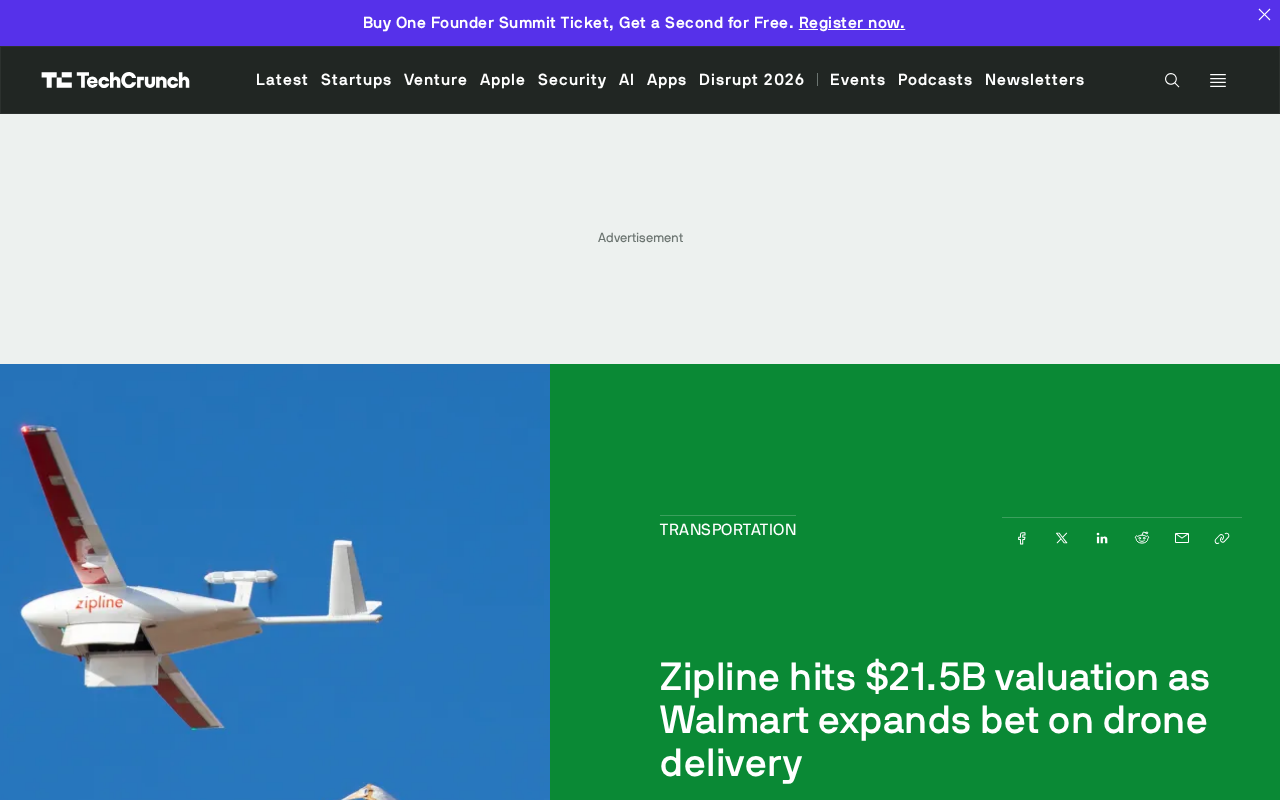
Drone delivery company Zipline has raised $1.5 billion in funding at a $21.5 billion valuation while expanding its partnership with Walmart. The news sends a clear signal: drone delivery is moving from the technology demo stage toward large-scale commercial deployment, and retail giants are betting their fulfillment infrastructure on the skies.
Funding and Valuation: Why Capital Keeps Pouring In
A single $1.5 billion round is unusual in today's hard-tech sector. The fact that Zipline secured this funding while its valuation was pushed up to $21.5 billion shows investors aren't betting on a single product but on a replicable delivery network.
The long-standing skepticism around drone delivery centers on the unit economics—whether the per-order cost can be driven below that of ground delivery. Zipline's approach is to first close the loop on high-value, time-sensitive categories, then expand into more everyday scenarios. Capital's willingness to place a heavy bet at this stage is essentially a wager on the network's economies of scale: the denser the takeoff and landing points and the more mature the flight routes, the lower the marginal cost of each flight.
Unit economics is the key framework for assessing whether a delivery business can sustain itself. At its core, it breaks down the revenue and costs of each order: on the revenue side are delivery fees and product markups; on the cost side are vehicle depreciation, energy, operations labor, insurance, and airspace compliance costs. A business can only sustain itself when per-order revenue consistently exceeds per-order variable costs and, after covering fixed investments, can also cover capital expenditures. What makes drone delivery special is that fixed costs (takeoff and landing points, fleet, route approvals) account for a high share, while variable costs (electricity consumption and wear per flight) are relatively low—so order density directly determines whether the unit cost curve can trend downward. This is the underlying logic behind capital's bet on economies of scale.
What Walmart's Expanded Bet Means
Walmart's expansion of its partnership with Zipline is the more noteworthy part of this news. Retailers have always been pragmatic about choosing delivery methods—only when time efficiency, cost, and reliability all hold up will they move a partnership from pilot to standard operations.
For Walmart, drone delivery fills the toughest stretch of the "last few kilometers"—in remote areas and traffic-congested scenarios, ground delivery capacity drops off markedly. Handing some orders to aerial capacity amounts to layering a flexible fulfillment capability on top of the existing store network. Once this partnership scales, it will directly change the cost structure of retail delivery and put pressure on other retailers to follow suit.
Last mile refers to the stretch of the journey where goods travel from the final fulfillment node (store, forward warehouse, or delivery station) to the consumer. It typically accounts for only a small fraction of total transport distance yet represents a large share of overall logistics costs. The difficulty lies in highly dispersed orders, small per-trip payloads, routes that are hard to consolidate, and the strictest time requirements. In remote areas, road networks are sparse and one-way distances are long; in congested urban areas, traffic and parking conditions constrain operations—ground delivery efficiency drops significantly in both cases. Drones, with their straight-line flight and immunity to road congestion, hold a structural advantage in these two scenarios, which is why retailers are willing to entrust this most challenging fulfillment link to aerial capacity.
Competitive Landscape of the Drone Delivery Sector
Zipline's funding scale has raised the bar for the sector. Drone delivery isn't purely a hardware business—it involves airspace approvals, route planning, ground takeoff and landing facilities, and operations systems, each requiring long-term investment. Players with smaller capital bases will struggle to roll out networks across multiple cities simultaneously, and industry consolidation is likely to continue.
The key variable in competition is the pace of regulation. The degree of airspace openness determines how many people a single route can cover and how fast unit costs can fall. Whoever can secure more route permits faster within the compliance framework will gain the edge in the scale race. Zipline's partnership with Walmart itself serves as a credit endorsement, helping it advance approval negotiations in more regions.
Beyond Visual Line of Sight (BVLOS) is the regulatory prerequisite for scaling drone delivery. It refers to operators conducting missions without relying on direct visual observation of the aircraft, typically relying on sense-and-avoid systems, ground radar, and remote monitoring to ensure safety. Early regulations in most countries required drones to remain within the operator's line of sight, severely limiting the coverage radius and serviceable population of a single route. Regulators opening up BVLOS operations and allowing a single operator to simultaneously supervise multiple aircraft is the key threshold for a delivery network to move from single-point demos to multi-city replication. The pace of approvals therefore directly determines route density and, in turn, the speed at which unit costs fall.
Hurdles Still to Clear for Large-Scale Deployment
Valuations and funding figures reflect expectations, not realized reality. For drone delivery to truly become a mainstream fulfillment method, several hurdles remain: site selection and community acceptance for takeoff and landing facilities, reliability in adverse weather, and idle capacity during periods of low order density.
Walmart's expanded partnership provides a real high-frequency scenario, which is a boon for Zipline in refining its operating model. But going from a single-point partnership to multi-region replication will multiply operational complexity. Whether this funding can translate into actual network expansion speed is the most important metric to track going forward.
Directions Worth Watching
For industry observers, Zipline's next moves are more informative than its valuation figure: the pace of new takeoff and landing points, the geographic scope of its Walmart partnership, and whether it opens delivery to more product categories. These details will show how far drone delivery is from becoming everyday infrastructure.
For retail and logistics professionals, the signal from this funding round is clear—aerial capacity is becoming a component that must be seriously planned within fulfillment systems, not an option that stays at the concept stage.
One-line Summary
Zipline raises $1.5 billion at a $21.5 billion valuation and expands its Walmart partnership, marking drone delivery's move toward large-scale commercial deployment.
Paragraph Summary
Zipline has raised $1.5 billion at a $21.5 billion valuation while expanding its drone delivery partnership with Walmart. The article argues this marks drone delivery's transition from technology demos to large-scale commercial deployment. The core logic behind the capital bet isn't a single product but a replicable delivery network: the denser the takeoff and landing points and the more mature the routes, the lower the marginal cost per flight. Walmart's expanded bet reflects the value of drones in covering the last few kilometers with flexible fulfillment in remote areas and congested scenarios. The sector's bar has risen accordingly, with airspace approvals and route permit pacing becoming key competitive variables. The article also cautions that valuations reflect expectations rather than reality—facility siting, adverse-weather reliability, and idle capacity remain hurdles to scale, and whether funding translates into actual network expansion speed is what's most worth tracking.
Related articles
 Tech Frontiers
Gemini Omni 1.2 Flash: AI Video Moves Toward Draft-Style Editing
Google's Gemini Omni 1.2 Flash update enables conversational, draft-style editing of the same video—swap scenes while keeping products, adjust lighting while keeping characters. Clips up to 15s, 720p costs 30% less than the previous Flash—ideal for e-commerce ads, previs, and short-asset production.

Codex Tutorial: One-Command Install and Run Your First Task
Codex tutorial: one-command install and run your first task. Covers the four Codex forms, sandbox and approval guardrails, AGENTS.md and MCP configs, cloud network policy, and the iron rule of human review—everything you need to get started with this autonomous coding agent.
 Tech Frontiers
Localix: An Open-Source Agentic Development Environment with Multi-Model and Local AI Integration
Localix is an MIT open-source Agentic Development Environment (ADE) supporting seamless Claude Code plugin loading, multi-model cloud and local execution, Mini Apps extensions, and agent context management—an open AI collaboration workbench for developers.