#FinOps
8 related articles

Five Cloud Computing Trends for 2027: Agentic AI and AI-Optimized Infrastructure Lead the Way
Five cloud computing trends for 2027: Agentic AI autonomous operations, AI-optimized infrastructure, hybrid cloud and data sovereignty, platform engineering, and FinOps.

9 Apple Relay Accounts Drain $1,900: Architecture for Preventing AI Free-Tier Abuse
A breakdown of a real case where 9 Apple Private Relay accounts drained $1,900 in AI trial credits, analyzing the race-condition vulnerability in post-hoc accounting, plus implementation points and boundaries of a three-layer anti-abuse architecture: atomic Redis Lua pre-authorization, hardware/subnet fingerprinting, and Stripe card-fingerprint Step-Up.
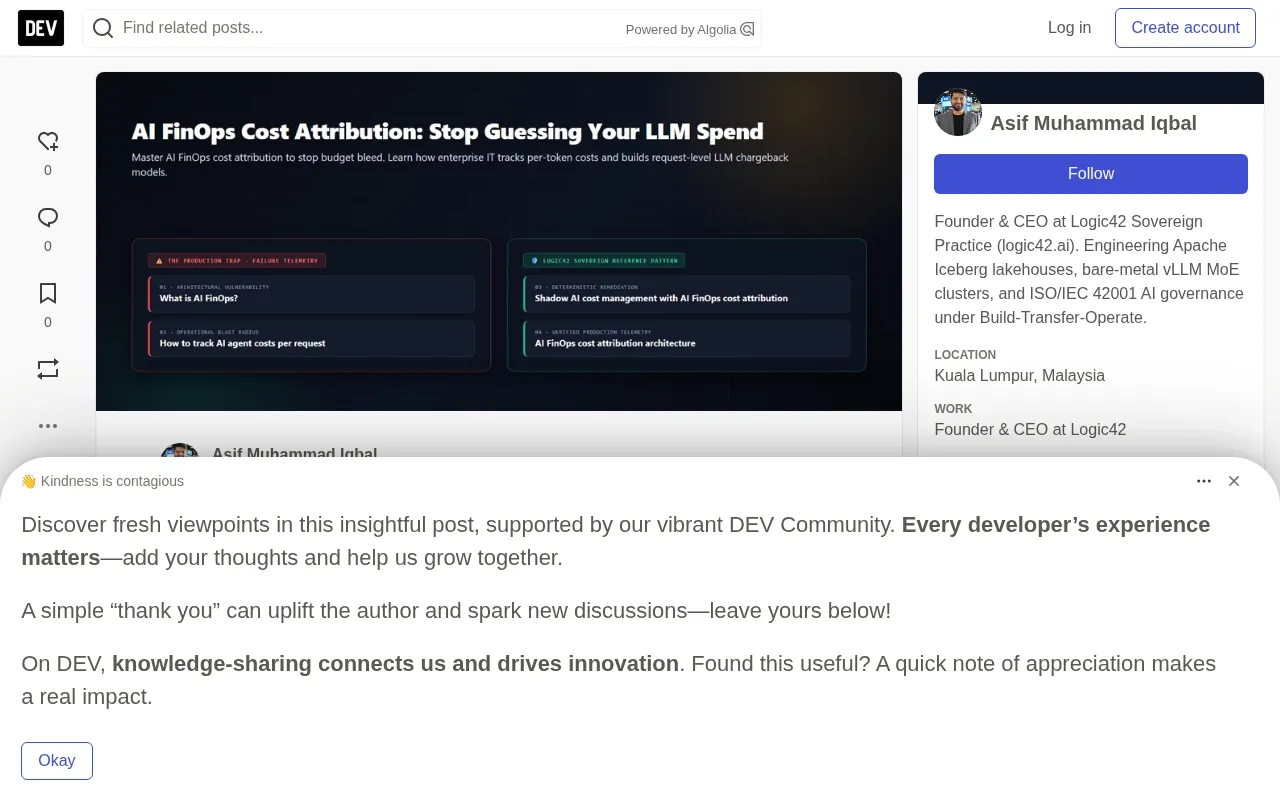
AI FinOps Cost Attribution: Stop Guessing Your LLM Spend
A practical guide to AI FinOps cost attribution: use API gateway correlation ID injection, OpenTelemetry telemetry, and token-level pricing mapping to trace LLM spend to each business request, solving budget overruns from shadow AI and super adopters.

GPU Repatriation: How Private Clusters Beat Cloud Giants and Save Millions
When cloud GPU annual rental costs exceed self-owned hardware costs, GPU repatriation becomes the rational choice. Logic42 breaks down the 65% utilization rule, 3-year TCO comparison, and private cluster engineering prerequisites based on a real enterprise model, revealing how private colocation saves $288K over cloud reserved instances.

The VRAM Parking Problem: Eliminating the 60% Idle GPU Tax
The VRAM parking problem leaves enterprise GPU utilization at just 25%, wasting $160K per node annually. This article dissects the static weight allocation trap and presents three engineering rules—Multi-LoRA shared backbones, sub-second NVMe weight streaming, and time-sharing batch arbitrage—to raise compute efficiency from 25% to over 85%.

AI Agent Risk Mitigation: WarderBox's Security and Cost Governance Solution
WarderBox v0.3.1 is an open-source AI agent security and FinOps framework that prevents data loss, cost overruns, and compliance risks in production through risk classification, budget constraints, intelligent routing, and state rollback.

Azure Savings Plans for Databases: How Flexible Spending Commitments Cut Database Costs
Azure Savings Plans for Databases offers flexible hourly spend commitments with no service or region lock-in. Learn how it works, billing logic, and when to use it vs. Azure Reservations.
 Industry Insights
AI Agent Token Consumption Out of Control: Budget Crises and Response Strategies from 15 Enterprises
AI Agent token consumption is growing exponentially beyond enterprise budgets. Based on 15 real cases, this article analyzes cost overrun causes and provides strategies including model tiering, semantic caching, and token governance.