#NLP
10 related articles

Seq2Seq Model Only Predicts Padding Tokens? Common Causes and Fixes
Seq2seq models predicting only padding tokens is a classic beginner mistake. Learn the root causes — unmasked loss, data imbalance — and fixes like loss masking and teacher forcing.

The Price of Token Boundaries: Quantifying the Trade-off Between Compression Efficiency and Prediction Quality
New arXiv paper quantifies the cost of tokenization boundaries: boundary rules increase optimal token counts by 28.3–36.8% on English Wikipedia, and BPE sits 10.9% above the unconstrained lower bound. Compression and prediction favor different vocabularies.

Text Classification Models Evolved: A Visual Journey from Bag-of-Words to Transformers
From Bag-of-Words to RNN, CNN, and Transformers, this article visually traces the evolution of text classification models and explores accuracy, efficiency, and calibration tradeoffs.

A Sober Look at TypeSafe AI's Jev: Genuine Architecture or Overhyped?
A veteran NLP practitioner argues that TypeSafe AI's Jev looks more like an improvement on existing classifiers and language models than a brand-new AI paradigm — and that key architectural details and independent benchmarks are still missing.

Stop Removing Stopwords: How an Inherited Preprocessing Default Distorts Legal Text Data Analysis
A new arXiv paper uses exhaustive single-word ablation to show that removing stopwords in interpretable legal text analysis hurts rather than helps, distorting jurisprudential and ideological signals.

ARR August Cycle Discussion: Review Quality, Result Timing, and Rebuttal Period Changes
A deep dive into Reddit discussions on ARR's August cycle: review quality polarization, uncertain result timelines, and the rebuttal period extended from 6–7 days to 10 days.
 Tutorials
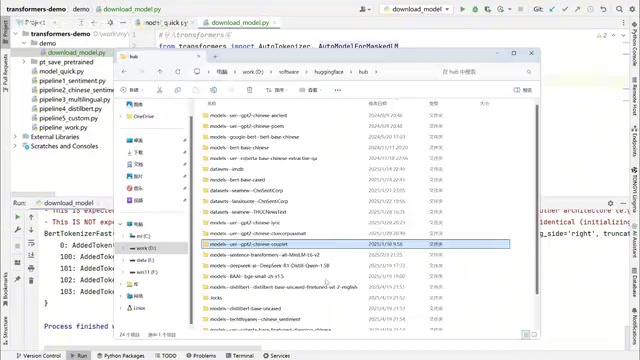
HuggingFace Transformers Beginner's Guide: Model Download, Pipeline Inference, Training & Saving
Learn HuggingFace Transformers core usage: pretrained model download, Pipeline API for sentiment analysis, Tokenizer principles, model inference with Softmax, and saving workflows with Python examples.
 Tutorials
Hugging Face Transformers: Deep Dive & Practical Guide to the 160K-Star AI Model Framework
Deep dive into Hugging Face Transformers: core features, multi-framework support, 500K+ pretrained models, full-modality task coverage, and hands-on code examples to build AI apps efficiently.
 Tutorials
Hugging Face Transformers: The Secret Behind 160K Stars & A Practical Guide
Deep dive into Hugging Face Transformers: the open-source framework with 160K GitHub Stars. Covers full-modality model support, pipeline API, Hub ecosystem, and community mechanisms driving AI democratization.
 Product Reviews
Hugging Face Transformers: A Deep Dive into the AI Open-Source Framework Behind 160K Stars
Deep dive into Hugging Face Transformers: core features, Pipeline API usage, ecosystem synergy, large model support, and future challenges of this 160K-star AI framework.