A Week of Seismic Shifts in AI: The Compute Race, Model Price Wars, and Robotics Breakthroughs

AI advances on all fronts this week: compute, open-source models, AI agents, and robotics accelerate real-world adoption.
Five major AI events this week: Anthropic partnered with SpaceX to solve compute bottlenecks, OpenAI released the more reliable GPT 5.5 Instant, Google secretly tested its always-on AI agent Rimi, DeepSeek V4 challenged closed-source giants with open-source at a fraction of the cost, and Chinese humanoid robots achieved dual breakthroughs in precision and power. Together, these events signal AI's acceleration from the technology demonstration phase into real-world application and industrial transformation.
This week saw several blockbuster events in AI: Anthropic partnering with SpaceX for compute access, OpenAI releasing GPT 5.5 Instant, Google secretly testing an AI agent called Rimi, DeepSeek V4 challenging closed-source giants at a fraction of the cost, and Chinese humanoid robots demonstrating stunning capabilities. While these events may seem unrelated, together they paint a picture of the deep transformation sweeping through the AI industry.
Anthropic Teams Up with SpaceX: Compute Is the Real Battleground
Anthropic made a surprising move — partnering with Elon Musk's SpaceX to access the Colossus data center in Memphis, Tennessee. This supercomputing facility houses 220,000 NVIDIA GPUs powered by 300 megawatts of electricity — enough to supply a small city.
The immediate impact: Claude Code usage limits have doubled, Pro and Max users will no longer face peak-hour restrictions, and Claude Opus API quotas have increased significantly. For users plagued by "usage limit reached" messages, this is welcome news.
Even more noteworthy is the long-term vision outlined in the agreement — building AI data centers in space. SpaceX plans to launch satellites capable of running AI computations, powered by solar energy. Given that Musk simultaneously owns SpaceX and xAI (a direct competitor to Claude), this "compete and cooperate" dynamic makes the AI race all the more intriguing. Musk's response? "Nobody's triggering my evil detector" — when business interests align, competitive tensions can be set aside.
Key takeaway: AI's bottleneck is no longer algorithms — it's power and chips. Whoever controls more compute controls the competitive advantage.
GPT 5.5 Instant: From "More Powerful" to "More Reliable"
OpenAI upgraded ChatGPT's default model to GPT 5.5 Instant, but this time the focus isn't on being "more powerful" — it's on being "more reliable."
In internal testing, GPT 5.5 Instant reduced hallucinations by 52.5% compared to its predecessor, with significantly fewer errors in high-stakes domains like healthcare, law, and finance. The response style has also changed — roughly 30% fewer words, 29% fewer paragraphs, but higher information density.

Personalization is another major highlight. GPT 5.5 Instant can leverage past conversations and file context, and with user authorization, connect to Gmail — no need to start from scratch every time. This marks AI's transition from "search tool" to "daily assistant" — it doesn't just answer questions, it understands your preferences, project progress, and work habits.
Google Rimi: The Ambition of an Always-On AI Agent
Google is secretly testing an AI agent called Rimi, described in internal documents as "an always-on personal agent covering work, learning, and daily life." Unlike ordinary chatbots, Rimi integrates with over a dozen apps — Gmail, Google Calendar, Docs, Drive, WhatsApp, Spotify, and even GitHub — weaving a user's entire digital life together.
Reportedly, Rimi can send messages on your behalf, share documents, and even make online purchases. More critically, it runs silently in the background, learning user habits and proactively anticipating needs before you even ask. Compared to Meta's Hatch (built into Instagram, primarily for shopping assistance), Rimi's scope is far broader.
The real test comes on May 19 at Google I/O — whether Rimi officially launches will determine Google's position in the AI agent race.
DeepSeek V4: Open-Source Models Ignite a Price War
The release of DeepSeek V4 is arguably the most disruptive event of the week. This model — with 1.6 trillion parameters and a 1-million-token context window — matches Claude Opus and Gemini Pro on multiple benchmarks, but at an almost unbelievably low price.

Here's the breakdown: GPT 5.5 charges about $8 per million tokens, Claude Opus about $15, while DeepSeek V4 charges just 27 cents — 30 to 50 times cheaper. On the Putnam Mathematics Competition, V4 scored a perfect 120; in a 1-million-token long-context retrieval test, V4 successfully located a specific sentence buried within, while Gemini and Claude both underperformed.
Three facts carry even greater strategic significance:
First, the team is one-fortieth the size of OpenAI's. This proves that elegant architectural design can compensate for resource disadvantages.
Second, it's fully open-source. Weights are available on Hugging Face — anyone can download, fine-tune, and deploy without API calls, usage limits, or price hike concerns.
Third, it's compatible with Huawei Ascend chips. This means that even under U.S. chip export controls, V4 can run on domestic Chinese hardware, directly challenging the assumption that "you can't compete at the AI frontier without top-tier NVIDIA hardware."

The Open-Source vs. Closed-Source Battle
At its core, this competition represents two fundamentally different business models. American AI labs follow the "closed-source moat" approach — spending billions to train models, wrapping them behind APIs, and charging per call. The open-source approach represented by DeepSeek bets on adoption — releasing models for free, letting developers worldwide build applications on top, competing not at the model layer but at the platform layer.
This strategy isn't new: Android vs. iOS, Linux vs. Windows — open-source growth is always gradual and quiet, until one day it's everywhere and paid alternatives start feeling out of place. For closed-source labs, when your entire business model depends on scarcity, and that scarcity is being eroded, it's an uncomfortable position indeed.
Chinese Humanoid Robots: Dual Breakthroughs in Precision and Power
While the AI software battle rages on, China is making stunning progress in humanoid robot hardware. Two robots represent two distinctly different technical directions.
Unitree H2: Precision and Coordination
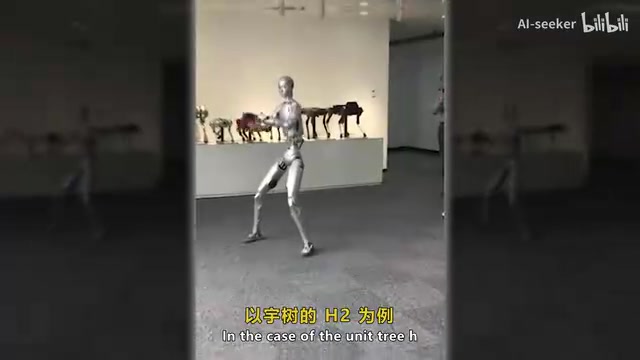
The H2, developed by Hangzhou-based Unitree Robotics, demonstrates breathtaking full-body coordination — leaping into the air, completing a full rotation mid-flight, precisely kicking a suspended watermelon, and landing steadily. The entire sequence runs at full speed with no pre-scripted movements. The key lies in its real-time motion control system, which fuses sensor data with body feedback to adjust balance and posture in real time. H2 has also demonstrated ballet spins, martial arts routines, runway walks, and even performed on China's Spring Festival Gala.
Engine AI T800: Explosive Power and Impact
The T800 from Shenzhen-based ENGINE takes a completely different approach — flying kicks, smashing through barriers, and simulated combat, all executed with crisp, high-impact movements. When internet users accused the footage of being CGI, company founder Zu Tangyang stood directly in front of the robot and let T800 deliver a kick, sending him sliding across the room while the robot remained rock-solid. Its high-torque joints deliver explosive force, while its endurance-oriented design ensures sustained operation without losing stability.
Strategic Significance of Both Approaches
H2 is suited for research, services, and scenarios requiring fine control and human-robot collaboration; T800 targets industrial production, logistics, and environments demanding greater strength and durability. China isn't limiting itself to a single technical path — it's advancing on multiple fronts simultaneously, with precision and power evolving in parallel to build a comprehensive robotics capability ecosystem.
AI Regulation Accelerates: Pre-Release Safety Reviews Become the Norm
It's worth noting that the U.S. government is also stepping in at an accelerating pace. Google DeepMind, Microsoft, and xAI have agreed to submit powerful new models to CAISI (the Center for AI Standards and Innovation) under the U.S. Department of Commerce for safety review before release, screening for cyber weapons, dangerous chemicals, biological threats, and other major risks. Combined with similar agreements previously signed by OpenAI and Anthropic, this means most AI models that everyday users interact with — Gemini, Copilot, Grok — will be subject to pre-release review.
When AI models score above 90% on bar exams, can write code, plan trips, and answer medical queries, regulatory involvement is both inevitable and necessary.
Final Thoughts
This week's events reveal several major threads in the AI industry: the compute race is reaching a fever pitch, model reliability is becoming the new focus, the open-source vs. closed-source battle is intensifying, AI agents are moving from concept to product, and robots are advancing from labs to extreme scenarios. These changes aren't happening in isolation — they all point in one direction: AI is accelerating from the technology demonstration phase into real-world application and industrial transformation.
Related articles
 Industry Insights
AI Product Development in Practice: Model Selection, Building Moats, and Paths to Commercialization
Practical strategies for AI product development: why not to train models from scratch, when to use APIs vs. fine-tuning, building product moats, and the full path from evaluation systems to commercialization.
 Industry Insights
No Product Fits Your Needs? Building It Yourself Is the Best Starting Point for Indie Developers
Can't find a product that fits? Building from personal pain points is the best entry for indie developers. Niche needs + AI tools = rapid product creation.
 Industry Insights
OpenAI Codex Tutorials Mass-Copied on Bilibili, Highlighting AI Content Farm Problem
At least 9 Bilibili accounts mass-published identical OpenAI Codex tutorial videos, exposing content farm operations in the AI tools space.