Claude Code vs OpenClaw Architecture Comparison: Deep Analysis of Two AI Agent Technical Approaches
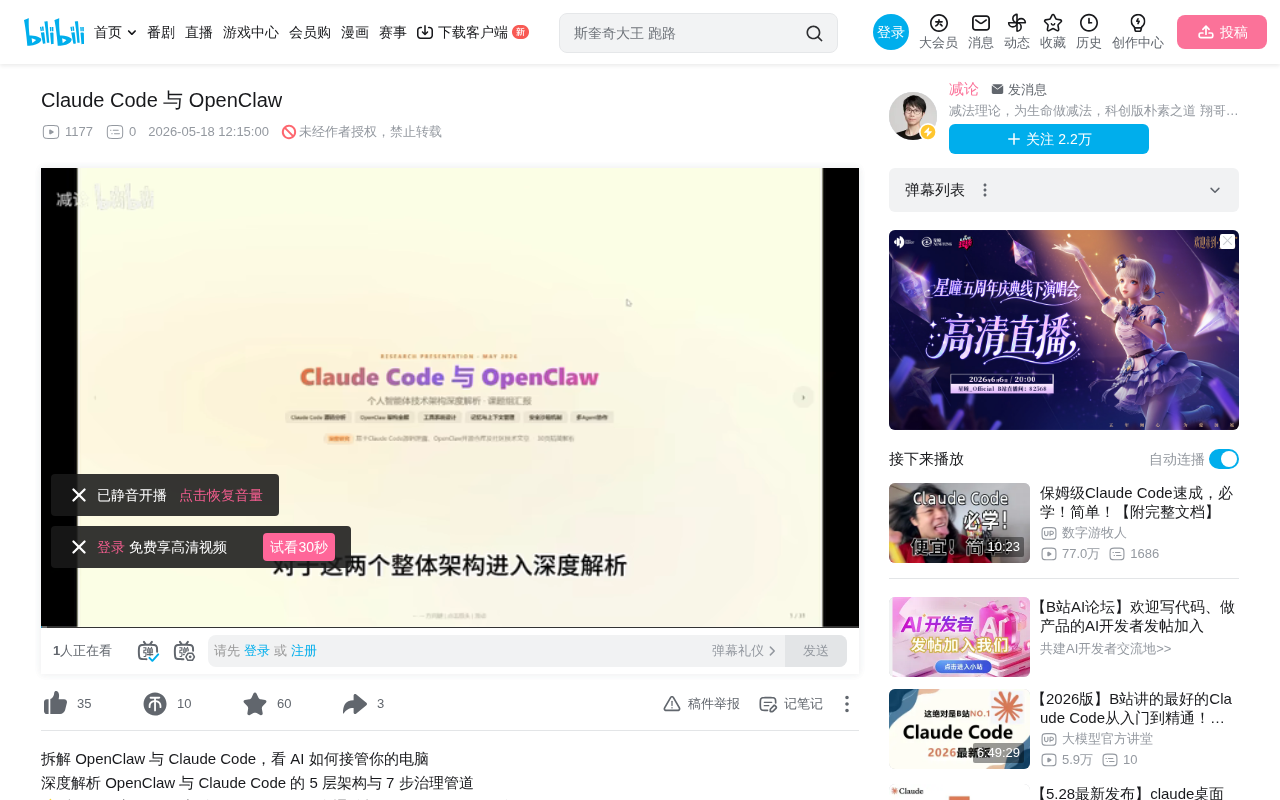
In-depth comparison of Claude Code and OpenClaw AI Agent architecture design philosophies and implementations
This article systematically analyzes the architectural designs of Claude Code and OpenClaw, two major AI Agents. Claude Code, as a professional coding Agent, employs a five-layer architecture with a TAOR autonomous loop, featuring a 14-step tool governance pipeline, seven-layer security model, and Kairos memory daemon. OpenClaw positions itself as a local-first general Agent platform, centered on a Gateway control plane, supporting multi-channel unification and a community skill ecosystem. The two differ in their approaches to tool governance, memory systems, and security mechanisms, together representing the current technical frontier of AI Agents.
Research Background: Why Focus on AI Agent Architecture
AI Agents are transitioning from proof-of-concept to production deployment. Breakthroughs in large model reasoning capabilities support complex multi-step tasks, and tool calling has become standard, giving Agents "hands and feet." The leaked Claude Code source code sparked a community research frenzy, OpenClaw surpassed 248K GitHub stars, and all of this indicates that AI agents are gradually becoming mainstream.
This article is based on a Bilibili creator's in-depth analysis of Claude Code's source code and OpenClaw's architecture, systematically examining the similarities and differences between the two in tool system design, memory and context management, security sandbox mechanisms, and multi-agent collaboration, providing a reference for understanding the current technical frontier of AI Agents.
Designing a reliable AI agent requires answering several core questions: How do you design a reliable reasoning loop? How do you make tool calls safe and controllable? How do you manage context in long conversation scenarios? How does a personal agent achieve local privacy protection?
Claude Code: Architecture Analysis of a Professional Coding Agent
Five-Layer Architecture Overview
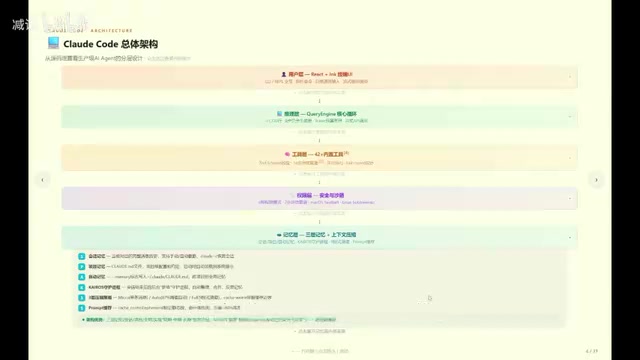
Claude Code adopts a five-layer architecture: User Layer, Reasoning Layer, Tool Layer, Permission Layer, and Memory Layer.
The User Layer uses a React + Ink terminal UI with a componentized design that can be invoked on demand. It includes 20+ slash commands (e.g., /compact triggers summary compression freeing 80% of space, /cost displays real-time token costs), and uses SSE (Server-Sent Events) for token-by-token streaming rendering, with first-token latency of only 200 milliseconds—a perceived speed improvement of roughly 10x.
The Reasoning Layer is the core loop system, employing an eight-step processing flow: load context → assemble prompt → call API → stream receive → tool parsing → execution → result injection → next loop iteration. Token budget management divides the total context window into Input, Output, and Reserve segments to prevent tokens from exceeding window limits.
TAOR Autonomous Loop Mechanism
Claude Code's overall operation can be summarized as the TAOR loop: Think → Act → Observe → Repeat.
- Think Phase: Parses user natural language input, loads project context (claude.md configuration + conversation history), analyzes task complexity to determine single-agent or multi-agent execution
- Act Phase: Parses tool_use call requests from model output, validates tool parameter legality through Zod Schema validation, employs Pre-tool Hook and Post-tool Hook dual safety hooks
- Observe Phase: Parses tool return results, integrates a "What-if Agent" that automatically runs tests, detecting anti-laziness behavior
- Repeat Phase: Feeds observation results back to the reasoning engine, forcibly terminates when max_turns limit is exceeded
14-Step Tool Governance Pipeline Explained
Claude Code includes 42+ built-in tools (Read, Write, Edit, Bash, etc.) and employs a 14-step governance pipeline to ensure each tool call goes through a complete lifecycle:
- Parsing & Validation Phase (Steps 1-4): Extract tool_use JSON blocks from the SSE stream, detect parallel execution possibilities, verify tool existence, validate JSON format through the Zod component library
- Security Check Phase (Steps 5-9): Match blacklisted commands for direct interception, permission assessment, whitelist checking, user authorization confirmation, sandbox preparation
- Result Processing Phase (Steps 10-14): Truncate output (2000 lines truncated to 250 lines), encapsulate as JSON format, record audit logs, update context
The parallel execution strategy uses Promise.allSettled—if one file read fails, it won't crash the entire call, saving up to 60% of time.
Seven-Layer Security Model and Sandbox Strategy
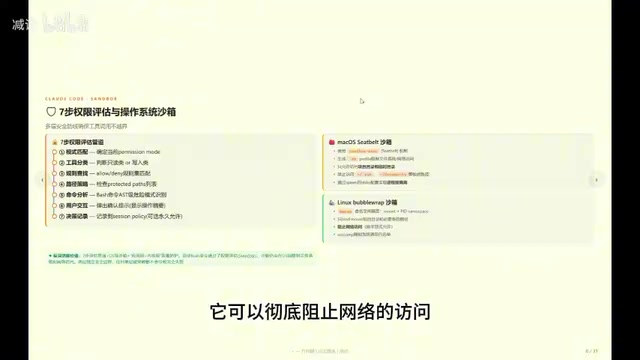
Claude Code employs six permission modes (Default → Accept Edits → Plan → Auto → Don't Ask → Bypass), ranging from strict to permissive for different scenarios. A seven-step permission evaluation pipeline ensures every operation has audit logic.
Regarding sandbox strategies:
- macOS: Uses Seatbelt sandbox, restricting file/network/process access, blocking HTTP requests from transmitting data out
- Linux: Uses Bubblewrap sandbox, completely isolating namespaces, with only whitelisted directories accessible
Defense-in-depth philosophy: Each layer is an independent security boundary—even if a single layer is breached, subsequent layers can still intercept threats.
Three-Layer Memory and Five-Layer Compression System
Claude Code employs a three-layer memory strategy:
- Session Memory: Complete history of the current conversation, supporting manual and automatic settlement
- Project Memory: claude.md files storing project configuration and conventions, automatically loaded at startup
- Auto Memory: Cross-project global memory stored in the main claude folder
Kairos Daemon is a mechanism similar to "dreaming" that runs in the background after a session ends, automatically organizing memories, merging reflections, identifying recurring patterns and solidifying them into rules. This transforms the Agent from passive memory to active learning—the more you use it, the better it understands you.
Five-layer compression system: Single message truncation → 87% threshold auto-compression → nine-section summary near 100% → cache boundary preservation → dynamic sliding window. Combined with Anthropic's Prompt Caching mechanism, this can save approximately 80% of token costs.
OpenClaw: A Local-First Agent Operating System Prototype
Core Positioning and Five-Layer Architecture
OpenClaw's distinguishing feature is its local-first, self-hosted multi-channel AI Agent framework. It's not an ordinary chatbot but a long-running Agent platform. All session states, memory files, and configurations are stored locally—outbound access only occurs when calling external models.
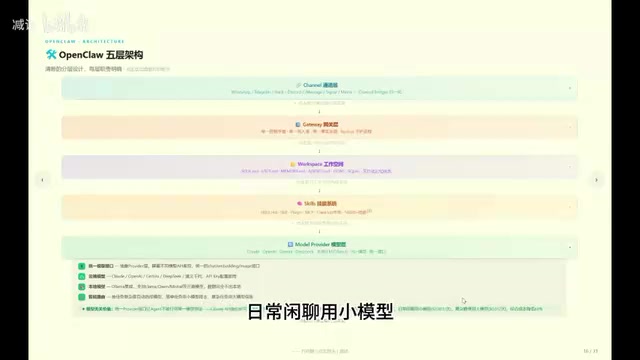
OpenClaw also has a five-layer architecture, but differs from Claude Code:
- Channel Layer: Normalizes messages from various platforms into unified internal events through Channel Bridge
- Gateway Layer: Single control plane, the system's nerve center
- Workspace Layer: Stores persona definitions, user profiles, and session records
- Skill Layer: CloudHub marketplace with 16,000+ community skills
- Model Provider Layer: Unified model interface supporting multiple providers
Gateway: The Brain of the System
The Gateway is OpenClaw's most important layer, serving three roles:
- Control Plane: All operations are coordinated by the Gateway
- Single Writer: Only the Gateway can write state and memory
- Single Source of Truth: Internal information is the established fact
This design eliminates race conditions from concurrent writes—all state changes are serialized through the Gateway, requiring no distributed locks. Stability guarantees include request rate limiting (10 messages/minute), circuit breaker (trips after 3 consecutive failures), default-deny, and complete audit trails.
Multi-Channel Unification and Memory System
OpenClaw currently supports 7+ official channels (Telegram, Discord, CLI, etc.), achieving "one soul, many faces" through a unified Channel Adapter interface—a task started in CLI can seamlessly continue in Telegram, with the Agent's persona and memory remaining consistent throughout.
The memory system uses a four-layer architecture: Current session → Daily memory → Long-term memory → Vector retrieval (Embedding + BM25 hybrid search). All memories are stored as Markdown plain text—human-readable, editable, and version-controllable.
Heartbeat Mechanism and Proactive Interaction
OpenClaw's heartbeat mechanism differs from Claude Code's Kairos daemon. Claude Code silently organizes memory when the terminal is idle, while OpenClaw emphasizes proactive user interaction—not just organizing memory, but actively pushing information and services. The two represent different dimensions of agent proactivity.
Comprehensive Comparison: Claude Code vs OpenClaw
Core Technical Architecture Differences
| Dimension | Claude Code | OpenClaw |
|---|---|---|
| Positioning | Professional Coding Agent | General Personal Agent |
| Sandbox | OS-level (more rigorous) | Application-level |
| Channels | Terminal + IDE | 7+ channels |
| Models | Claude only | Multi-model support |
| License | Commercial proprietary | MIT open source |
| Multi-Agent | Platform-determined | User-customizable |
Key Insights and Takeaways
Tool governance matters more than tool quantity: Claude Code's 14-step governance pipeline proves that safe, controllable tool calling is more important than the number of tools.
Memory is the soul of an agent: A good memory system makes the Agent understand you better over time; a poor memory system makes every conversation feel like the first meeting. Investing in memory systems is investing in the Agent's intelligent growth.
Markdown as configuration, configuration as code: Both Claude Code and OpenClaw use MD files to record memory, naturally offering human readability, version management, and collaborative editing. Future Agent customization may no longer mean writing code, but writing Markdown.
Open-source ecosystems unlock long-tail needs: Claude Code's 60+ built-in tools cover 80% of mainstream coding needs, but the remaining 20% is scattered across countless niche scenarios that only a community ecosystem can fully address.
Future Outlook: Evolution of Agent Memory and Architecture
Current Agent memory management is overly "engineered"—either users manually compress, or the agent passively triggers compression. How to achieve human-like automatic topic switching and context management (e.g., seamlessly switching from paper discussion to travel planning and back) remains an open problem. Algorithm design for automatic session switching may be a valuable direction for Agent memory research.
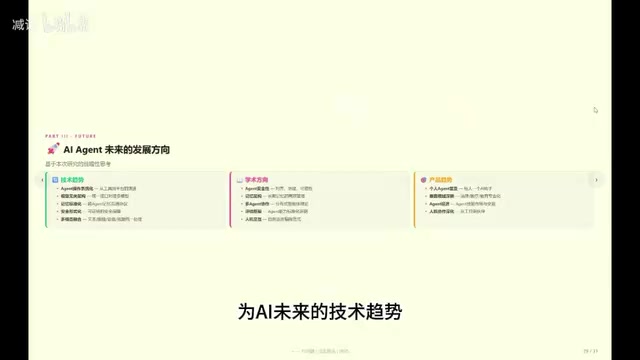
Claude Code is the pinnacle of professional coding Agents, while OpenClaw is the open-source benchmark for general personal Agents. Future AI Agents will combine the advantages of both, offering professional-grade depth alongside general-purpose scenario coverage.
Related articles
 Industry Insights
AI Product Development in Practice: Model Selection, Building Moats, and Paths to Commercialization
Practical strategies for AI product development: why not to train models from scratch, when to use APIs vs. fine-tuning, building product moats, and the full path from evaluation systems to commercialization.
 Industry Insights
No Product Fits Your Needs? Building It Yourself Is the Best Starting Point for Indie Developers
Can't find a product that fits? Building from personal pain points is the best entry for indie developers. Niche needs + AI tools = rapid product creation.
 Industry Insights
OpenAI Codex Tutorials Mass-Copied on Bilibili, Highlighting AI Content Farm Problem
At least 9 Bilibili accounts mass-published identical OpenAI Codex tutorial videos, exposing content farm operations in the AI tools space.