Cursor 3.0 Deep Dive: From Code Editor to AI Agent Command Center
Cursor 3.0 rewrites in Rust, evolving from code editor to multi-AI agent management platform
Cursor 3.0 marks a major leap in AI programming tools: completely rewritten in Rust to break free from the VS Code ecosystem, it's repositioned from a code editor to an AI agent management platform supporting multi-agent parallel workflows. Its proprietary model Composer 2 was revealed to be fine-tuned on Moonshot's Kimi KR, sparking transparency controversy. With a built-in browser preview and design mode, the developer's role shifts from "writing code" to "managing and reviewing AI agents," though code quality and security auditing face entirely new challenges.
From Copilot to Air Traffic Controller: Cursor's Three Evolutions
Cursor's development journey is a microcosm of AI programming tool evolution. In 2024, Cursor 1.0 launched as a fork of VS Code, playing the role of a "copilot" — using AI to auto-complete your code. Six months later, version 2.0 upgraded the chat interface, capable of taking over the terminal to build complete features, elevating its role to "captain."
The just-released Cursor 3.0 fundamentally changes the relationship between developers and code. It no longer expects you to write code yourself — instead, it wants you to become an "air traffic controller," simultaneously dispatching multiple AI agents working in parallel across multiple repositories, multiple machines, and even the cloud.
What's even more noteworthy is that Cursor 3.0 is no longer a fork of VS Code — it's been completely rewritten from scratch in Rust and TypeScript. To understand the significance of this decision, you need to understand VS Code's technical architecture: VS Code is built on the Electron framework, running JavaScript/TypeScript on Node.js under the hood. Electron's advantage is high cross-platform development efficiency, but the tradeoff is significant memory consumption — a blank VS Code instance typically consumes 200-400MB of memory. Cursor's early days as a VS Code "fork" meant it directly reused VS Code's codebase, quickly gaining access to a mature editor ecosystem, but also inheriting its performance bottlenecks.
Choosing to rewrite in Rust is a major engineering decision. Rust is renowned for memory safety and runtime performance approaching C, and is rapidly replacing C++ in systems programming. For an editor that needs to simultaneously manage multiple AI agents and handle massive concurrent I/O operations, Rust's zero-cost abstractions and lack of GC (garbage collection) can significantly reduce latency and memory usage. This choice also means Cursor will gradually depart from VS Code's plugin ecosystem, heading toward building its own — a double-edged sword that gains performance freedom while bearing the risk of ecosystem rebuilding.
Composer 2 Model: Impressive Yet Controversial
The core engine of Cursor 3.0 is its proprietary coding model, Composer 2. At launch, this model's performance was stunning: its intelligence level reportedly surpassed Claude Opus, at a fraction of the cost and much faster speed.
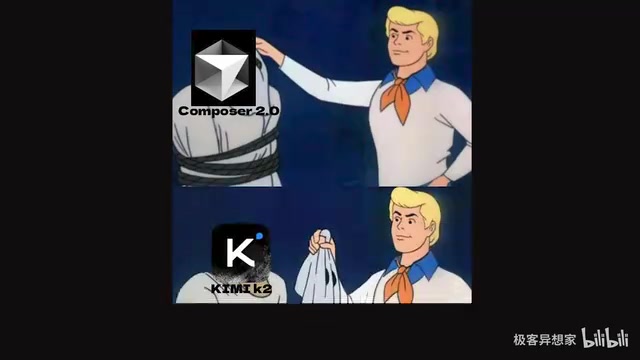
However, things quickly took a turn. Someone discovered the model ID in Composer's metadata and exposed it on social media — Composer 2 is actually based on Moonshot's Kimi KR model, not entirely proprietary. Even more interesting, Kimi itself has been accused of using Claude's outputs for training, as it occasionally says things like "Hi, I'm Claude."
To understand the technical context of this controversy, you need to know the industry norms around AI model fine-tuning. Performing targeted fine-tuning on open-source or licensed base models is the mainstream approach in the current AI industry, known as RLHF (Reinforcement Learning from Human Feedback) or domain-specific fine-tuning. The core logic is: general-purpose large models possess broad language understanding capabilities, but their performance on specific tasks (such as code generation, mathematical reasoning) can be further enhanced through specialized training data and reward signals. The reinforcement learning fine-tuning that Cursor performed on top of Kimi KR is essentially "professional training" using large volumes of high-quality programming task data, making the model perform better in scenarios like code completion and bug fixing.
However, the Composer 2 incident exposed a systemic problem in the AI tools market: when "proprietary model" becomes an important competitive advantage label, vendors' descriptions of model origins are often vague. The accusation that Kimi used Claude outputs for training (the model "memorized" Claude's self-introduction) reveals another layer of risk — training data contamination can cause models to inherit the "identity" of upstream models, which remains a gray area both legally and ethically.
Cursor subsequently apologized for the lack of transparency and published a complete technical report explaining that they performed reinforcement learning fine-tuning on top of Kimi. Objectively speaking, performing targeted optimization on open-source models is common industry practice — what matters is the end result. A smart, fast, and cheap coding model does indeed hold enormous value in the age of AI agents.
New Interface: A Workbench Built for Agents
The most visible change in Cursor 3.0 is its entirely new UI design philosophy. The old VS Code-style editor is still retained, but the new interface's focus has shifted from "editing code" to "managing agents."

This new interface integrates a professional development environment, language servers, file system, remote SSH connections, and the capabilities of multiple AI models. Developers can run any number of agents anywhere, truly realizing the positioning of "a home for agents."
Multi-Agent Parallel Workflows
Multi-Agent systems are not an original concept from Cursor — their theoretical foundation traces back to the field of distributed artificial intelligence. In software engineering scenarios, the core idea of multi-agent architecture is to decompose complex tasks into parallelizable subtasks, each handled by different AI agents, similar to the division of labor among frontend, backend, and test engineers in a software development team.
Implementing this architecture faces several key technical challenges: First is context sharing between agents — each agent needs to understand the overall project state, not just the module it's responsible for; second is conflict resolution mechanisms — when multiple agents simultaneously modify related files, merge strategies similar to Git are needed; third is the design of human-machine interaction nodes — the system needs to accurately determine when human authorization is needed and when it can make autonomous decisions.
The new interface's most powerful capability is precisely the multi-agent parallel operation based on this architecture. Using the project demonstrated in the video as an example, developers can:
- Launch an architecture planning agent: Enter planning mode and let AI design the basic architecture
- Simultaneously launch a marketing page agent: Independently develop a landing page in the background
- Remote deployment agent: Connect to a cloud server via SSH and let AI work in the remote environment
- Switch across projects: Launch new agents in completely different projects
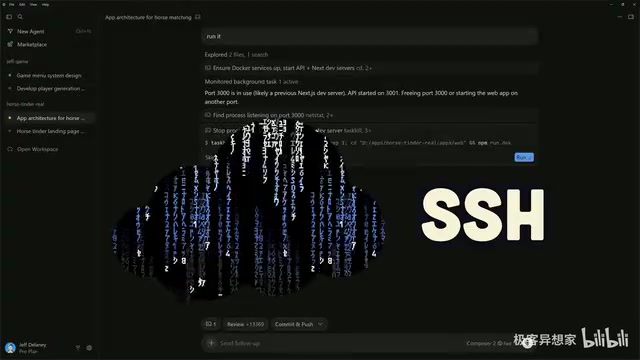
All these operations can proceed seamlessly in parallel within the same window. Each agent has clear status indicators: a yellow dot means human input is needed (usually to authorize unsafe commands), and a blue dot means work is complete and awaiting review. This color-coding system is the visual embodiment of the multi-agent human-machine collaboration mechanism — it helps developers in their "air traffic controller" role quickly identify which agents need immediate attention.
In the demonstration, 13,000 lines of code were generated within minutes. Developers can view Git history in the right panel, open the terminal, or inspect code in the minimalist file browser.
Built-in Browser and Design Mode
Cursor 3.0 includes a built-in browser preview feature, allowing developers to navigate to their application and try the final product directly within the editor. Even more practical is its "Design Mode" — when you spot a UI issue, you don't need to manually modify CSS. Simply select the element and describe the desired change in natural language, and AI will make the adjustments in the background.

You don't even need to wait for each modification to complete — you can queue up multiple fix requests in succession, and AI will process them sequentially. This workflow dramatically improves frontend development efficiency.
Controversies and Reflections: The Debate Over AI Programming's Direction
Despite the exciting capabilities Cursor 3.0 demonstrates, not everyone agrees with this direction.
Similarity to OpenAI Codex is a major point of contention. Many developers note that Cursor 3.0's multi-agent management interface is highly similar to OpenAI Codex — both adopt the core design philosophy of task queues and state management, sparking discussions about product differentiation.
Concerns about "zero-code programming" are equally worth noting. When developers shift from "writing code" to "managing agents," generating tens of thousands of lines of code in minutes, code quality control, security auditing, and long-term maintenance all face entirely new challenges. This is precisely why CI/CD (Continuous Integration/Continuous Delivery) and Observability take on new meaning in the age of AI-generated code: AI-generated code may be syntactically perfect yet harbor risks in business logic, security boundaries, or performance characteristics. Observability means developers need to be able to trace the decision chain behind every piece of generated code, quickly pinpointing which agent introduced a defect at which step when problems arise. The video also mentions that when agents write thousands of lines of code "without parental supervision," these monitoring mechanisms become critical.
Model transparency issues also serve as a wake-up call for the industry. The Composer 2 "proprietary" controversy shows that as competition among AI tools intensifies, vendors need to be more forthcoming in their marketing — especially when "proprietary model" has become a core narrative in market competition.
Another Paradigm Shift in Programming
Cursor 3.0 represents not just a product iteration, but another paradigm shift in programming. From manual coding to AI-assisted completion, to AI agents coding autonomously, the developer's role is transforming from "code producer" to "AI agent manager and reviewer."
Is this transformation happening too fast? Can code quality be guaranteed? How will developers' core competencies be redefined? There are no standard answers to these questions, but Cursor 3.0 at least shows us one possible future — a future where the core skill of programming is no longer writing code, but clearly expressing requirements, effectively managing AI agents, and precisely reviewing output results.
Key Takeaways
- Cursor 3.0 is completely rewritten in Rust, transforming from a VS Code fork into an independent product, repositioned from a code editor to an AI agent management platform
- The proprietary model Composer 2 is actually based on Moonshot's Kimi KR model with reinforcement learning fine-tuning, sparking model transparency controversy
- Core functionality supports multi-agent parallel work, allowing developers to simultaneously dispatch AI agents across multiple repositories, machines, and the cloud
- Built-in browser preview and design mode support natural language UI modification requests with continuous queued submissions
- The programming paradigm is shifting from manual coding to AI agent management, but code quality control and security auditing face new challenges
Related articles
 Product Reviews
Qoder vs Cursor Real-World Comparison: Which $20/Month AI IDE Is Better?
Hands-on comparison of Qoder vs Cursor AI IDEs: Agent autonomy, human interaction count, and architecture decisions. Qoder needed only 2 interactions vs Cursor's 8.
 Product Reviews
Cursor Cloud Agent Demo: Eliminating Bottlenecks Across the Entire Software Development Lifecycle
Deep analysis of Cursor's Cloud Agent demo showing how cloud VMs, automated test artifacts, and a full-chain control plane systematically eliminate human bottlenecks across the software development lifecycle.
 Product Reviews
Cursor 3.0 Deep Dive: Multi-Agent Parallelism, Design Mode, and Best-of-N Model Comparison
Cursor 3.0 evolves from an AI coding assistant into an Agent fleet command center. Explore multi-agent parallelism, Design Mode, and Best-of-N model comparison.