Devin 2.0 Deep Dive: What Can the First AI Software Engineer Actually Do?
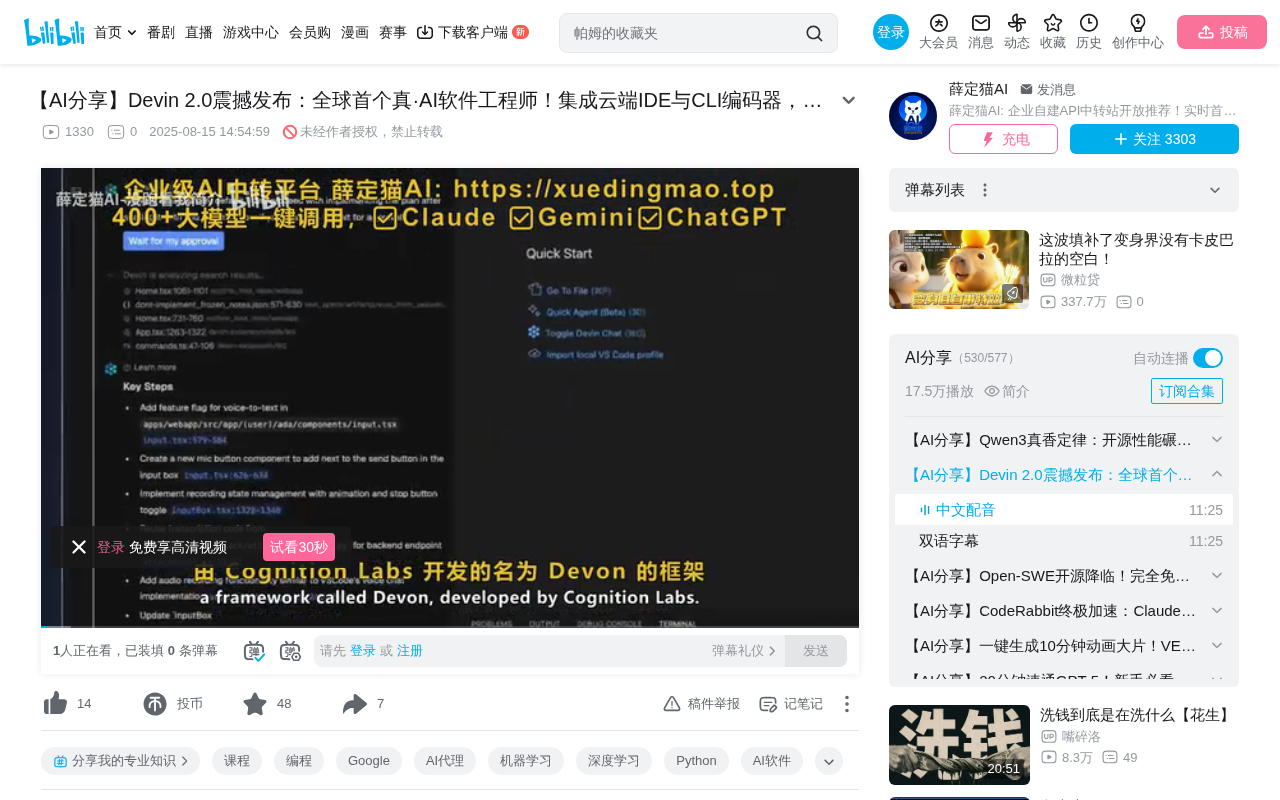
Devin 2.0 marks the paradigm shift in AI programming from assisted completion to autonomous execution.
Devin 2.0, developed by Cognition Labs, is an autonomous AI software engineer capable of independently completing entire engineering tasks from requirements analysis to PR submission, with support for multi-agent parallel work. It introduces Ask Devin for intelligent Q&A and Deep Wiki for automatic documentation generation, deeply integrates with GitHub, Slack, Jira, and other tools, and features an MCP plugin marketplace. With pricing starting at $20, it signals a transition from enterprise-grade tool to everyday developer tool, forming a complementary line-level/file-level/project-level division of labor with Copilot and Cursor.
From Concept to Practice: Devin's Evolution
Developed by Cognition Labs, Devin has been called "the world's first AI software engineer." Unlike code completion tools such as GitHub Copilot and Cursor, Devin is a fully autonomous AI agent equipped with a complete toolchain — it doesn't just write code, but can also invoke the command line, browser, and access the internet to independently complete entire engineering tasks from requirements analysis to deployment.
What is an AI Agent? An AI agent is an AI system capable of perceiving its environment, autonomously planning, and executing multi-step tasks — fundamentally different from traditional single-turn Q&A AI models. Agents typically possess "tool-calling" capabilities, allowing them to operate browsers, execute code, read and write files, and iterate through reasoning and action cycles via "Chain of Thought" or "ReAct" frameworks until the goal is achieved. This enables Devin to "think — act — verify" like a real engineer, rather than merely generating a static piece of code.
Since its initial release, Devin has undergone multiple rounds of iterative upgrades. Today's 2.0 version represents a quantum leap in stability, feature richness, and usability, and is being adopted by an increasing number of development teams in their production workflows.
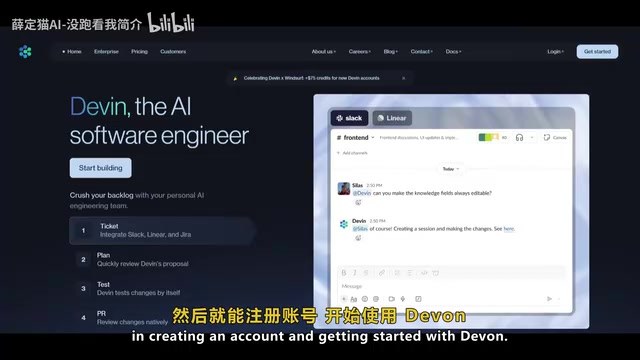
Comprehensive Feature Breakdown
Autonomous Engineering: More Than Just Writing Code
Devin's biggest differentiator is its "autonomy." Traditional AI coding assistants require developers to guide them line by line, whereas Devin can receive a high-level task description and then autonomously plan execution steps, write code, run tests, and submit PRs.
In practice, you simply describe the task in natural language, and Devin automatically completes the following workflow:
- Indexes and understands the entire code repository
- Sets up a dedicated virtual development environment
- Executes code initialization and static analysis
- Creates a draft PR and submits changes
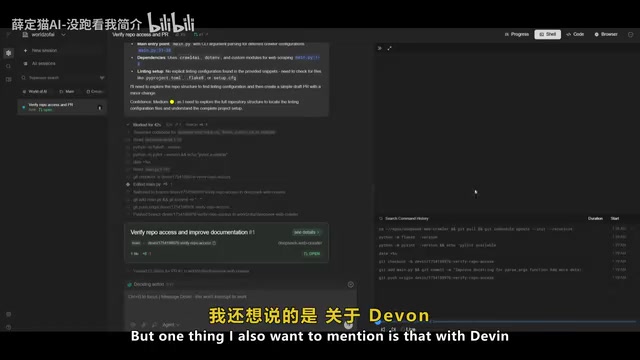
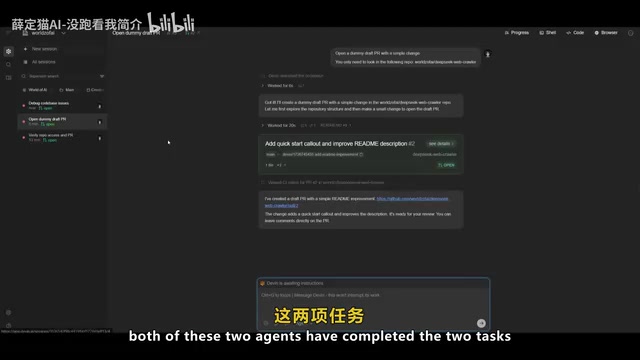
More notably, Devin supports multi-agent parallel work. You can open multiple sessions simultaneously, letting different Agents handle different tasks — for example, one Agent creating a PR while another debugs code issues, without interference.
The Technical Logic Behind Multi-Agent Systems Multi-Agent Systems are a cutting-edge direction in AI engineering. By running multiple independent Agents in parallel, the system can decompose complex tasks into subtasks for concurrent execution, dramatically improving overall throughput. This architecture draws from distributed computing principles — each Agent has its own independent context window and tool-calling permissions, coordinating through message passing or shared state to avoid mutual interference. For teams that need to work on multiple feature modules simultaneously or fix multiple bugs in parallel, this capability means transforming originally sequential engineering processes into parallel pipelines, significantly compressing delivery cycles.
Integrated Development Environment: A Complete Cloud IDE Experience
Devin sets up an isolated virtual development environment for each session, with a built-in integrated terminal, file manager, and browser. In this environment, developers can:
- Directly view and edit all project files
- Execute arbitrary commands through the terminal
- View code diffs in real time
- Engage in interactive collaborative development with Devin
This means Devin is not a black box — you can intervene at any time, review its work, provide feedback, and truly achieve a human-AI collaborative development model.
Two New Products: Ask Devin and Deep Wiki
Beyond the core engineering Agent, Devin 2.0 also introduces two important auxiliary products.
Ask Devin is an intelligent Q&A system built on your code repository. It performs deep indexing and analysis of the entire repo, answering questions about code architecture, functional logic, and more. With "deep analysis" mode enabled, it provides more detailed answers — like having a senior engineer available at all times to help with code research.
Deep Wiki automatically transforms code repositories into complete technical documentation with diagrams. It auto-generates key component overviews, workflow diagrams, quick-start guides, and more — essentially giving you a professional documentation team. For open-source project maintainers and teams that collaborate frequently, this feature offers tremendous practical value.
Ecosystem Integration and Workflow Automation
Third-Party Tool Integrations
Devin 2.0 covers mainstream development toolchains in its ecosystem integrations, currently supporting:
- Code Hosting: GitHub, GitLab, BitBucket
- Project Management: Linear, Jira
- Team Collaboration: Slack
- API Interface: Devin API, supporting programmatic auto-triggering
Through Slack integration, teams can assign tasks to Devin directly in chat; through Linear/Jira integration, tickets can be automatically imported for Devin to handle. The Devin API allows developers to embed the AI engineer into their own CI/CD pipelines for automated responses.
MCP Marketplace: Extensible Capability Boundaries
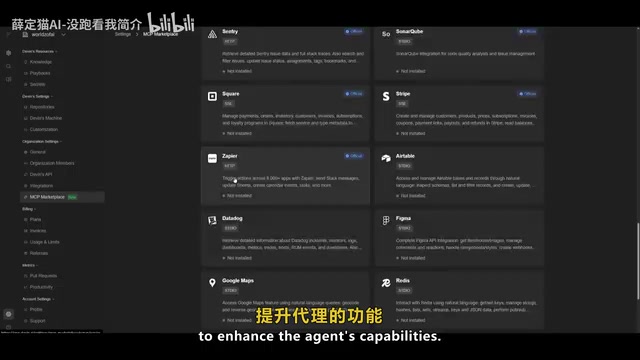
Devin 2.0 also introduces the MCP (Model Context Protocol) Marketplace, allowing users to extend the Agent's capabilities by installing various tool plugins. This plugin-based design means Devin's functional boundaries are no longer fixed and can be flexibly customized according to team needs.
What is the MCP Protocol? MCP (Model Context Protocol) is a standardized protocol proposed and open-sourced by Anthropic in late 2024, designed to solve the fragmentation problem of integrating AI models with external tools and data sources. It defines a unified interface specification that enables AI applications to connect to various tools and services in a plugin-based manner — similar to package managers in programming language ecosystems (like npm or pip). Before MCP, every AI product needed to develop separate integration solutions for each tool, which was extremely costly; MCP's standardization makes "develop once, reuse everywhere" possible, driving the AI tool ecosystem toward interoperability. Devin's adoption of the MCP marketplace means its capability expansion will benefit from the continuous growth of the entire MCP ecosystem.
Pricing Strategy: From High Barrier to Accessibility
One of Devin's biggest pain points previously was its prohibitively high price threshold. Version 2.0 introduces a completely new pricing structure:
- Basic Plan: Starting at $20/month, pay-as-you-go
- Access to nearly all core features
- Dramatically lowers the barrier for individual developers and small teams
This adjustment signals Devin's transition from an "enterprise-grade tool" to an "everyday developer tool," aiming to reach a much broader user base.
A Sober Assessment: Where Are Devin's Limits?
While Devin 2.0 demonstrates exciting capabilities, it's equally important to view its positioning rationally.
What is it good at? Repetitive engineering tasks, code debugging, documentation generation, repository analysis — these high-frequency but time-consuming tasks are Devin's sweet spot. The multi-Agent parallel capability also multiplies its efficiency when handling batch tasks.
Where are its limits? Complex architectural decisions, innovative algorithm design, feature development requiring deep business understanding — these still require human engineering judgment. Devin is better suited as a highly efficient "executor" rather than a "decision-maker."
From an industry trend perspective, Devin represents a paradigm shift in AI programming tools from "assisted completion" to "autonomous execution."
The Three Stages of AI Programming Tool Evolution This evolution follows a clear technical progression: Stage One is "line-level completion" represented by GitHub Copilot, predicting the next line of code based on current context — essentially an application of statistical language models; Stage Two is "file-level editing" represented by Cursor, leveraging larger context windows to understand entire files or even multi-file semantics, supporting large-scale refactoring; Stage Three is "project-level autonomous execution" represented by Devin, capable of understanding an entire repository's architectural intent and independently completing end-to-end engineering tasks. This evolution is closely tied to the expansion of LLM context windows from 4K to 100K+, the maturation of tool-calling (Function Calling) capabilities, and the engineering-ready deployment of Agent frameworks.
Devin, Cursor, and Copilot are not simple substitutes for each other — they cover different levels of development needs. The future development workflow will likely involve multiple AI tools working in concert — Copilot handling line-level completion, Cursor handling file-level editing, and Devin taking on project-level autonomous engineering tasks.
For developers, now is an excellent time to experience and evaluate these tools. The $20 entry threshold is low enough to warrant hands-on exploration of an AI software engineer's true capability boundaries.
Key Takeaways
- Devin 2.0 is an autonomous AI software engineer that can independently complete entire engineering tasks from code writing to PR submission, with support for multi-agent parallel work
- Two new products — Ask Devin for intelligent Q&A and Deep Wiki for automatic documentation generation — dramatically improve code comprehension and documentation maintenance efficiency
- Deep integration with GitHub, Slack, Linear, Jira, and other tools, plus an MCP standard protocol-based plugin marketplace for capability extension, with API support for programmatic triggering
- Pricing shifts from a high barrier to a pay-as-you-go basic plan (starting at $20), lowering the threshold for individual developers
- Devin represents a paradigm shift in AI programming from "assisted completion" to "autonomous execution," forming a complementary line-level/file-level/project-level division of labor with Copilot and Cursor
Related articles
 Product Reviews
Qoder vs Cursor Real-World Comparison: Which $20/Month AI IDE Is Better?
Hands-on comparison of Qoder vs Cursor AI IDEs: Agent autonomy, human interaction count, and architecture decisions. Qoder needed only 2 interactions vs Cursor's 8.
 Product Reviews
Cursor Cloud Agent Demo: Eliminating Bottlenecks Across the Entire Software Development Lifecycle
Deep analysis of Cursor's Cloud Agent demo showing how cloud VMs, automated test artifacts, and a full-chain control plane systematically eliminate human bottlenecks across the software development lifecycle.
 Product Reviews
Cursor 3.0 Deep Dive: Multi-Agent Parallelism, Design Mode, and Best-of-N Model Comparison
Cursor 3.0 evolves from an AI coding assistant into an Agent fleet command center. Explore multi-agent parallelism, Design Mode, and Best-of-N model comparison.