Pangu Skill: An Open-Source Project That Distills 18 Business Leaders into Callable AI Protocols
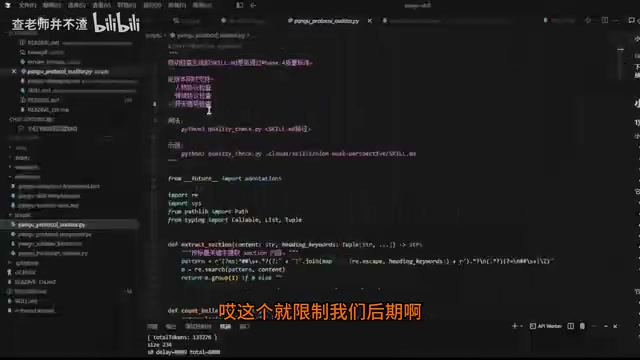
Open-source project distills 18 business leaders' decision logic into callable AI protocols.
Pangu.skill is an open-source project that distills the cognitive patterns and decision-making logic of 18 top global business leaders — including Tim Cook and Jensen Huang — into callable AI protocols. Built on a six-layer rule framework, it features a unique "Kaitian" mechanism that validates questions before answering, multi-source data distillation from YouTube subtitles and public speeches, and dual protocol extraction for both persons and domains. The project supports platforms like Claude Code and ChatGPT.
Project Overview: From Person Distillation to Protocol Workshop
A developer spent a week building an open-source project called "Pangu.skill" that distills the cognitive patterns, judgment structures, and decision-making logic of 18 top global business leaders into callable AI protocols. These protocols provide users with perspective-specific analysis and decision support around the clock, 24/7.
The concept of "distillation" here is borrowed from the machine learning technique known as Knowledge Distillation. First proposed by Geoffrey Hinton and colleagues in 2015, the original idea involves compressing and transferring knowledge from a large, complex model (the teacher model) into a smaller model (the student model). In the context of Pangu.skill, "distillation" is redefined as: extracting cognitive patterns, decision-making logic, and judgment frameworks from a real person's public expressions, then structuring them into standardized protocols that can be invoked by AI systems. This analogy aptly describes the process of refining core cognitive structures from massive amounts of unstructured information.
The core philosophy of Pangu.skill goes beyond simple role-playing. It uniformly encapsulates person protocols, domain protocols, and judgment structures into callable tool objects. The concept of "protocol" here draws from the idea of communication protocols in computer science — defining a set of standardized interaction rules that enable reliable communication between different systems. Here, the protocol is extended into a cognitive interface specification: it defines a person's or domain's inputs (what types of questions), processing logic (how to analyze and judge), and outputs (in what form to respond). This design makes each skill a "cognitive microservice" with a clearly defined interface that can be composed, invoked, and reused. Users only need to input a name, a domain, or a vague objective, and Pangu automatically completes the protocol generation workflow.
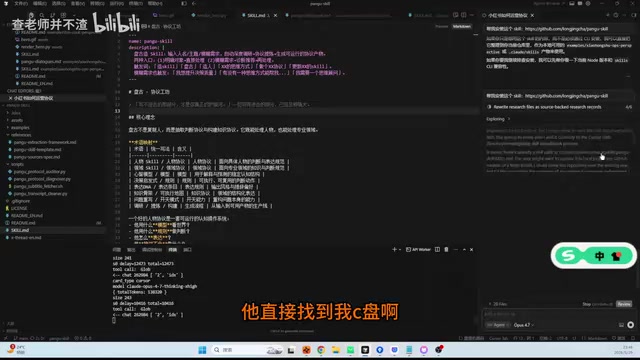
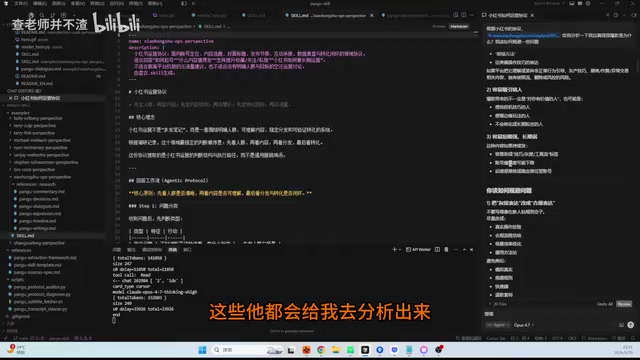
Technical Evolution: The Iterative Path from Colleague.skill to Pangu.skill
Pangu.skill didn't appear out of thin air — it was built on the foundation of two predecessor projects:
- Colleague.skill: Proved that turning a person into a callable object is feasible
- Nuwa.skill: Extracted the cognitive operating system and established a six-layer rule framework
Pangu took this further — it doesn't just handle individual persons but also processes knowledge protocols, pathways, and rules for professional domains. The key difference from Nuwa.skill is that Nuwa focuses on person distillation, while Pangu turns persons, domains, and the questions themselves into protocols.
Continuation and Innovation of the Six-Layer Rule Framework
Pangu carries forward Nuwa.skill's six-layer rules but with notable differences. The design philosophy of this six-layer rule framework shares similarities with multi-layer cognitive models in cognitive science. Daniel Kahneman's dual-system theory (fast thinking and slow thinking) and metacognition theory (cognition about one's own cognitive processes) are both reflected in this framework:
- Expression Layer: How one speaks and thinks. This corresponds to the outermost layer of cognitive output — a person's unique linguistic style and way of expressing thoughts.
- Judgment Layer: How problems are decomposed, what's actionable and what's not. This reflects specific decision-making logic and the ability to prioritize.
- Cognitive Framework Layer: Why different people make different judgments about the same issue. This corresponds to deep mental models — different people have different underlying assumptions and analytical frameworks for viewing the world, leading to vastly different conclusions from the same information.
- Boundary Layer: Each skill is clearly annotated with awareness of its own limitations. This embodies metacognitive capability — the system's self-awareness of its own competency boundaries.
- Honesty Boundary: Extracts intuition without producing hallucinations. In the context of large language models being prone to "hallucination" (generating content that seems plausible but is actually incorrect), this layer ensures the protocol only outputs evidence-based judgments.
- Transferability: What's extracted are transferable cognitive structures, not generic process templates. This ensures that what's captured isn't rigid rules but cognitive structures that can adapt to new contexts.
Distillation Sources and Coverage of the 18 Business Leaders
The project was inspired by the recent event of U.S. President Trump leading 17 business leaders on a visit to China. In May 2025, this delegation of top business leaders visited China, signaling an important thaw in U.S.-China trade relations. The delegation included tech giants such as Apple CEO Tim Cook, NVIDIA CEO Jensen Huang, and Qualcomm CEO Cristiano Amon, as well as corporate leaders from finance, energy, agriculture, and other sectors. The combined market capitalization of these companies exceeds $16 trillion, representing the most influential business forces in the U.S. and globally. The visit covered topics including semiconductor supply chains, AI technology cooperation, and agricultural trade, providing Pangu.skill with highly timely and analytically valuable source material.
These 18 individuals cover multiple key domains:
- Technology and semiconductors
- Financial payments
- Engineering, industrial, and aerospace
- Traditional agriculture
The developer systematically distilled their public speeches, interviews, and other content into standardized protocols.
Data Sources and Processing Workflow
Distillation isn't based on guesswork — it's evidence-based:
- Subtitle Extraction: Download Chinese and English subtitles from YouTube videos to extract real-world scenarios. The project uses SRT (SubRip Subtitle) and VTT (Web Video Text Tracks), two mainstream subtitle file formats. SRT format contains sequence numbers, timestamps, and text content with a simple, easy-to-parse structure; VTT is part of the HTML5 standard and supports richer style markup. Extracting subtitles from YouTube typically relies on auto-generated speech recognition (ASR) subtitles or creator-uploaded manual subtitles.
- Text Transcription: Use SRT and VTT subtitle text transcription, adapted to the plain text format required for Pangu protocol extraction. After converting these timestamped texts into plain text, additional preprocessing is needed — including deduplication, sentence break repair, and context restoration — before they can serve as high-quality distillation inputs. This workflow is essentially a conversion pipeline from multimodal information to structured knowledge.
- Multi-Round Distillation: Continuously refine protocol quality through multiple rounds of dialogue. Each round of distillation builds upon the previous one with supplements, corrections, and deeper analysis, similar to iterative optimization in machine learning.
- Quality Verification: Includes person protocol checks, domain protocol checks, and Kaitian ("Opening the Heavens") signal detection.
Core Capability Analysis: How the Kaitian Mechanism Ensures Output Quality
Pangu.skill introduces a unique "Kaitian" (Opening the Heavens) capability. When a user asks a question about a person or domain, if the question itself is flawed (a false premise, an invalid question, etc.), the system first performs a "Pangu Opens the Heavens"-style challenge and dialectical analysis.
The design philosophy of the Kaitian mechanism is aligned with critical thinking in philosophy and Karl Popper's falsificationism in scientific methodology. Popper argued that the essence of science lies not in verification but in falsification — a good theory must be falsifiable. Similarly, in AI-assisted decision-making, the most dangerous situation is often not giving a wrong answer, but giving a seemingly correct answer based on a flawed premise. The Kaitian mechanism implements a form of "meta-question analysis" through upfront question validity verification — something extremely rare in traditional AI assistants, which tend to answer directly rather than question the question itself.
Specifically, the Kaitian mechanism includes the following capabilities:
- Determining whether a question is valid
- Identifying false premises (e.g., questions based on incorrect assumptions)
- Annotating the limitations of a question
- Triggering the Kaitian capability for correction when necessary
This mechanism effectively ensures the safety and accuracy of protocol outputs, preventing misleading answers based on flawed premises. This design philosophy is highly relevant to the "Alignment" problem emphasized in the AI safety field in recent years — ensuring that AI system outputs truly serve users' real needs rather than mechanically responding to surface-level instructions.
Practical Case Study: Generating and Applying a Xiaohongshu Operations Protocol
The developer used Xiaohongshu operations as an example to demonstrate the practical effectiveness of domain protocols. Xiaohongshu (RED/Little Red Book) is one of China's most influential lifestyle-sharing platforms, with over 300 million monthly active users, known for its "seeding" culture. Its algorithmic distribution mechanism differs significantly from traditional social platforms: initial content exposure doesn't depend on follower count but achieves cold starts through algorithm-recommended content on the "Discover" page, meaning even low-follower accounts can produce viral content.
Protocol Generation Process
The Xiaohongshu operations protocol generated through Pangu.skill includes:
- Audience definition and core philosophy
- Operations scope breakdown (audience layer, content layer, distribution layer, conversion layer)
- Positioning pathways and methodology
- Knowledge-type vs. transaction-type content classification — the platform's content ecosystem is divided into knowledge-type (tutorials, guides, methodologies) and transaction-type (product recommendations, reviews, commerce) categories, with significant differences in algorithm weighting, user interaction patterns, and monetization pathways
Actual Analysis Results
The developer used the generated protocol to analyze one of their own viral posts (reaching tens of thousands of views with only a few hundred followers):
- Viral Success Analysis: The post simultaneously hit multiple content signals including result-orientation, precise audience targeting, benefit-driven appeal, sense of exclusivity, and boundary-setting. These signals essentially correspond to the key factors driving recommendation weight in Xiaohongshu's algorithm — upstream drivers of click-through rate (CTR), completion rate, engagement rate, and other metrics.
- Risk Alerts: Pointed out that going viral doesn't equal long-term sustainability, and flagged specific risk signals. This demonstrates the protocol system's "Boundary Layer" capability — it doesn't just tell you why something succeeded, but also the conditions and limitations of that success.
- Optimization Suggestions: Provided improvement directions for subsequent operations.
Installation and Usage Guide
Pangu.skill supports multiple installation methods:
- Command Installation: Install directly with a single command
- Manual Installation: Suitable for users without LLM capabilities
- Supported Platforms: Claude Code, ChatGPT, VS Code, PyCharm, and other tools with LLM capabilities
After installation, users can simply tell the Agent:
- Build a Trump protocol
- Create a skill protocol from Allen Zhang's perspective
- Use these protocols for investment analysis
This interaction approach reflects the current trend in AI toolchain development: shifting from "people adapting to tools" to "tools adapting to people." Users don't need to learn complex configuration syntax — they simply describe their intent in natural language, and the system automatically completes the entire workflow from data collection to protocol generation.
How It Works: System Architecture
Pangu.skill's workflow:
- Kaitian Judgment: First determines whether the question itself needs to be challenged
- Six-Path Parallel Collection: Simultaneously collects from six dimensions including books, podcasts, and social media. This multi-source information fusion approach borrows from the "Multi-INT" (Multi-Source Intelligence) concept in intelligence analysis — a single information source may be biased, but cross-validation from multiple independent sources significantly improves information reliability.
- Dual Protocol Extraction: Person protocols and domain protocols are extracted in parallel. Person protocols capture "how this person would think," while domain protocols capture "what are the patterns in this field." Combining both produces analytical output that has both personal perspective and professional depth.
- Quality Verification Audit: Ensures output quality
The entire system isn't a single-point tool but a protocol production system capable of continuous output — from subtitle transcription and source standardization to extraction and review, forming a complete pipeline. This architectural design is similar to CI/CD (Continuous Integration/Continuous Delivery) pipelines in software engineering, ensuring that every protocol's production process is traceable, reproducible, and verifiable.
Conclusion: Core Value and Use Cases of Pangu.skill
The core value of Pangu.skill lies in this: it doesn't just answer "who does this sound like" — it judges "is the question even right"; it doesn't just do person distillation — it turns domain methodologies into callable objects as well. For content creators, operations professionals, investment analysts, and similar roles, this protocol system provides a low-cost pathway to accessing expert perspectives.
From a broader perspective, Pangu.skill represents an emerging AI application paradigm — making human experts' tacit knowledge explicit, structured, and callable. Management scholar Ikujiro Nonaka pointed out in his knowledge creation theory that the most valuable knowledge in organizations is often tacit knowledge that's difficult to articulate. Pangu.skill attempts to transform this tacit knowledge into reusable digital assets through a systematic distillation process.
The project is completely open-source and free. Each distilled person protocol has its own independent repository available for direct use.
Related articles

OpenAI Codex Data Analytics Plugin in Practice: The Complete Workflow from Data Collection to Report Delivery
Deep dive into OpenAI Codex's Data Analytics Plugin: cross-system data integration, smart chart generation, data provenance, and Google Slides export reshaping analytics workflows.

OpenAI Codex Creative Production Plugin: How AI Is Revolutionizing Marketing Asset Creation
Deep dive into OpenAI Codex Creative Production Plugin: AI product image generation, Remix style adjustment, one-click brochure creation, and Canva integration for editable output.

Preparing for an Antarctic Cycling Expedition with ChatGPT: How AI Powers Extreme Adventure
An explorer uses ChatGPT to prepare for an unprecedented solo Antarctic cycling expedition. Learn how AI serves as gear optimizer, training coach, and emergency lifeline in extreme adventure.