OpenAI Codex Data Analytics Plugin in Practice: The Complete Workflow from Data Collection to Report Delivery

OpenAI Codex's new Data Analytics Plugin covers the full workflow from data collection to report delivery.
OpenAI's new Codex Data Analytics Plugin extends AI capabilities from code generation to enterprise data analytics. It features cross-system data integration via configurable Skills and Data Sources, intelligent chart generation with interactive editing, robust data provenance for audit compliance, and template-based Google Slides export. The plugin reshapes how data teams work by compressing the data-to-decision pipeline into a single platform.
Introduction: When Codex Joins the Data Analytics Team
OpenAI recently launched a brand-new Data Analytics Plugin for Codex, extending this AI coding tool's capabilities from code generation into the realm of enterprise-grade data analytics. This means Codex is no longer just a programmer's assistant — it's becoming a true "AI team member" within data analytics teams, capable of collecting data across systems, automatically generating chart-based reports, and even exporting directly to Google Slides for management review.
This shift deserves attention because it represents a significant step in the evolution of AI tools from "coding assistance" to "end-to-end business workflows."
To understand the significance of this step, it helps to review Codex's technical evolution. OpenAI Codex was originally released in 2021 as a specialized model fine-tuned on the GPT architecture for code generation tasks, and it served as the core engine behind GitHub Copilot. Codex could understand natural language instructions and translate them into executable code, supporting over a dozen programming languages including Python and JavaScript. In 2025, OpenAI gave Codex a major upgrade, repositioning it from a simple code completion tool to an AI Agent capable of autonomously executing multi-step tasks within a sandboxed environment. The launch of this data analytics plugin is a concrete manifestation of that agent-oriented strategy — Codex no longer just generates code snippets; it can understand business context, call external APIs, orchestrate complex workflows, and ultimately produce deliverable business artifacts.
Core Capabilities of the Codex Data Analytics Plugin: Full Workflow Coverage
Cross-System Data Integration
The core design philosophy of the Codex Data Analytics Plugin is a combinable configuration of Skills and Data Sources. Users can point the plugin at their own workflows and business tools, enabling Codex to understand specific business contexts and data structures.
This architecture is essentially a modular AI agent design pattern. Skills define the types of operations Codex can perform — such as data cleaning, statistical analysis, and chart generation — while Data Sources represent the external systems Codex can connect to, including databases, SaaS platform APIs, and data warehouses. This design draws from the iPaaS (Integration Platform as a Service) concept: by abstracting away underlying system differences through standardized connectors, the AI agent can orchestrate cross-system data without needing to understand each system's technical details. Users simply "point" Codex at their business tool stack through configuration rather than coding, quickly gaining customized analytical capabilities.
In the demo, Codex was able to collect all relevant context across multiple disparate systems within minutes, automatically constructing Business Impact Reports. This process traditionally requires data analysts to spend hours manually extracting, cleaning, and integrating data from various systems.
Intelligent Chart Generation and Deep Analysis
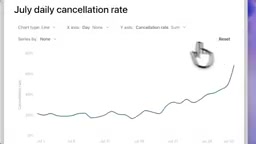
The generated Data Science Artifacts include detailed data breakdowns, visualizations, and in-depth analysis. This isn't a simple data dump — it's a structured report with genuine business insights.
In data science, an Artifact refers to any trackable, reproducible output produced during the data analysis pipeline, including datasets, feature engineering scripts, statistical models, visualizations, and analytical reports. In traditional data science workflows, these artifacts are typically scattered across different tools like Jupyter Notebooks, Excel, and Tableau, lacking unified management and version control. Codex consolidates these artifacts within a single interactive interface, where each chart and analytical conclusion is bound to its underlying data and generation logic. This effectively implements a lightweight form of Data Lineage management — users can not only see results but also trace how those results were derived step by step from raw data.
More critically, Codex provides a real-time, editable interactive interface. Users can make adjustments directly while viewing charts, tailoring them to business users' reading preferences. This "what you see is what you edit" experience eliminates the repetitive communication costs of the traditional "analyst creates chart → business stakeholder gives feedback → analyst revises chart" cycle.
Data Provenance Mechanism: Ensuring Report Transparency and Trustworthiness
In enterprise data analytics scenarios, a report's credibility is just as important as its data traceability. Codex's design in this area is commendable — it provides complete data source transparency, allowing users to clearly see the data origins and workflow logic behind every report.
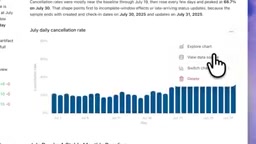
This transparency mechanism addresses a core pain point in AI-generated content: when management questions data sources, analysts can quickly trace back to the original data and processing logic. Additionally, if users want to reproduce these analytical workflows in their own systems, they can directly reference Codex's workflow design.
The importance of Data Provenance in enterprise environments extends far beyond the technical level. In regulated industries such as finance, healthcare, and manufacturing, every data point in a report may need to withstand audit scrutiny. For example, the EU's General Data Protection Regulation (GDPR) requires organizations to explain data origins and processing methods; the U.S. SOX Act requires publicly traded companies' financial reports to have complete audit trails. When AI participates in data analysis workflows, the "black box" problem significantly amplifies compliance risk — if an AI-generated report cannot explain its data sources and calculation logic, the enterprise faces serious challenges during audits. The transparency mechanism Codex provides essentially bridges the gap between AI-Generated Content (AIGC) and enterprise compliance requirements, enabling AI-assisted analysis results to meet basic Auditability standards.
Template-Based Export: Bridging the Last Mile of Report Delivery
The value of data analysis is ultimately realized through deliverables. Codex handles this step very pragmatically — it supports direct export to Google Slides and can match existing enterprise report templates.
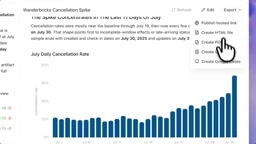
Users can send follow-up instructions to have Codex generate reports according to specific workflows and template formats, ensuring business-side users receive reports in the familiar style they expect. This detail may seem simple, but it actually solves a common barrier to AI tool adoption: output format compatibility with existing enterprise processes.
In enterprise IT procurement and tool selection, this is known as the "last mile problem" — no matter how powerful a tool's core functionality is, if its output can't seamlessly integrate into existing enterprise workflows and delivery standards, adoption rates will suffer significantly. Many BI tools (such as Tableau and Power BI) offer excellent analytical capabilities but often require manually copying charts into PowerPoint or Google Slides during the report delivery phase, then adjusting formatting to match corporate brand guidelines. This seemingly trivial step can consume dozens of hours of data team effort per week in large organizations. Codex's direct support for template-based export to Google Slides means it understands that enterprise reports are not just data presentations — they're a standardized communication protocol where fonts, color schemes, layouts, and logo placement all carry the enterprise's professional image and communication standards.
Throughout the entire process, Codex serves as a unified work platform, supporting real-time editing and adjustments while building reports, rather than requiring users to switch back and forth between multiple tools.
Industry Impact: How Will the Data Analyst's Role Evolve?
The launch of this plugin raises a deeper question: When AI can handle the entire workflow from data collection to report delivery, how will the data analyst's role be redefined?
Based on the current demo, Codex isn't aiming to replace data analysts but rather to free them from repetitive data processing work. Analysts' core value will increasingly shift toward:
- Defining and decomposing business questions: Telling Codex "what to analyze" matters more than "how to analyze"
- Interpreting results and providing decision recommendations: AI generates charts; humans provide business judgment
- Data governance and quality control: Leveraging transparency mechanisms to verify the accuracy of AI outputs
It's worth noting that the Codex Data Analytics Plugin also reshapes the competitive landscape between AI tools and traditional BI tools. Traditional BI tools like Tableau, Power BI, and Looker have served enterprise data analytics needs for years and have recently integrated AI features (such as Tableau's Ask Data natural language queries and Power BI's Copilot smart assistant). But Codex differentiates itself through its "code-first" underlying architecture — it fundamentally completes analytical tasks by generating and executing code, giving it far greater flexibility and customizability than drag-and-drop BI tools. Meanwhile, AI agent frameworks like LangChain and CrewAI are also rapidly evolving, enabling developers to build custom data analytics agents. Codex's advantage lies in OpenAI's model capabilities and brand endorsement, but its relatively closed ecosystem may also be a concern for enterprise adoption — data-security-sensitive organizations may prefer open-source solutions that can be deployed privately.
That said, it's important to note that the demo scenarios are relatively idealized. In real enterprise environments, challenges such as data permission management, cross-system API integration, and data quality issues still persist. Whether the Codex Data Analytics Plugin can truly become a standard tool for enterprise data teams remains to be proven in more complex real-world scenarios.
Conclusion
OpenAI Codex's Data Analytics Plugin marks a shift in AI tools from "technical assistance" to "business enablement." It integrates data collection, analysis, visualization, editing, and delivery into a single platform, dramatically compressing the timeline from data to decisions. For data-intensive teams, this may be one of the most noteworthy productivity tool upgrades in recent times.
Related articles

Straight from the Creator of Claude Code: Practical Tips for Using AI Coding Assistants Effectively
Claude Code creator Boris shares advanced tips: code Q&A, CLAUDE.md context management, parallel workflows, shortcuts, and expert-level practices.

OpenAI Stargate Michigan Data Center Breaks Ground: A Deep Dive into the 1GW Super Computing Facility
OpenAI's Stargate project breaks ground in Michigan, building a 1GW super data center with closed-loop cooling, thousands of union jobs, and $40M in free Codex credits for students.

OpenAI Codex Creative Production Plugin: How AI Is Revolutionizing Marketing Asset Creation
Deep dive into OpenAI Codex Creative Production Plugin: AI product image generation, Remix style adjustment, one-click brochure creation, and Canva integration for editable output.