Why Is GPT-5.5 Called an 'Autistic Genius'? The Truth Behind Codex's Explosive Growth
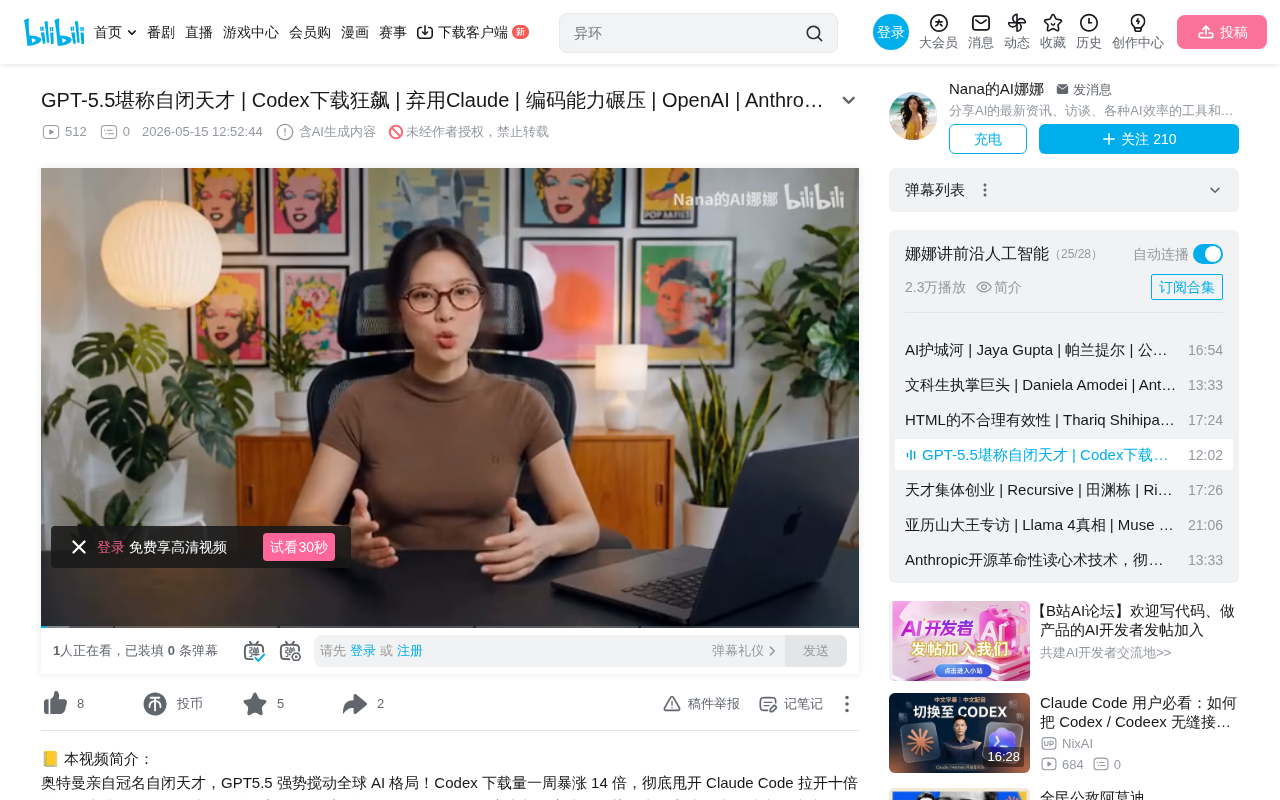
GPT-5.5 crushes competitors in coding but critically lacks 'human touch'
Altman calls GPT-5.5 an 'autistic genius' whose raw intelligence opens a tier-breaking gap from competitors. Codex downloads surged 1397% in one week to 86.1 million, dwarfing Claude Code's 7.2 million. Multiple engineering teams are migrating from Claude to Codex for cost-effectiveness. However, GPT-5.5 falls notably short in humanized interaction, reflecting the fundamental philosophical divide between OpenAI's raw intelligence approach and Anthropic's humanized experience strategy.
Altman's Stunning Assessment: GPT-5.5 Is an "Autistic Genius"
On May 10, OpenAI CEO Sam Altman posted a tweet on X that set the entire internet ablaze: "5.5 is an autistic genius with very strange taste in naming, shocking that we would make such a thing."
This tweet sparked massive reactions because Altman rarely uses such emotional, personal language to describe his own products. In the half month since GPT-5.5 launched, he has repeatedly and openly expressed his excitement on multiple occasions, even claiming that GPT-5.5's raw intelligence has opened up a "tier-breaking gap" from all other models.
AI professor Deria Unutmaz stated bluntly that GPT-5.5's performance fully deserves to be called GPT-6. This gap manifests in three core areas: benchmark scores that completely crush competitors, dramatically reduced token consumption, and overall performance that can only be described as "brute-force elegance."
Codex Downloads Surge 1397%: Developers Vote with Their Wallets
Data Comparison: The 12x Gap Between Codex and Claude Code
On the same day Altman posted his tweet, market research firm Ticker Trends released download data that shocked the entire industry. The data showed that as of May 3, Codex had reached 86.1 million total downloads, a week-over-week surge of 1397% — equivalent to a 14x increase in downloads within a single week. By May 8, Codex's weekly downloads had further climbed to 90 million.
Meanwhile, Anthropic's Claude Code recorded only 7.2 million downloads during the same period, with a week-over-week decline of 38%. One is climbing at a near-vertical angle, while the other is bleeding out. The speed of this divergence left many industry insiders breathless.
The Trigger: Three Killer Features in Codex V0.128-0
The trigger for this explosive growth is crystal clear — the V0.128-0 version of Codex released on April 30. This version introduced three key changes:
- Persistent Workflows: Support for multi-step task planning across sessions — Codex can remember users' long-term goals without starting from scratch each time
- Million-Token Context: The ultra-long context window enabled by GPT-5.5
- 40% Token Efficiency Improvement: Directly reducing usage costs
These three changes combined ignited developer enthusiasm. In a letter to internal employees, Altman used just one word to describe Codex's growth — "insane."
A 16-Person Team Collectively Cancels Claude: A Clear-Cut Economic Decision
If download data represents the macro signal, then real engineering teams "voting with their feet" provides the most compelling evidence.
Morgan Linton, founder of startup Boldmetrics, posted on social media announcing: "We've officially said goodbye to Anthropic. For my small 16-person engineering team, the Codex plus Cursor combination has completely replaced our previous solution."
He laid out a straightforward calculation: each engineer on the team was spending over $2,000 per month on Claude API fees — adding up to over $32,000 monthly for 16 people. After switching to Codex plus Cursor, thanks to GPT-5.5's extremely high token utilization rate, costs dropped dramatically while performance remained uncompromised.
Linton's final prediction is even more noteworthy: "I believe more and more engineering leads will make decisions similar to mine." For Anthropic, engineering developers represent one of their most core user groups — the ones with the strongest willingness to pay and highest stickiness. If even this group begins migrating at scale, Anthropic's commercial foundation will be seriously shaken.
GPT-5.5 Coding Capabilities: Real-World Validation
More and more developers have stepped forward to validate GPT-5.5's advantages in coding:
- Microsoft VP Omar Shahine publicly praised Codex's performance in creating Swift iOS apps as "truly extraordinary" — generating a complete app from a single simple prompt that solved 95% of the work
- OpenAI's Head of Developer Experience Romain Huet added that today's Codex can not only design interfaces and write high-quality Swift code, but can even run apps in the simulator without opening Xcode, and automatically complete testing through computer-use capabilities
- Multiple independent developers stated they now "clearly trust Codex more"
GPT-5.5's Fatal Flaw: An Autistic Genius Lacking "Human Touch"
However, GPT-5.5 is far from invincible. On the same day Altman posted his tweet, he launched an online survey asking what people most wanted improved in the next-generation model. A highly upvoted comment from former OpenAI researcher Will Depue struck right at the heart of the issue.
He said: "GPT-5.5 has indeed narrowed the gap with Claude, but it loses catastrophically when it comes to 'human touch.'" He gave a vivid example — if you tell GPT-5.5 you want to learn astrophysics, it immediately dumps a pile of cold abbreviations and formulas. But ask Claude the same question, and it acts like a knowledgeable, elegant tutor, gently guiding you deeper into the rabbit hole of knowledge.
This comment received tens of thousands of likes. The nickname "autistic genius" is terrifyingly accurate — extremely strong raw intelligence, but lacking empathy and unable to communicate well with humans.
OpenAI vs Anthropic: The Battle Between Raw Intelligence and Humanized Experience
Behind this competition lies a fundamental divergence in product philosophy between OpenAI and Anthropic:
| Dimension | OpenAI (GPT-5.5) | Anthropic (Claude) |
|---|---|---|
| Core Advantage | Raw intelligence, cost-effectiveness | Humanization, alignment experience |
| Best-Fit Scenarios | Coding, reasoning, complex problems | Long-form text, communication, content safety |
| User Profile | Developers, engineering teams | Enterprise users, general users |
For developers, they need efficient, accurate, problem-solving tools — GPT-5.5's hard capabilities and high cost-effectiveness hold fatal attraction. But for general users, they need more than just answers — they need a partner that understands them — and that's precisely where Claude excels.
Future Outlook: How Will the AI Coding Tool Landscape Evolve?
Looking at the comments from Altman's feedback survey, user expectations for the next-generation model center on: improving instruction-following ability, enhancing writing quality, optimizing frontend development configuration, and most importantly — improving "human touch."
Another signal worth watching: OpenAI officially changed its long-standing slogan from "Ask ChatGPT" to "Message ChatGPT." Combined with Altman's "Call Me Maybe" hint, this likely signals an imminent launch of voice calling features or even related hardware products.
Large model competition has entered an entirely new phase. In the past, the race was about who could build a large model and who had more parameters. Now it's about who is more usable, who offers better value, and whose experience feels more human. The future market will most likely not be dominated by a single player — OpenAI maintains its lead in raw intelligence and developer ecosystem, while Anthropic finds its position in humanization and enterprise services. And the ultimate beneficiaries of this robust competition are all AI users.
Related articles
 Industry Insights
AI Product Development in Practice: Model Selection, Building Moats, and Paths to Commercialization
Practical strategies for AI product development: why not to train models from scratch, when to use APIs vs. fine-tuning, building product moats, and the full path from evaluation systems to commercialization.
 Industry Insights
No Product Fits Your Needs? Building It Yourself Is the Best Starting Point for Indie Developers
Can't find a product that fits? Building from personal pain points is the best entry for indie developers. Niche needs + AI tools = rapid product creation.
 Industry Insights
OpenAI Codex Tutorials Mass-Copied on Bilibili, Highlighting AI Content Farm Problem
At least 9 Bilibili accounts mass-published identical OpenAI Codex tutorial videos, exposing content farm operations in the AI tools space.