5 AI Startup Ideas Deep Dive: Developer Career Pivot, EV Residual Value, Privacy SaaS
5 AI Startup Ideas Deep Dive: Develope…
Five niche AI startup ideas for indie developers in 2026, with feasibility analysis.
This article breaks down 5 AI micro-startup directions suited for indie developers and small teams in 2026, including a developer AI skill graph generator, EV residual value calculator, and job-driven skill matching tool. They share common traits: narrow focus, real pain points, and quickly validatable MVPs using existing LLM APIs and cloud infrastructure.
Micro-Startup Opportunities in the AI Wave: 5 Directions Worth Watching
By 2026, AI technology has permeated far beyond big tech labs into every niche scenario. For indie developers and small teams, the real opportunity isn't building the next foundation model—it's finding overlooked "pain point gaps" and solving specific problems for specific people with lightweight tools.
A recent business inspiration analysis highlighted 5 AI startup directions worth attention, covering developer career transitions, EV asset management, SaaS privacy compliance, and founder mental health. These directions share common traits: narrow focus, real pain points, and quickly validatable MVPs.
What is MVP? MVP (Minimum Viable Product), systematized by Eric Ries in The Lean Startup, is about building the lowest-cost version of a product that can validate core assumptions and gather real user feedback, avoiding over-investment in unvalidated directions. In AI tool startups, the MVP threshold has dropped dramatically—with OpenAI API, Anthropic Claude, plus infrastructure like Vercel and Supabase, a solo developer can ship a fully functional AI prototype in weeks, making "rapid validation" a truly actionable startup path.
Let's break down each direction.
Direction 1: Career Pivot Compass — AI Skill Graph Generator for Developers
What Problem Does It Solve?
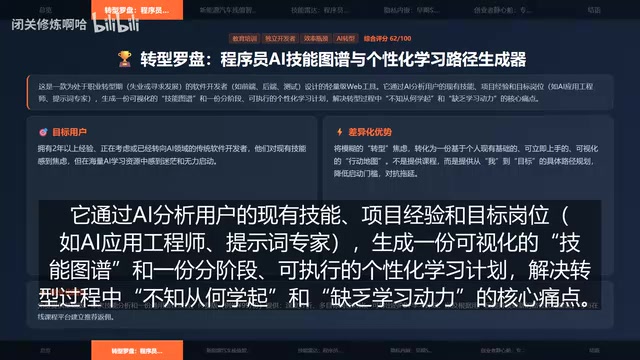
Countless traditional software developers (frontend, backend, QA, design) face career anxiety: AI job demand is surging, but the overwhelming volume of learning resources makes it hard to know where to start. The core logic of this tool is to transform vague transition anxiety into a visual action map based on your existing foundation.
Users input their tech stack, project experience, and target role (e.g., AI Application Engineer, Prompt Specialist), and the system generates two things via AI analysis: a skill graph and a phased personalized learning plan.
On the technical implementation side, the skill graph is essentially a vertical application of knowledge graphs, structuring skill nodes, dependencies, and job requirements as entities and relationships in a graph database (e.g., Neo4j). Combined with LLM semantic understanding, the system parses natural language descriptions (e.g., "I know Python and Django, 3 years of backend experience") into structured skill vectors, then performs similarity matching against target job requirements to calculate skill gaps. The personalized learning plan typically uses a RAG (Retrieval-Augmented Generation) architecture, retrieving the most relevant resources from course libraries, technical docs, and hiring data, then having the LLM organize them into a logically sequenced learning path—this tech stack is already quite mature for indie developers.
Where's the Differentiation?
The market doesn't lack AI course platforms—what's missing is "from where I am to where I want to be" path planning. This tool doesn't sell courses; it helps you figure out: given your existing Python background and backend experience, what specific modules do you need to fill in to transition to AI application development, in what order, and to what depth.
Overall score: 62 points, above-average feasibility. The key challenge is ensuring recommendation paths stay practical and current—AI job skill requirements are themselves evolving rapidly.
Direction 2: EV Residual Value Calculator — An Underestimated Anxiety Market
The Core Confusion for Car Owners
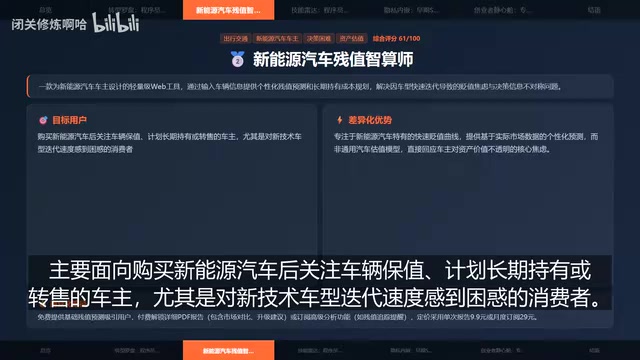
New energy vehicles iterate far faster than ICE cars. A model might get a refresh in six months, and battery tech upgrades fill older models' residual values with uncertainty. Owners face one core question: What's my car worth now? What will it be worth in three years? Should I sell now?
This tool takes vehicle information (brand, model, purchase date, mileage, battery health, etc.) and provides personalized residual value predictions and long-term ownership cost planning.
Why Aren't General Valuation Tools Enough?
Traditional ICE vehicle depreciation follows relatively stable linear or exponential decay models, with primary variables being mileage, age, and brand retention rates. But EV residual value systems are far more complex:
- Battery State of Health (SOH) is the core variable—lithium battery capacity degradation through charge cycles directly impacts range and thus secondhand market pricing;
- OTA (Over-The-Air) software update strategies create significant feature differences within the same model, with some manufacturers even software-locking hardware performance, creating a "software-defined vehicle" pricing logic;
- New model release cadence (e.g., Tesla's frequent price cuts) creates immediate market shocks to existing models.
These stacked factors make traditional valuation models highly inaccurate. A vertical tool focused on EV-specific depreciation curves is actually more convincing than all-in-one platforms.
Overall score: 61 points. Business models could include partnerships with used car platforms or insurance companies, or offering paid in-depth reports to owners.
Direction 3: Skill Radar — Job-Driven Developer Transition Matching Tool
How Is It Different from the "Career Pivot Compass"?
At first glance, this direction seems highly similar to the first one, but the core logic differs. The Career Pivot Compass works "from skills to find paths," while the Skill Radar works "from job requirements to find gaps."
It real-time scrapes AI job postings from recruitment platforms, analyzes specific role requirements (e.g., AI Application Developer, Prompt Engineer, Data Annotation Manager), then performs precise matching against the user's resume skills to generate a "skill gap report."
Technically, this involves two key layers: the data collection layer obtains JD data via scrapers or official APIs (e.g., LinkedIn Talent Insights, Boss Zhipin open platform); the semantic analysis layer uses NLP to extract skill keywords from unstructured JD text and performs standardized mapping (e.g., mapping "familiar with vector databases" and "experience with Pinecone/Weaviate" to the same skill node).
Related articles
 Industry Insights
AI Product Development in Practice: Model Selection, Building Moats, and Paths to Commercialization
Practical strategies for AI product development: why not to train models from scratch, when to use APIs vs. fine-tuning, building product moats, and the full path from evaluation systems to commercialization.
 Industry Insights
No Product Fits Your Needs? Building It Yourself Is the Best Starting Point for Indie Developers
Can't find a product that fits? Building from personal pain points is the best entry for indie developers. Niche needs + AI tools = rapid product creation.
 Industry Insights
OpenAI Codex Tutorials Mass-Copied on Bilibili, Highlighting AI Content Farm Problem
At least 9 Bilibili accounts mass-published identical OpenAI Codex tutorial videos, exposing content farm operations in the AI tools space.