Alibaba's $52B AI Investment: A Full-Stack Cloud Infrastructure Upgrade for the Agent Era
Alibaba's $52B AI Investment: A Full-S…
Alibaba's $52B AI bet pays off as full-stack Agent upgrades drive a cloud infrastructure paradigm shift.
Alibaba's $52B AI investment is showing returns: Bailian Platform ARR hits 8 billion yuan with a year-end target of 30 billion, and AI product revenue has grown triple digits for 11 straight quarters. Alibaba Cloud unveiled a full-stack Agent upgrade — from the Hanguang M890 chip to cloud platform Scale-ification to Qwen 3.7 MAX — proposing the "Agent Driving Cloud" paradigm that extends cloud users from humans to AI Agents, marking the beginning of cloud computing's fourth paradigm shift.
The $52 Billion Echo: Alibaba's AI Investment Starts Paying Off
Last year, Alibaba CEO Eddie Wu announced a 380 billion yuan (~$52B) investment over the next three years in AI cloud infrastructure — a figure exceeding Alibaba's total investment over the past decade and setting a record for private-sector AI investment in China. The market has been asking ever since: when will this astronomical investment start showing returns?
We found preliminary answers in Alibaba's latest earnings report. Three key figures stand out: Bailian Platform's Annual Recurring Revenue (ARR) has reached 8 billion yuan, with a year-end target of 30 billion yuan, and AI-related product revenue has maintained triple-digit growth for 11 consecutive quarters. This isn't a slide-deck vision — it's real revenue built on actual API calls and token consumption.
Annual Recurring Revenue (ARR) is the most critical health metric in the SaaS and cloud services industry. It measures predictable, sustainable subscription-based revenue rather than one-time transactions. Bailian Platform's 8 billion yuan ARR means that enterprise customers have already embedded AI inference capabilities into their business processes, forming a habit of continuous usage and payment. The underlying business model charges based on API call volume and token consumption — tokens are the basic units that large language models use to process text, with each input and output consuming tokens, similar to how cloud computing charges by CPU hours. This "pay-as-you-go" model naturally benefits from economies of scale: as Agent applications proliferate, individual enterprise call volumes will grow exponentially, driving rapid ARR growth.

Alibaba AI has already proven out a commercially efficient closed loop: Agent applications on the front end, the Bailian Platform providing the inference layer in the middle, and proprietary chips delivering compute power through the cloud platform at the bottom. At the latest Apsara Conference, Alibaba Cloud fully deconstructed this loop, showcasing the upgrades made at every layer for the Agent era — a first among global AI cloud providers.
Why Is Everything Revolving Around Agents?
Every year, the AI field produces breakout applications. In recent years, it was ChatGPT and DeepSeek, whose core capability was "giving you answers." But the trend truly exploding right now is Agents — rather than an AI that answers questions, users need an AI that can actually get the job done.

The fundamental difference with Agents is that they can independently decompose tasks, research information, invoke tools, execute code, generate content, and deliver results. This is no longer simple Q&A interaction — it's complete workflow automation. From this perspective, Agents represent the ultimate form of AI applications.
From a technical architecture standpoint, a typical Agent contains four core modules: a Planner that decomposes complex tasks into executable sub-steps; a Memory system that maintains short-term working context and long-term knowledge accumulation; a Tool Use layer that enables the Agent to access search engines, databases, code executors, and other external capabilities; and a Reflection mechanism that allows the Agent to evaluate its own output quality and self-correct. This architecture means that when executing a task, an Agent may need to perform dozens or even hundreds of internal reasoning loops, each involving model calls, tool interactions, and state updates — placing extremely high demands on the underlying inference infrastructure's concurrency and latency control.
This is why every major tech company is frantically emphasizing Agent capabilities when releasing new models. Google just reshaped the search engine used by billions of people with Agents. As an infrastructure provider, Alibaba Cloud thinks at an even more fundamental level — Agents need a cloud-based "super workstation" to operate, which places unprecedented demands on infrastructure.
From Chips to Entry Points: Alibaba Cloud's Full-Stack Agent Upgrade
Alibaba Cloud's upgrade this time covers the complete technology stack from bottom-layer chips to top-layer entry points, with deep modifications at every layer for Agent scenarios.
Hanguang M890 Chip: The Agent Compute Foundation Makes Its Debut
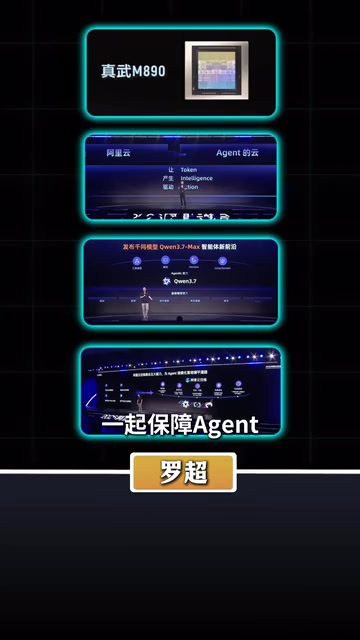
The next-generation Hanguang M890 chip delivers several key specifications: 144GB of large memory, inter-chip interconnect bandwidth of up to 800GB/s. More importantly, the 128-card super node design stitches AI chips together into a supercomputer, providing the compute foundation for large-scale Agent inference.
The Hanguang series is an AI inference chip independently developed by Alibaba's T-Head semiconductor division. Unlike NVIDIA GPUs, which take a general-purpose computing approach, Hanguang chips are deeply customized and optimized for the Transformer architecture. The M890's 144GB of large memory directly determines the model parameter scale it can support — current mainstream large models range from tens of billions to trillions of parameters, and memory capacity is the hard constraint on whether a model can be fully loaded. The 800GB/s inter-chip interconnect bandwidth addresses the data transfer bottleneck in multi-chip collaborative inference, a metric that directly impacts distributed inference efficiency. The 128-card super node design philosophy is similar to NVIDIA's NVLink interconnect approach but is specifically optimized for inference scenarios. In the global AI chip landscape, in-house chip development means Alibaba Cloud can reduce dependence on a single supplier while gaining cost and performance advantages through vertical software-hardware integration.
Cloud Platform Scale-ification: Letting Agents Use Cloud Services Like Function Calls
Alibaba Cloud made a remarkably bold move — directly Scale-ifying traditional cloud products, transforming the consoles and menus previously designed for humans into modules that Agents can use like function calls. This means the cloud platform is no longer just a tool for human operations — it's the Agent's native working environment.
The core of Scale-ification is transforming cloud services from "human-computer interaction interfaces" to "machine-programmable interfaces." The traditional cloud platform's operational logic works like this: operations personnel log into a console and click buttons through a graphical interface to create servers, configure networks, and deploy applications. After Scale-ification, all these operations are abstracted into standardized Function Calls, allowing Agents to directly control cloud resources the way a programmer calls an SDK. This involves a series of technical transformations including API semantic standardization, permission management automation, and declarative resource orchestration. The deeper significance is this: when Agents can autonomously manage cloud infrastructure, "unattended operations" is no longer a concept but a deployable production model.
Qwen 3.7 MAX: Rising to the Top Tier of Domestic Models
Qwen 3.7 MAX has surged into the top tier of domestically developed models in terms of performance. Most impressively, it can work autonomously on Hanguang chips for 35 hours without human intervention, independently writing production-grade AI kernel code. This not only validates the model's Agent capabilities but also demonstrates the depth of Alibaba's software-hardware synergy.
The 35-hour unattended autonomous programming is a landmark capability validation. In traditional software development, even senior engineers require frequent code review, debugging, and refactoring cycles. Qwen 3.7 MAX's ability to independently produce production-grade AI kernel code means the model possesses comprehensive capabilities in long-horizon task planning, error self-diagnosis, and code quality self-assessment. The qualifier "production-grade" is particularly critical — it's not generating demo code or code snippets, but complete engineering code that can be directly deployed to production environments. This experiment simultaneously validates the Hanguang chip's stability: 35 hours of continuous high-load inference is a rigorous test of the chip's thermal management, power consumption management, and computational precision — any minor hardware-level error would cause model output quality to collapse.
Bailian Platform Inference Layer: Addressing the Unique Challenges of Agent Multi-Step Reasoning
The Bailian Platform addresses the unique challenges of Agent scenarios through a comprehensive technology stack. An Agent's reasoning pattern is fundamentally different from traditional single-turn dialogue — it requires multi-step reasoning, tool invocation, and state management, placing higher demands on the inference platform's latency, throughput, and stability.
Traditional large model usage scenarios are primarily single-turn dialogues: the user asks a question, the model answers, and the interaction ends. In this mode, the inference platform only needs to optimize latency and throughput for individual requests. But an Agent's working mode is entirely different — completing a complex task may require dozens or even hundreds of consecutive model calls, with strict dependency relationships and state transfers between each call. This creates a triple challenge: first, the latency accumulation effect — a 100-millisecond delay per inference step accumulates to 5 seconds across a 50-step chain, causing user experience to deteriorate sharply; second, state management complexity — Agents need to maintain context windows, tool call results, and intermediate states throughout multi-step reasoning; third, fault tolerance requirements — any single failure in a chain of reasoning can crash the entire task, requiring the platform to support checkpoint recovery and graceful degradation. The Bailian Platform has built a specialized inference scheduling engine and state management middleware to address these challenges.
Qwen Cloud Entry Point: A Radical Interaction Design for the Agent Era
The most disruptive element is the entirely new Qwen Cloud entry point. Open the homepage, and there are no traditional navigation menus or control panels — just a single line of code. This isn't an interface designed for humans; it's a prompt for Agents. This is the "Hello World" of the Agent era.

Agent Driving Cloud: A Deep Paradigm Shift in Cloud Infrastructure
While other cloud providers are still bolting AI feature bars onto traditional cloud products, Alibaba Cloud has executed a full-stack reconstruction from bottom to top, purpose-built for Agents. This difference isn't just a choice of technical direction — it reflects a judgment about the current stage of AI industry development.
Alibaba Cloud's logic is clear: whatever digital infrastructure the industry needs, Alibaba Cloud builds it. The $52 billion investment is essentially building highways for the AI era — once the roads are in place, all industries can flourish. As AI moves from the laboratory to industrial-scale production, infrastructure like Agent Driving Cloud is essential to support it.
From the 8 billion to 30 billion yuan revenue target, from 11 consecutive quarters of triple-digit growth, Alibaba's $52 billion investment is already generating echoes. But as is characteristic of this era — Agents are just getting started, and the real explosion is still ahead. For Alibaba Cloud, the odds on this massive bet are becoming increasingly favorable.
Final Thoughts
Looking back at the evolution of cloud computing, every paradigm shift in infrastructure has been accompanied by massive investment and long payback periods. From virtualization to containerization, from microservices to Serverless, each transition has redefined what "cloud" means.
Since AWS launched S3 and EC2 in 2006, cloud computing has undergone several paradigm shifts. The first phase was the Virtualization Era (2006-2013), where the core innovation was partitioning physical servers into virtual machines to enable elastic resource allocation. The second phase was the Containerization Era (2013-2018), where Docker and Kubernetes shifted application deployment from "machine-centric" to "application-centric," dramatically improving resource utilization and deployment efficiency. The third phase was the Serverless Era (2018-2023), where developers no longer needed to worry about server management — they just wrote business logic while the cloud platform automatically handled scaling and operations. Each paradigm shift moved the abstraction layer up one level, allowing developers to focus on higher-level business value.
Agent Driving Cloud is very likely the fourth and most important paradigm shift of the next decade — expanding cloud platform users from human developers to AI Agents, requiring fundamental reconstruction of cloud infrastructure in interface design, resource scheduling, and security models. Alibaba's $52 billion bet isn't just on a technical direction — it's a firm conviction that the era of AI industrialization has arrived.
Related articles
 Industry Insights
AI Product Development in Practice: Model Selection, Building Moats, and Paths to Commercialization
Practical strategies for AI product development: why not to train models from scratch, when to use APIs vs. fine-tuning, building product moats, and the full path from evaluation systems to commercialization.
 Industry Insights
No Product Fits Your Needs? Building It Yourself Is the Best Starting Point for Indie Developers
Can't find a product that fits? Building from personal pain points is the best entry for indie developers. Niche needs + AI tools = rapid product creation.
 Industry Insights
OpenAI Codex Tutorials Mass-Copied on Bilibili, Highlighting AI Content Farm Problem
At least 9 Bilibili accounts mass-published identical OpenAI Codex tutorial videos, exposing content farm operations in the AI tools space.