A Middle Schooler with Zero Coding Skills Built a Story-Driven Game with AI: Creativity Unshackled from Technical Barriers
A coding-novice middle schooler used AI to create a branching story game, showcasing AI's power to democratize creativity.
A middle school student with zero programming skills used an AI tool to build an interactive branching narrative game featuring surreal alien adventures. This article breaks down the game's design, draws parallels to Surrealism's automatic writing, and examines how AI tools are eliminating technical barriers to creation. It also discusses current limitations like long-range narrative coherence and the future of AI-assisted game development.
When Zero Experience Meets AI: Even a Middle Schooler Can Make a Game
Recently, a creator on Bilibili shared a fascinating case: a middle school student with absolutely no programming background used an AI tool (referred to as "Teacher D") to generate an interactive story-driven game. While the game is brimming with wild imagination and adolescent flair, it genuinely demonstrates AI's enormous potential to lower the barriers to creation — even without knowing a single line of code, you can turn the wild ideas in your head into an interactive experience.
Let's break down this wonderfully bizarre game and explore what it reveals about the current state and implications of AI-assisted creation.
Game Breakdown: An Absurd Alien Adventure
The game uses the classic text adventure + branching choices format, where players make decisions at key moments that lead to entirely different storylines.
Text adventure games (also known as Interactive Fiction) are among the oldest genres in video game history, dating back to 1976's Colossal Cave Adventure. At their core, these games are built on the concept of a "state machine" — each scene is a state node, and the player's choices trigger state transitions. From early pure-text interfaces to later titles like Detroit: Become Human and The Invisible Guardian, which evolved branching narratives to staggering complexity with dozens of endings and hundreds of branch nodes, this genre has maintained remarkable vitality. Traditionally, even the simplest branching narrative game required developers to use specialized engines like Twine or Ren'Py, or write scripting code to implement logic jumps — but now, AI is making that technical barrier disappear.
The Main Storyline: To Save or Not to Save?
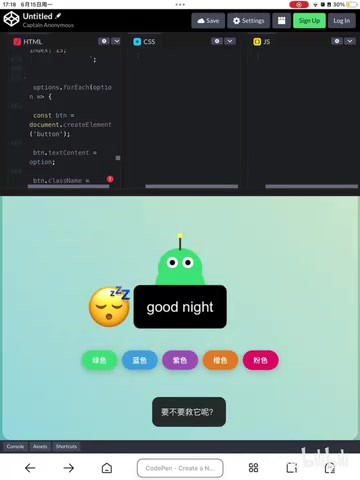
The game opens with a simple but effective choice scenario — "Should I save him?" The player faces a character in need and must make a decision.
If you choose "Don't save," the game ends abruptly with a cold "good night" — blunt, but dripping with dark humor. Choosing "Save," on the other hand, kicks off an even more bizarre adventure: an alien takes a puppy back to a creepy home, eats the puppy, and then the alien goes to the bathroom… The plot veers completely off the rails of conventional logic, but that's precisely what makes it a showcase of the young creator's unique imagination.
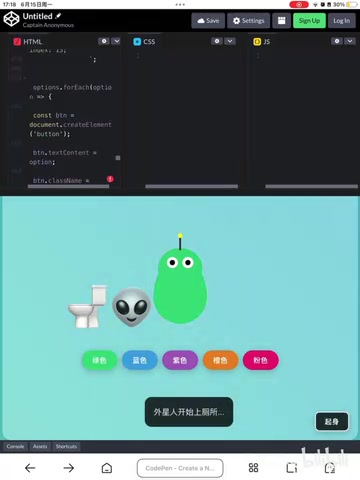
This storyline wraps up with "A green alien wax-worm-dog appeared inside the dock" — a scene that's equal parts eerie and childlike.
Branch Storyline: An Ice Cream That Changes Your Fate
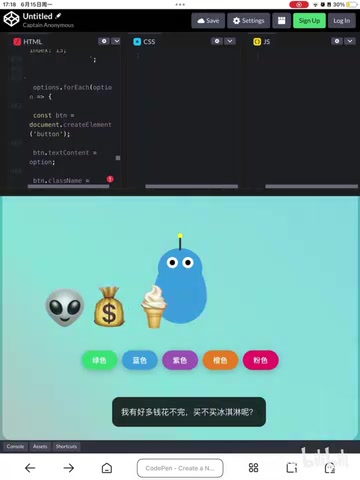
Another major branch revolves around "sell or don't sell ice cream" — another classic binary choice structure.
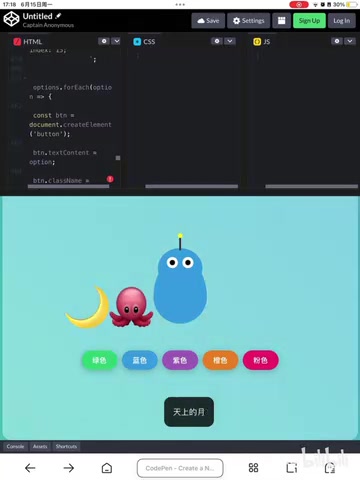
Choosing "Don't sell": The moon in the sky turns into a purple octopus, the alien starts melting, and the player meets a "you died" ending. This branch uses surreal imagery to create an apocalyptic atmosphere.
Choosing "Sell": The alien pays for ice cream, but the coin suddenly turns into a knife, a fly starts gnawing on the ice cream, the alien gets angry and eats the fly, leading to "the real end." This path, while equally absurd, has a relatively complete chain of cause and effect.
It's worth noting that these seemingly absurd images — "the moon turning into a purple octopus," "a coin turning into a knife" — have an interesting resonance with the Surrealism art movement. Founded by André Breton in 1924, Surrealism's core philosophy was to bypass rational control and unleash the creativity of the subconscious. Salvador Dalí's melting clocks and René Magritte's floating boulders are iconic examples. This middle schooler's free associations, untrained in "logical consistency," combined with AI's characteristic of faithfully executing any instruction, inadvertently recreated Surrealism's "Automatic Writing" method — letting the stream of consciousness flow without censorship, often producing results with a unique artistic tension.
From "Toy" to Trend: The Real Value of AI Game Creation Tools
What Does Zero Barrier to Creation Actually Mean?
From a technical standpoint, this game isn't complex — branching narratives, text with images, simple interactive logic. But the key point is that the creator had absolutely no programming background. In a traditional development workflow, even a simple text adventure like this would require basic programming logic, interface design, and asset creation skills. With AI tools, the middle schooler only needed to provide creative ideas and plot concepts, while AI handled the technical implementation.
The core capability of current AI-assisted creation tools comes from the code generation ability of Large Language Models (LLMs). These tools can transform natural language descriptions into executable code — essentially a "translation" ability formed by training on massive amounts of open-source code and documentation, converting human intent into machine instructions. A user only needs to describe in everyday language, "I want a scene where you choose to save or not save someone, and if you don't save them, the game ends," and the AI automatically generates the corresponding HTML/JavaScript code or game engine scripts. This "natural language programming" paradigm is fundamentally redefining what it means to be a "developer" — you don't need to know how to write code; you just need to know how to speak and describe what you want.
This means the bottleneck of creation has shifted from "Can I build it?" to "Do I want to build it?" and "Is my imagination rich enough?" From this perspective, this middle schooler clearly has no shortage of imagination.
The Double-Edged Sword of Content Quality
Objectively speaking, the game's plot logic is chaotic, the narrative is fragmented, and many twists lack coherence. But consider another perspective:
-
For learners, the ability to quickly turn ideas into a working product is itself an enormous positive feedback loop. This relates to the well-known "Flow Theory" and "Self-Determination Theory" in psychology. Psychologist Mihaly Csikszentmihalyi proposed that people most easily enter a highly focused "flow" state when the challenge level matches their skill level and they receive immediate feedback. The problem with traditional programming education is the long "silent period" between learning syntax and producing a working product — a stage where many beginners drop out. AI tools compress this feedback cycle from weeks to minutes, dramatically reducing the probability of the "frustration-abandonment" loop, which is especially critical for young learners. This instant gratification motivates creators to keep iterating and improving.
-
For creative exploration, expression unconstrained by technical limitations can actually spark unexpected creative breakthroughs. Those ideas about "the moon turning into a purple octopus" or "a coin turning into a knife," while absurd, carry a distinctly surrealist artistic flavor.
What AI-Assisted Game Creation Still Needs
This case also exposes the limitations of current AI creation tools: the generated content lacks deep narrative structure, and the quality of visuals and text is inconsistent.
The most fundamental challenge is AI's "long-range coherence" problem. Current large language models, based on probabilistically predicting the next token, excel at local coherence but lack the ability to plan narratives at a global level. Some cutting-edge research is exploring solutions: for instance, introducing hierarchical "story outline" planning, where the AI first generates a macro-level plot skeleton before filling in details; or using "Narrative Graph" technology that pre-defines structural constraints like character motivations, escalating conflicts, and thematic arcs. Latitude's AI Dungeon and Inkle's Ink scripting language are already exploring hybrid models of AI-human collaborative storytelling, but we're still a considerable distance from a true "AI narrative mentor."
Future AI creation tools need continuous improvement in the following areas:
- Narrative guidance: Helping creators build more coherent plot frameworks, rather than merely executing instructions. The ideal AI tool should gently remind creators when they're going wild — "What's this character's motivation?" "This twist needs some foreshadowing" — guiding creation like an experienced screenwriting mentor.
- Style consistency: Ensuring that generated visual and textual styles remain unified and harmonious, avoiding jarring shifts between multiple art styles within the same game.
- Interaction depth: Supporting more complex game mechanics beyond simple binary choices — such as numerical systems, character relationship networks, random events, and other richer layers of interactivity.
Conclusion: An Era Where Creativity Is Unleashed by Technology
A middle school student with zero programming experience used AI tools to create an interactive game bursting with personal style. While the finished product is still rough, the act itself is the perfect footnote for the democratization of creation through AI.
This wave of "creative democratization" is happening simultaneously across the entire digital content landscape. Since 2023, Roblox has launched an AI code assistant, Unity has integrated AI generation tools, and Epic Games' MetaHuman technology has shortened character creation from months to hours. Even more radically, tools like Scenario and Leonardo.ai enable non-professionals to generate game art assets. It's not limited to games — music (Suno, Udio), video (Runway, Pika), 3D modeling (Meshy, Tripo), and other fields are all experiencing a similar collapse of barriers. Industry research firm Newzoo predicts that by 2027, over 30% of indie games will deeply integrate generative AI into their development pipelines.
When technical barriers are no longer obstacles, every wild idea in anyone's mind has a chance to become reality — even if that reality includes moons turning into purple octopuses and aliens fighting over ice cream.
This is perhaps the most fascinating thing about the AI era: Creativity is no longer held hostage by technology — it's set free by it. And this middle schooler's case is a small but vivid microcosm of that grand narrative — reminding us that the next great game idea might not be born in some major studio's office, but at a middle schooler's desk after school.
Related articles

The Compute Crisis: Why Google and Anthropic Are Paying SpaceX a Premium to Rent GPUs
Microsoft, Google, and Anthropic face severe compute shortages. Anthropic pays SpaceX $1B/month for GPUs. From TSMC capacity to HBM, storage, and power, the AI supply chain is in full crisis.

Mistral Le Chat Image Generation Review: Can It Replace Fable?
Mistral AI launches image generation in Le Chat, dubbed Le Chaton Fat. We analyze its capabilities, compare it with Fable, and explore the trend of AI chat platforms integrating image generation.

Testing DeepSeek's Safety Mechanisms: Multiple Jailbreak Attempts Successfully Blocked
An overseas security blogger systematically tested DeepSeek's jailbreak resistance using direct requests, rephrased prompts, and varied strategies. Results show robust intent recognition, consistent blocking, and context-aware safety mechanisms.