Mistral Le Chat Image Generation Review: Can It Replace Fable?
Mistral Le Chat adds image generation, challenging specialized tools like Fable in the multimodal AI race.
Mistral AI has launched image generation capabilities in its Le Chat assistant, with the community-dubbed "Le Chaton Fat" feature drawing comparisons to Fable. This move reflects the broader trend of chat platforms integrating image generation, following ChatGPT's DALL-E and Gemini's Imagen. While specialized tools retain advantages in fine-grained control, Le Chat's quality signals growing competition in the AI image generation market and highlights Europe's rising AI influence.
Mistral Le Chat's Image Generation Feature Sparks Buzz
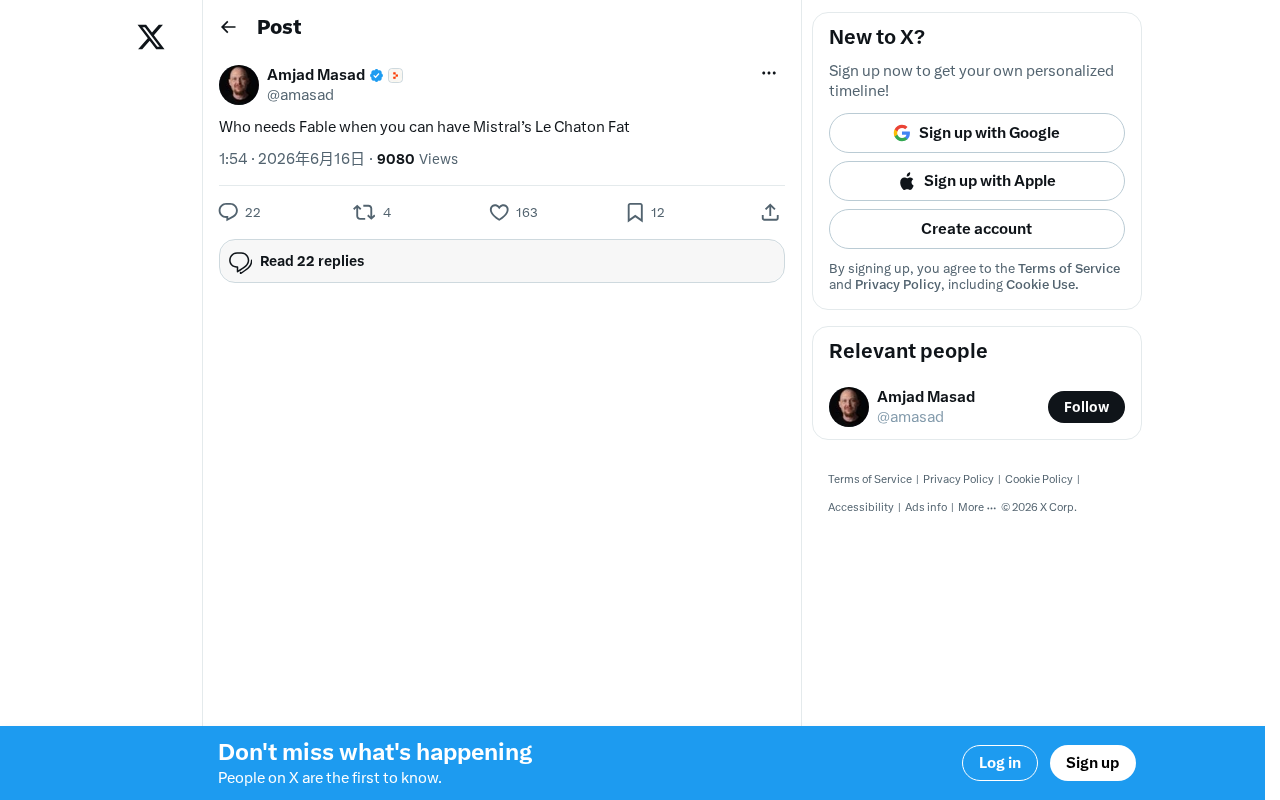
Mistral AI recently launched image generation capabilities in its chat assistant Le Chat, and one particular feature — playfully dubbed "Le Chaton Fat" (Fat Kitten) by the community — has quickly sparked widespread discussion. One user bluntly stated on social media: "With Mistral's Le Chaton Fat, who even needs Fable?"
This comment directly pits Mistral Le Chat's image generation capabilities against Fable — a tool specializing in AI image and video generation — suggesting that Le Chat has already achieved considerable competitiveness in the image generation space.
Mistral AI's Multimodal Strategic Vision
From Language Models to a Multimodal AI Platform
As one of Europe's most prominent AI companies, Mistral AI has long been known for its high-quality open-source language models. From Mistral 7B to the Mixtral series, this French company has built a solid technical reputation in the large language model space. Mistral 7B, released in September 2023, outperformed competing models with several times more parameters across multiple benchmarks despite having only 7 billion parameters. Its core innovations included Grouped-Query Attention (GQA) and Sliding Window Attention (SWA) mechanisms — the former significantly reduces memory usage during inference by sharing key-value heads, while the latter enables the model to efficiently process long text sequences within a limited computational window. The subsequent Mixtral 8x7B introduced the Mixture of Experts (MoE) architecture, whose core idea is to split the model into multiple "expert" sub-networks, activating only a subset of experts during each inference pass. This keeps actual computational costs at small-model levels while maintaining large-model performance. This "punching above its weight" technical approach earned Mistral widespread recognition from the developer community.
Now, Mistral is expanding its capabilities into the multimodal domain, and Le Chat's image generation feature is a key move in this strategy. Multimodal AI refers to artificial intelligence systems capable of simultaneously understanding and generating multiple information modalities such as text, images, audio, and video. The technical evolution of this field has gone through several key milestones: OpenAI's CLIP model, released in 2021, achieved high-quality semantic alignment between text and images for the first time, laying the foundation for subsequent text-to-image generation; the 2022 breakthrough in Diffusion Models — particularly the open-sourcing of Stable Diffusion — made high-quality image generation accessible to everyone; and the current frontier involves deeply integrating large language models' reasoning capabilities with image generation abilities, enabling AI not just to "draw it" but to "think it through before drawing." Mistral's leap from language models to multimodal AI is perfectly aligned with this technological trend.
As Mistral's official chat assistant product, Le Chat is positioned similarly to OpenAI's ChatGPT or Google's Gemini. With the addition of image generation capabilities, Le Chat is evolving from a pure text conversation tool into a comprehensive multimodal AI assistant platform.
Le Chat vs. Fable: A Competitive Comparison
Fable is a well-known tool in the AI image generation space, popular among creators for its distinctive stylized image generation capabilities. Fable's core strength lies in its precise control over specific artistic styles — from animation-style character design to cinema-grade concept art, Fable provides a workflow tailored for professional creators, allowing users to fine-tune outputs through advanced features like style reference images and character consistency controls. By comparison, Midjourney is renowned for its exceptionally high default aesthetic quality and community-driven iteration model, Stable Diffusion has become the go-to choice for tech enthusiasts and enterprise custom deployments thanks to its fully open-source architecture, and the DALL-E series leverages OpenAI's brand power and ChatGPT's massive user base to claim a significant share of the general market. Each tool has found its own differentiated position in the image generation race.
The fact that users are voluntarily comparing Mistral Le Chat's image generation feature with Fable speaks volumes — it indicates that Le Chat has reached a level of image quality and stylistic expressiveness that cannot be ignored.
Of course, a single user's assessment doesn't constitute a comprehensive product comparison, but this kind of spontaneous recommendation from actual users often reflects a product's true competitiveness more accurately than official marketing.
The AI Image Generation Market Is Being Reshaped
Chat Platform Integration of Image Generation Has Become Mainstream
A notable trend in the current AI industry is that mainstream chat platforms are integrating image generation capabilities one after another. ChatGPT has integrated DALL-E, Google Gemini has built-in Imagen, and Mistral's Le Chat has now officially joined this movement. Notably, these integration approaches differ in their technical implementations: OpenAI's DALL-E 3 integration with ChatGPT employs a "language model prompt rewriting" strategy, where ChatGPT first expands the user's brief description into a detailed image generation prompt before passing it to DALL-E for rendering — this approach significantly lowers the barrier for prompt engineering; Google's Imagen is deeply embedded within Gemini's multimodal architecture, leveraging Gemini's native cross-modal understanding capabilities to guide image generation, achieving tighter text-image interaction. The specific technical approach Mistral uses for integrating image generation into Le Chat hasn't been fully disclosed, but based on user feedback, it has already demonstrated considerable maturity in stylistic expression and generation quality.
This "one-stop-shop" product strategy is changing user habits — there's no longer a need to switch between multiple specialized tools, as a single platform can handle text conversations, image creation, and more.
Specialized Image Generation Tools Face New Challenges
This trend poses potential pressure on specialized AI image generation tools like Fable and Midjourney. When general-purpose AI assistants deliver sufficiently impressive image generation quality, some users may reduce their reliance on specialized tools. However, specialized tools still hold advantages in fine-grained parameter control, specific artistic styles, and professional workflow integration — for example, Midjourney's "Stylize" and "Chaos" parameters, as well as the deep integration of open-source workflow orchestration tools like ComfyUI with Stable Diffusion, are capabilities that general chat platforms will find difficult to fully replicate in the short term. Therefore, the two are more likely to form a complementary rather than substitutive relationship in the near term: general platforms serve everyday creation and rapid prototyping needs, while specialized tools cater to professional scenarios demanding higher quality and control.
The Rise of European AI and User Choice
Mistral AI's continued progress also reflects the rise of European AI power. Against the backdrop of U.S. tech giants dominating the AI industry, this French company is establishing a firm foothold in the global AI market through strong technical capabilities and differentiated strategies. Mistral's rise is closely tied to Europe's unique AI policy environment. The EU AI Act, officially passed in 2024, is the world's first comprehensive legal framework regulating AI. It classifies AI applications by risk level for tiered regulation and imposes transparency and safety requirements on general-purpose AI models (including large language models). While this regulatory framework increases compliance costs in the short term, it also creates differentiated competitive advantages for European companies like Mistral that emphasize open-source transparency — compared to American companies that frequently face scrutiny over data privacy and model transparency, Mistral's European DNA and open-source strategy naturally align with the EU's regulatory philosophy. Additionally, the French government's strong support for the AI industry — including billions of euros allocated to AI under the "France 2030" investment plan — has provided crucial funding and policy support for companies like Mistral. In this context, Mistral is not just a technology company but is seen as Europe's "standard-bearer" in the global AI race.
The launch of Le Chat's image generation feature further enriches Mistral's product portfolio and offers global users more diverse choices.
For users keeping an eye on AI tools, Le Chat's image generation feature is worth trying firsthand. Especially for developers and creators already using Mistral's language models, gaining access to high-quality image generation within the same platform can significantly enhance the overall user experience and creative efficiency.
Key Takeaways
Related articles

The Compute Crisis: Why Google and Anthropic Are Paying SpaceX a Premium to Rent GPUs
Microsoft, Google, and Anthropic face severe compute shortages. Anthropic pays SpaceX $1B/month for GPUs. From TSMC capacity to HBM, storage, and power, the AI supply chain is in full crisis.

Testing DeepSeek's Safety Mechanisms: Multiple Jailbreak Attempts Successfully Blocked
An overseas security blogger systematically tested DeepSeek's jailbreak resistance using direct requests, rephrased prompts, and varied strategies. Results show robust intent recognition, consistent blocking, and context-aware safety mechanisms.
A Middle Schooler with Zero Coding Skills Built a Story-Driven Game with AI: Creativity Unshackled from Technical Barriers
A middle schooler with no coding experience used AI to build an interactive story game with branching choices and surreal alien adventures. We explore what this means for creative democratization.