Agent Skills Architecture Explained: Modular AI Agent Development and How It Differs from MCP

Anthropic's Agent Skills architecture enables modular, pluggable AI agent development — distinct from MCP.
This article provides a comprehensive analysis of Anthropic's Agent Skills architecture, a modular framework for building enterprise AI agents through standardized, dynamically loadable skill packages. It explains the core mechanism of encapsulating LLM instructions, metadata, and resources into reusable units, clarifies the fundamental difference between Agent Skills (an architecture) and MCP (a protocol), and highlights how this approach solves key enterprise pain points like functional coupling and poor reusability.
What Is the Agent Skills Architecture
In the world of AI agent development, a new technical architecture is rapidly gaining traction — Agent Skills. Formally introduced by Anthropic and released as an open standard, this framework is redefining how enterprise-grade AI agents are built.
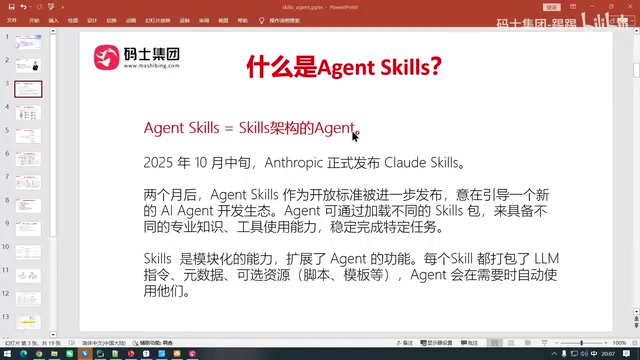
Put simply, "Skill" means exactly what it sounds like — a capability. The Agent Skills architecture is a development framework and technical solution for building AI agents. When an enterprise needs to develop an agent-based application, Agent Skills provides a standardized architectural blueprint that makes the development process more structured and efficient.
The emergence of Agent Skills is no accident. Enterprise AI Agent development is currently at a critical inflection point — transitioning from proof-of-concept (PoC) to production deployment. According to a McKinsey 2024 report, over 65% of enterprises have experimented with generative AI, yet fewer than 20% have achieved deployment at scale. One of the core reasons for this gap is the lack of standardized engineering architecture. Many enterprise agent projects are still stuck in a primitive stage of "Prompt stitching + API calls," resulting in poor code maintainability and low team collaboration efficiency. This situation closely mirrors the monolithic application struggles before the rise of microservices architecture around 2010 — it was only through an architectural paradigm shift that cloud-native applications achieved large-scale adoption. Agent Skills was born to address this very industry pain point.
Core Definition and Technical Implementation of Agent Skills
Modular Capability Encapsulation
The core idea behind Agent Skills can be summed up in one sentence: An AI agent gains different domain knowledge and tool-use capabilities by loading different Skills packages, enabling it to accomplish specific tasks.
This concept should feel familiar to developers with programming experience:
- Similar to the Package mechanism in Java
- Similar to Module imports in Python
- Essentially, it's about modularizing and encapsulating each capability of an agent
Modular encapsulation is a core design paradigm in software engineering that has been validated over decades. From the information hiding principle proposed by David Parnas in the 1970s, to the encapsulation concept in object-oriented programming, to service decomposition in microservices architecture, modular thinking has consistently driven improvements in software development efficiency. Introducing this concept into the AI agent domain is particularly critical — because an agent's capability boundaries are often fuzzy and dynamically changing, making traditional monolithic Prompt engineering inadequate for complex enterprise scenarios. Agent Skills brings this mature engineering practice into AI Agent development, giving each capability unit independent lifecycle management.
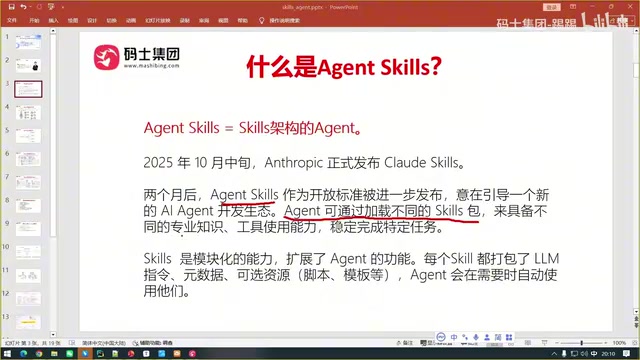
Each Skill can be packaged as an independent unit containing the following elements:
- LLM Instructions: Define the behavioral logic of the skill
- Metadata: Describe the skill's purpose, version, dependencies, etc.
- Resources: Data and configurations required for the skill to run
At runtime, the agent can automatically and dynamically load and use these Skills packages, achieving a flexible, on-demand composable architecture. This dynamic loading mechanism draws from design concepts in operating systems (dynamic link libraries — DLL/SO) and container orchestration. During execution, the agent's Orchestrator layer analyzes user input intent, retrieves matching Skills packages from a skill registry, and loads them into the current execution context. This process involves multiple stages including skill discovery, dependency resolution, context injection, and execution isolation. Compared to static configuration, the advantage of dynamic loading is that the agent doesn't need to preload every skill it might potentially use, effectively controlling token consumption within the context window — which is especially important given that context length in large language models remains a scarce resource.
Why Agent Skills Is a Development Ecosystem
Anthropic's goal in releasing Agent Skills is crystal clear — to foster a new AI Agent development ecosystem. This means:
- Standardization: Skills developed by different teams can be compatible with and reusable by one another
- Ecosystem Building: Creating a skill package ecosystem similar to npm or pip
- Engineering Maturity: Moving agent development from "artisanal craftsmanship" to "industrial production"
The ecosystem model that Agent Skills aspires to has successful precedents in the software industry. npm (Node Package Manager) hosts over 2 million JavaScript packages with billions of weekly downloads, dramatically accelerating the growth of the frontend and Node.js ecosystem. Python's pip and PyPI ecosystem similarly hosts over 500,000 packages. The success of these package management ecosystems proves a key pattern: once a technology domain establishes a standardized module distribution mechanism, the entire community's innovation velocity grows exponentially. Anthropic's strategic intent in promoting the Agent Skills ecosystem is precisely to replicate this success in the AI Agent space — accelerating industry-wide progress by lowering the barrier to skill reuse.
The Fundamental Difference Between Agent Skills and MCP
A Common Misconception Online
There is currently a flood of content online comparing Agent Skills with MCP (Model Context Protocol), which is actually a serious conceptual conflation. A large number of websites are making this inappropriate comparison.
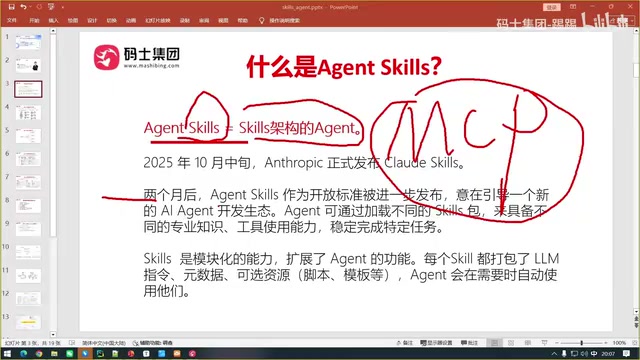
They Exist on Different Dimensions
To understand why this conflation is inappropriate, we first need to clarify the technical nature of MCP. MCP (Model Context Protocol) is an open communication protocol released by Anthropic in late 2024, designed to standardize how large language models interact with external data sources and tools. MCP adopts a client-server architecture, communicates via JSON-RPC 2.0 message format, and supports two transport layers: stdio and HTTP+SSE. It defines three core primitives: Resources (for exposing data to the model), Tools (for enabling the model to perform actions), and Prompts (for standardizing interaction patterns). MCP solved the M×N problem where every AI application previously needed custom integration code for different data sources, simplifying it into an M+N standardized connection model.
Once you understand MCP's positioning, the distinction becomes immediately clear:
| Dimension | Agent Skills | MCP |
|---|---|---|
| Nature | Technical framework / Development architecture | Network protocol |
| Function | Modular solution for AI agents | Communication protocol used in agent development |
| Level | Architecture layer | Protocol layer |
Here's a simple analogy: it's like comparing the architectural blueprint of a building (Skills architecture) with a specific plumbing standard used within that building (MCP protocol) — they simply aren't on the same dimension and aren't directly comparable.
Of course, if we must describe their relationship, it's this: in actual agent development, you might use the MCP protocol within the Skills architecture to implement certain communication functions. For example, when a Skill needs to call an external database or a third-party API during execution, it can absolutely use MCP to handle that interaction. But this is a "contains" or "uses" relationship — not a "competes with" or "replaces" relationship.
Enterprise Development Pain Points That Agent Skills Addresses
In traditional agent development, enterprises face several core pain points:
- Severe Functional Coupling: All capabilities are written together, making maintenance and extension difficult
- Poor Reusability: Capabilities developed for one project can't be easily migrated to another
- Collaboration Difficulties: Different teams struggle to develop different agent capabilities in parallel
- High Extension Costs: Adding new features often requires large-scale refactoring
The Agent Skills architecture, through its modular design, turns each skill into an independent, pluggable unit, fundamentally solving these problems. Development teams can assemble different Skills like building blocks based on business requirements, rapidly constructing agent applications tailored to specific scenarios.
The efficiency gains from this architectural shift are significant. Take a typical enterprise customer service agent as an example: under the traditional development model, functions like order inquiry, refund processing, and product consultation are often coupled within a massive system Prompt and codebase, where modifying any single function can affect the stability of others. Under the Agent Skills architecture, each business capability is encapsulated as an independent Skill — "Order Inquiry Skill," "Refund Processing Skill," "Product Knowledge Base Skill" — each with its own independent Prompt instructions, tool-calling logic, and test cases. They can be developed in parallel by different teams, deployed independently, and iterated on separate version tracks without interfering with one another.
Summary: The Core Value of the Agent Skills Architecture
As an emerging technical standard, Agent Skills represents a major trend in agent development — evolving from "monolithic applications" to "modular architecture." Its core value lies in:
- Standardizing and modularizing agent capabilities
- Supporting dynamic loading for on-demand composition
- Building an open skill ecosystem
For enterprise developers, understanding and mastering the Agent Skills architecture will become an essential competency in AI application development. As the ecosystem matures, we have every reason to look forward to a more efficient, standardized era of agent development. From a broader perspective, the significance of the Agent Skills architecture goes beyond modular improvements at the technical level — it has the potential to establish a "common language" for the AI Agent domain. Just as RESTful APIs standardized web service interactions and Docker containers standardized application deployment, Agent Skills has the potential to standardize how agent capabilities are defined, distributed, and composed — truly ushering in the industrialization era of AI Agents.
Related articles
Claude Code Workflow in Practice: From Requirement Grilling to AFK Agent Auto-Coding
A detailed walkthrough of building real features with Claude Code: Grill Me requirement interrogation, auto-generated PRDs, AFK agent coding, and QA iteration loops with DDD and TDD strategies.

A Gen-Z Woman Making $1.5M/Month: Deconstructing the Growth Methodology Behind AI Apps
Gen-Z indie dev Nicole built 4 hit AI apps earning $1.5M/mo. Deep dive into her industrialized UGC engine, traffic testing system, and minimalist tech stack.
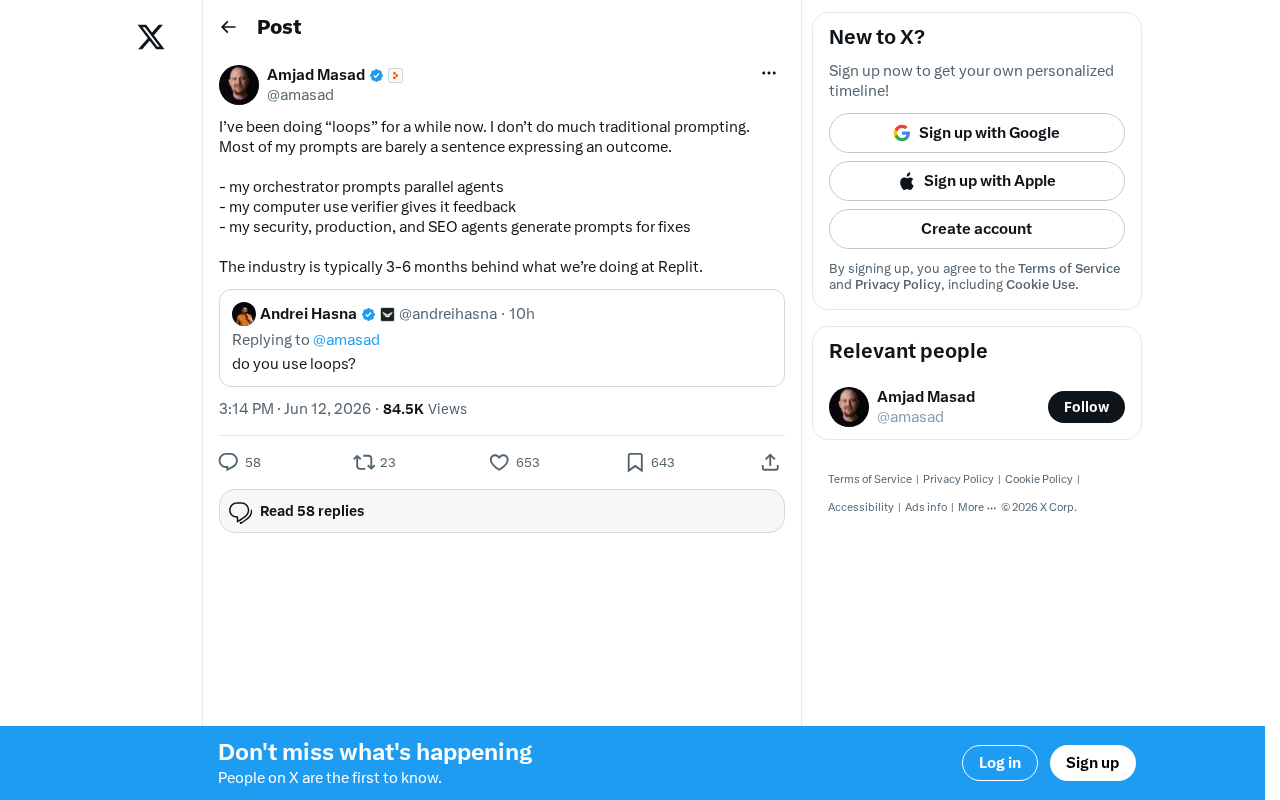
Replit's AI Loops Workflow Explained: Multi-Agent Collaboration Replaces Prompt Engineering
Deep dive into Replit's AI Loops workflow: how orchestrators, parallel agents, and Computer Use Verifiers build automated closed-loop systems through multi-agent collaboration.