Replit's AI Loops Workflow Explained: Multi-Agent Collaboration Replaces Prompt Engineering
Replit's Loops pattern replaces prompt engineering with multi-agent orchestration and automated verification.
Replit's AI Loops workflow introduces a paradigm shift from crafting prompts to designing multi-agent systems. An orchestrator decomposes goals into parallel agent tasks, a Computer Use Verifier autonomously validates outputs, and specialized agents handle security, production, and SEO fixes — all forming a closed-loop system that iterates without human intervention.
From Prompts to Loops: A Paradigm Shift in AI Development
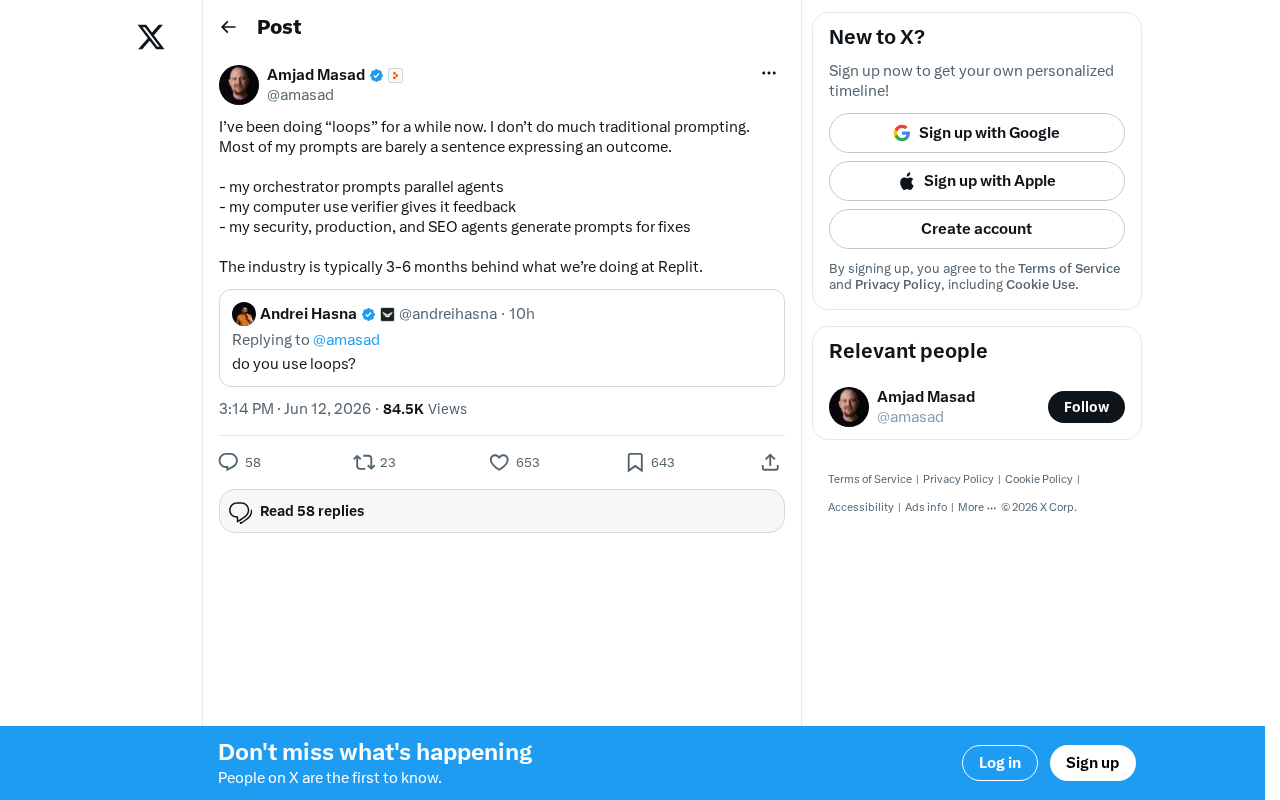
A Replit team member recently shared a cutting-edge AI development workflow on Twitter — the "Loops" pattern. This approach fundamentally upends traditional prompt engineering: instead of crafting elaborate prompts, developers build an automated closed-loop system powered by multiple AI agents working in concert.
Replit is an online integrated development environment (IDE) company founded in 2016, with its core product being a browser-based collaborative coding platform. Since 2023, Replit has invested heavily in AI-assisted development, launching Replit Agent — an AI agent capable of building complete applications from natural language descriptions. Unlike GitHub Copilot, which primarily focuses on code completion, Replit Agent is positioned more as a "full-stack AI developer," handling the entire pipeline from project initialization, code writing, and database configuration to deployment. It's precisely this technical foundation that enabled the Replit team to explore the more radical "Loops" development pattern.
As the developer put it: "Most of my prompts are barely a sentence long, expressing a desired outcome." While this sounds simple, it represents a deep architectural shift in how AI applications are built.
Core Design of the Loops Architecture
Orchestrator + Parallel Agents
At the heart of this system is an Orchestrator responsible for decomposing tasks and distributing them across multiple AI agents running in parallel. Developers only need to express their end goal to the orchestrator — no manual step-by-step breakdown required. The orchestrator automatically determines which agents to invoke, in what order to execute them, and how to coordinate dependencies between them.
The orchestrator concept originates from service orchestration patterns in distributed systems and microservices architecture. In traditional software engineering, container orchestration tools like Kubernetes manage and schedule multiple service instances; in the AI domain, the orchestrator's role is to coordinate multiple large language model (LLM) calls and interactions between agents. Several orchestration frameworks already exist in the industry, including LangChain's Agent Executor, Microsoft's AutoGen, and CrewAI, all attempting to solve the same problem: how to make multiple AI agents collaborate efficiently on complex tasks. The core challenges an orchestrator must handle include task decomposition (breaking high-level goals into executable subtasks), dependency management (determining the sequence and data flow between subtasks), and error handling (how to roll back or retry when an agent fails).
The key advantage of this design: humans shift from being "instruction writers" to "goal setters," while the AI system plans and executes the path to get there on its own.
Computer Use Verifier
The system also includes a Computer Use Verifier that can physically interact with a computer interface to verify whether AI-generated results meet expectations, feeding information back into the system. This creates a critical feedback loop — the AI doesn't just generate code or content, it autonomously validates output quality and automatically triggers remediation when issues are found.
The underlying technology here is the rapidly evolving "Computer Use" capability. In October 2024, Anthropic was the first to release Claude's Computer Use feature, enabling AI to operate a computer like a human — moving the mouse, clicking buttons, typing text, capturing screenshots, and understanding interface content. This technology is built on the visual comprehension capabilities of multimodal large models: the AI takes screenshots to capture the current interface state, then generates corresponding operation commands. Google's Project Mariner and OpenAI's Operator are exploring similar directions. In the context of development verification, this means the AI can actually open a browser to inspect a deployed webpage, check whether UI rendering is correct, and test whether interactive features work properly — far closer to real user experience than static code analysis alone.
This component addresses the biggest pain point in traditional AI workflows: the lack of an automated quality verification mechanism. Previously, developers had to manually inspect AI outputs; now this process is handled by AI as well.
Specialized Repair Agents
When the verifier detects issues, the system calls upon three types of specialized agents to generate fixes:
- Security Agent: Detects and remediates security vulnerabilities, including common risks like SQL injection, cross-site scripting (XSS), and authentication flaws
- Production Agent: Ensures code stability in production environments, addressing engineering concerns like performance optimization, error handling, logging, and fault tolerance
- SEO Agent: Optimizes search engine-related technical metrics, including meta tags, structured data, page load speed, mobile responsiveness, and other technical factors that affect search rankings
Each agent handles its own domain, automatically generating targeted repair prompts that the system then executes — the entire process requires no human intervention.
Why the Loops Pattern Represents an Industry Trend in AI Development
The developer claims that "the industry is typically 3 to 6 months behind what we're doing at Replit." While this statement carries some subjectivity, from a technical evolution standpoint, the assessment isn't without basis.
The current mainstream approach to AI development still largely remains at the stage of single-turn conversations or simple chain calls. Developers spend enormous amounts of time on prompt optimization, trying to extract better outputs through more precise instructions. The Loops pattern represents a fundamental shift in thinking.
To understand the far-reaching significance of this shift, it's worth reviewing the full evolution of AI development paradigms. The first stage was Single Prompt, where developers carefully crafted a detailed prompt expecting the model to produce perfect output in one shot. The second stage was Chain, the Prompt Chaining pattern popularized by frameworks like LangChain, which breaks complex tasks into multiple sequential LLM call steps. The third stage was the ReAct (Reasoning + Acting) pattern, where AI alternates between reasoning and tool usage, gaining rudimentary autonomous decision-making capabilities. The fourth stage is the multi-agent loop system described in this article, where multiple specialized agents work in parallel, coordinated by an orchestrator, with automated verification creating a closed loop. Each paradigm leap reduces human micro-level intervention and increases AI system autonomy.
The core breakthroughs of the Loops pattern can be summarized in three points:
- From single calls to continuous loops: AI is no longer "ask once, answer once" — it iteratively optimizes within a closed loop
- From manual verification to automated verification: Autonomous quality control through the Computer Use Verifier
- From generic prompts to specialized division of labor: Different domain-specific agents each handle their own area of expertise
Practical Takeaways for Developers
This multi-agent loop workflow offers several important insights for developers:
The value of prompt engineering is being redefined. Prompt Engineering rapidly became a hot discipline after ChatGPT's release in 2022, even spawning the new job title of "prompt engineer." Early prompting techniques included Few-shot Learning, Chain-of-Thought reasoning, and various structured prompt templates. However, as model capabilities have improved and agent frameworks have matured, the industry has begun debating whether prompt engineering will become obsolete. Andrej Karpathy once compared prompt engineering to "the best programming language is English," but the emergence of the Loops pattern suggests that the core skill of the future may not be how to converse with a single model, but rather how to design the collaboration topology between multiple agents, define their responsibility boundaries, and establish communication protocols. The prompts themselves can be very short — what matters is how the system automatically generates, validates, and iterates.
Multi-agent collaboration will become standard. A single AI model can hardly simultaneously address security, performance, SEO, and other dimensions, while specialized agent division of labor can significantly improve overall output quality. This aligns directly with the microservices architecture philosophy in software engineering — decomposing a monolithic application into multiple single-responsibility services, each evolving and scaling independently, communicating through well-defined interfaces. In the AI agent context, each agent is a "microservice" with its own system prompt, toolset, and evaluation criteria.
Feedback loops are the key to achieving autonomous AI iteration. An AI workflow without verification and feedback mechanisms is fundamentally "open-loop," with uncontrollable output quality. Introducing automated verification is what truly enables autonomous AI iteration and quality assurance. This concept has deep theoretical roots in cybernetics — any system requiring precise control must have a feedback loop, otherwise errors accumulate continuously. A "closed loop" in AI development means the system can perceive quality deviations in its own output and automatically trigger correction mechanisms.
As platforms like Replit continue to push these innovations forward, the "Loops pattern" is transitioning from cutting-edge experiment to mainstream application. For AI developers, it's time to start thinking about how to shift from "writing prompts" to "designing agent systems."
Related articles
Musk's Never Give Up Philosophy: From Near Bankruptcy to Industry Disruption
Decoding the real stories behind Musk's 'I don't ever give up' — from SpaceX's three failed launches to Tesla's production hell, and what his extreme persistence means for tech entrepreneurs.
Claude Code with Local LLMs: Token-Free Deployment Guide & Configuration
Learn how to connect Claude Code to local LLMs for token-free AI coding. Covers three-layer architecture, Ollama/LM Studio/vLLM setup, protocol translation, and hardware selection.
Inventory-Free Game Design and Godot Sprite Occlusion Sorting: A Practical Tutorial
Explore inventory-free game design with mouse-drag interactions. Learn Godot sprite occlusion sorting pitfalls and solutions, plus AI-generated shader tips.