AI Agents Deep Dive: The Paradigm Shift from Chat Tools to Autonomous Execution Systems

AI is evolving from passive LLM chat tools into autonomous Agents that perceive, decide, and act — restructuring society.
AI Agents are fundamentally different from LLMs: LLMs are passive information systems, while Agents autonomously perceive environments, formulate plans, invoke tools, and execute tasks. AI execution capability has evolved through three stages — tool-based, execution-oriented Agents, and decision-making proxies — penetrating along digital, physical, and environmental paths. Despite bottlenecks like hallucination, multi-agent collaboration mechanisms are breaking through. This revolution promises explosive productivity gains but may also cause human cognitive atrophy and deep workplace structural compression.
When most people still think of AI as a clever chat tool, a profound technological transformation has already quietly taken place — AI is evolving from an "information system" into an "execution system." It no longer just answers questions; it has begun to actively perceive environments, formulate plans, invoke tools, and execute tasks. This isn't science fiction speculation — it's happening right now.
The Fundamental Difference Between AI Agents and Large Language Models
Many people conflate AI Agents with large language models (LLMs), which is the biggest cognitive barrier to understanding this revolution.
An LLM is essentially a "super brain" sealed inside a server — a purely passive information system. No matter how vast its knowledge, it only moves when humans give it instructions. You ask, it answers; you don't ask, it sits idle. It's a completely passive Q&A mode. Think of it as a sage trapped in a glass jar — brilliant mind, but unable to touch the real world.
The emergence of Agents has completely rewritten these rules. Agents can perceive their environment, formulate their own plans, invoke tools, and take direct action. You only need to give it a final objective, and it will decompose the task on its own, call whatever tools are needed, handle unexpected problems independently, and deliver the finished product to you.
In simple terms, an Agent isn't a smarter LLM — it's a complete intelligent entity that integrates an LLM, is equipped with "hands and feet," and can perceive, decide, and act.
Three Generational Stages of Execution Capability Evolution
The industry has clearly divided AI's execution capability evolution into three progressively advancing stages:
Stage One: Tool-Based AI
This is the cognitive ceiling for the vast majority of people — the ChatGPT-style single-point Q&A mode. You provide a prompt, it writes you some copy. Efficiency is indeed high, but it has zero capacity for proactive action.
Stage Two: Execution-Oriented Agents
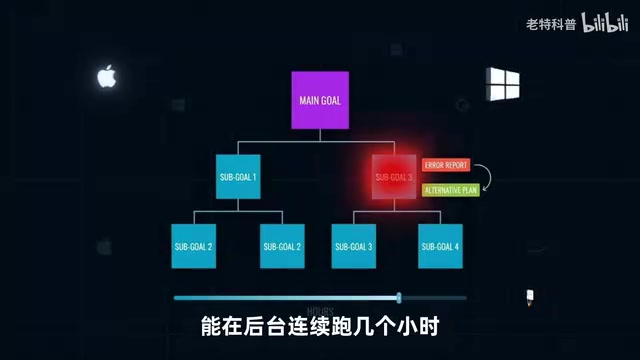
At this stage, machines have learned to "work assembly-line style." For example, if you ask it to produce an industry report, it knows to first search the entire web for the latest industry information, then extract core data, and finally format everything into a complete report. It can set its own sub-goals, find alternative solutions when errors occur, and run continuously in the background for hours until the job is done. This is the track that every Silicon Valley tech company is desperately racing to dominate.
However, early execution-oriented Agents had their share of embarrassing failures. AutoGPT, which went viral in 2023 and gained 100,000 GitHub stars in just weeks, turned out to be practically useless in real scenarios — you'd ask it to order a pizza, and it would get stuck in an infinite loop on a CAPTCHA page, burning hundreds of dollars in API costs while accomplishing absolutely nothing. It wasn't until Agents with planning and backtracking mechanisms emerged that the field finally broke out of this dead end.
Stage Three: Decision-Making Proxy
This is the ultimate form. It transcends the realm of "running errands for you" and can represent your personal will, automatically negotiating, making purchases, and even making business decisions on your behalf in the real world.
From Devin to OpenClaw: AI Agents in Practice
The people who truly broke through the technical barrier were those who stepped outside traditional academic circles. The most iconic example is Scott Wu, founder of Cognition — a top-tier coding prodigy who spent years competing in the International Olympiad in Informatics (IOI).
In early 2024, while Google and other tech giants were still obsessing over model parameter scale, Scott Wu seized upon a technical tipping point: LLMs' logical reasoning capabilities had just crossed the threshold for stable multi-step reasoning. Rather than following the big companies down the path of training larger models, he took the task decomposition skills he'd honed through competitive programming and built them into a planning control system layered on top of existing LLMs. The world's first true AI programmer — Devin — was born.
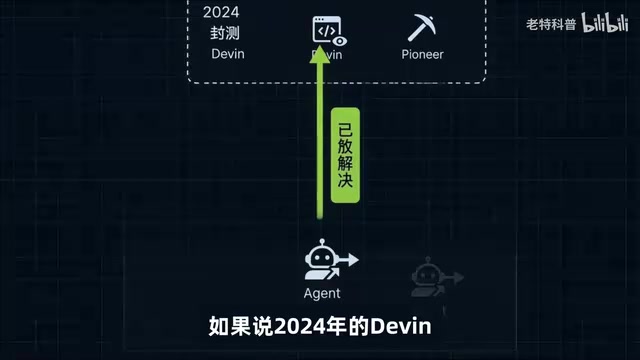
Devin demonstrated a complete, coherent execution loop in closed testing environments: you input a development requirement, and it opens the command line on its own, writes Python code, runs tests, and when console errors appear, it doesn't wait for human correction — it copies the error message, opens a browser to research the issue, then returns to the code editor to fix the bug. It proved through actual results that: machines can independently complete an entire long-chain closed-loop task in professional software environments, just like human engineers.
By 2025, Agents had long since escaped testing environments. The open-source project OpenClaw (codenamed "Crayfish") attracted attention because these Agents demonstrated the ability to complete continuous tasks across multiple software applications. Combining vision models with system control capabilities, it parses screen interfaces and generates corresponding operational behaviors — when facing legacy systems without API interfaces, it identifies interactive elements like buttons and input fields on the interface, simulates mouse and keyboard events to drive operations, and to a certain extent bypasses the limitation of "whether software provides an API interface."
Deconstructing the Four Core Architectural Components of Agents
Stripping away obscure academic jargon, the underlying architecture of Agents is actually very clear, consisting of four core components:
- Brain (LLM): The central nervous system, responsible for understanding your intent
- Planning System: The soul of the entire Agent — it breaks big goals into hundreds of granular execution steps, and when a path is blocked, it activates backtracking mechanisms to find alternatives
- Tool Invocation (Hands and Feet): Whether calling API interfaces or using visual takeover to directly operate computer interfaces, this grants the ability to intervene in the digital world
- Memory System: Short-term memory prevents losing the current thread of thought; long-term memory lets it remember past pitfalls so it doesn't get stuck in infinite loops on the same problem
Put these four components together, and you have a "digital worker" that never needs rest and carries no emotions.
Three Penetration Paths: From Screens to the Physical World
These digital workers are spreading at breakneck speed along three particularly clear penetration paths:
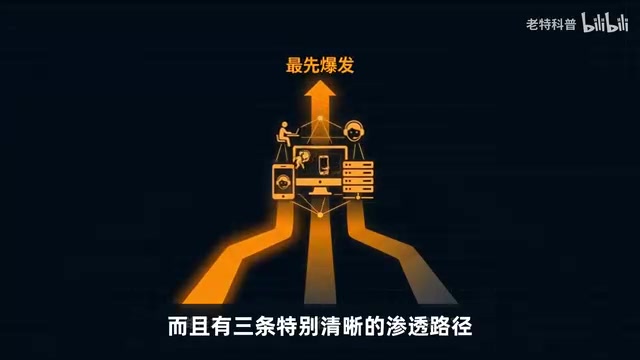
Path One: The Digital World. Agents represented by OpenClaw have begun to "dominate" the world inside screens. Microsoft and Apple are attempting to deeply embed Agents into the system-level foundations of computers and phones, extending hearing and vision through AI glasses, smartwatches, and other wearable devices to become always-ready personal proxies.
Path Two: The Physical World. Super brains are being installed in quadruped robot dogs, factory robotic arms, and autonomous vehicles. But the physical world is far more complex than digital code — the industry calls this the "Sim-to-Real Gap." Gravity, object deformation, and complex lighting conditions in the real world remain hurdles that Agents struggle to overcome.
Path Three: The Environmental World (Endgame). Future intelligent spaces will achieve truly seamless interaction. At the small scale, Agents can autonomously control every light in your home; at the large scale, they can permeate an entire city's traffic dispatch and power grid management. An entire city will become one massive, living Agent.
System-Level Bottlenecks and Multi-Agent Collaboration Mechanisms
The theory sounds great, but current Agents are more like "highly educated interns who are extremely prone to losing focus." The hallucination problem inherent in LLMs still hasn't been solved at its root — when executing complex tasks spanning hundreds of steps, if it suddenly "fabricates information" at step 99, it triggers a cascade of errors across the entire chain.
The solution that tech giants have devised is Multi-Agent Collaboration: Agent #1 specializes in writing code, Agent #2 serves as a strict tester running repeated validations, and Agent #3 acts as a project manager controlling progress. Machines supervise and correct each other, using internal adversarial mechanisms to directly suppress error rates.

Deeper Implications: The Double-Edged Sword of Productivity Explosion and Capability Atrophy
Once this technological wave achieves large-scale deployment, it brings genuine social structural reconstruction:
The Positive Side: Those who master Agents can command a swarm of Agents, instantly becoming super individuals operating at full capacity, ushering in an unprecedented productivity explosion.
The Harsh Reality: The traditional workplace pyramid is having its base and middle sections extracted by Agents. Junior clerks, data analysts, legal assistants — the skill barriers built on information transfer and organization are being completely dismantled. The future workplace will be deeply compressed: you either become the controller who issues commands, or you're reduced to a "human API" serving the machines.
The Deeper Concern: The Industrial Revolution gradually atrophied human bodies, and we didn't mind because machines handled the physical labor. But now Agents are beginning to think for us. After GPS became widespread, humans gradually lost the ability to navigate. When Agents take over product selection, trip planning, and even writing eulogies for loved ones, we'll gradually lose the ability to understand the world and make independent judgments. Once the muscles of thinking stop being exercised, they atrophy rapidly.
When we grow accustomed to easily obtaining "optimal solutions" from machines, what we lose isn't just decision-making ability — it's also the courage to bear the consequences of mistakes. Algorithms appear to be doing things for you, but in reality, they're reshaping your values in reverse.
Conclusion
The maturation of Agent technology was never as simple as "gaining one more fully automated piece of software." It will fundamentally reconstruct existing social structures, and behind this lies real wealth redistribution. Those who master Agents will become super nodes wielding the leverage of computing power, while those still trapped in old thinking patterns — treating AI as merely a text toy — will see their traditional execution skills diluted across the board and depreciated at an accelerating pace.
This critical inflection point has already arrived. Understanding the current landscape, breaking free from entrenched tool-based thinking, and repositioning yourself in the digital age — this is the only response available to us.
Related articles
 Industry Insights
AI Product Development in Practice: Model Selection, Building Moats, and Paths to Commercialization
Practical strategies for AI product development: why not to train models from scratch, when to use APIs vs. fine-tuning, building product moats, and the full path from evaluation systems to commercialization.
 Industry Insights
No Product Fits Your Needs? Building It Yourself Is the Best Starting Point for Indie Developers
Can't find a product that fits? Building from personal pain points is the best entry for indie developers. Niche needs + AI tools = rapid product creation.
 Industry Insights
OpenAI Codex Tutorials Mass-Copied on Bilibili, Highlighting AI Content Farm Problem
At least 9 Bilibili accounts mass-published identical OpenAI Codex tutorial videos, exposing content farm operations in the AI tools space.