AI Is Getting More Expensive: The Industry Truth Behind Rising Prices for Premium Models
AI Is Getting More Expensive: The Indu…
AI isn't becoming affordable — it's becoming an expensive game reserved for the wealthy.
Through evidence like an OpenAI engineer's $1.3M monthly token bill, steadily rising premium model prices, and top experts needing to join companies just to access models, this article reveals the AI industry's two price lists — cheap low-end models create an illusion of accessibility while premium model costs keep climbing. AI is heading toward unprecedented centralization, becoming a game dominated by a few companies and the wealthy, and its "democratization" narrative has lost public trust.
When an OpenAI engineer shared a screenshot of his $1.3 million monthly token bill, the entire industry should have had a wake-up call. AI isn't getting cheaper — it's getting more expensive. And this may be one of the tech industry's most well-concealed deceptions.
What a $1.3 Million Monthly Token Bill Really Means
Peter Steinberger, inventor of OpenCloud and current OpenAI employee, recently posted a jaw-dropping dashboard screenshot: he spent $250,000 on tokens in the past 7 days, and over the past 30 days, that number skyrocketed to $1.3 million.
To grasp the scale of this figure, you need to understand the basic logic of token economics. Tokens are the fundamental unit of measurement for how large language models process text — in English, one token corresponds to roughly 3/4 of a word; in Chinese, a single character typically maps to 1–2 tokens. Companies like OpenAI and Anthropic charge separately for input and output tokens, with output tokens typically costing 2–4x more than input. A $1.3 million monthly bill means that at current GPT-4-level pricing, tens of billions of tokens were processed — equivalent to thousands of books being read and rewritten repeatedly.
He posed a seemingly profound question: "If tokens were free, how would we build software in the future?" The absurdity of this question lies in the fact that it's built on a completely unrealistic assumption. As one sharp analogy put it: it's like a drug dealer asking, "If drugs were free, what would society look like?" Or asking, "If lumber were free, how would we build houses?"
The core issue isn't the hypothetical — it's the reality: The cost of using AI is climbing rapidly, not declining.
Two Price Lists: The AI Industry's Greatest Sleight of Hand
Many people hold a deeply ingrained belief that tech products follow Moore's Law — prices continuously drop until they're practically free. Moore's Law, proposed by Intel co-founder Gordon Moore in 1965, predicted that the number of transistors on integrated circuits would double every 18–24 months, with computing costs halving accordingly. Semiconductors, storage, and bandwidth have indeed followed this pattern.
But AI model pricing operates on an entirely different logic: training costs, inference compute, Reinforcement Learning from Human Feedback (RLHF), and R&D investments are all growing exponentially. GPT-4's training cost is estimated at over $100 million, and more powerful models could cost billions to train. This means the marginal cost of AI capabilities doesn't trend toward zero the way traditional software does — so the AI industry has quietly pulled a trick: it maintains two price lists.
The first list is for low-end models, whose prices are indeed dropping or staying roughly flat. This is the "progress narrative" shown to the public.
The second list is where the real battle is fought — the premium models you're forced to use when you want to do anything meaningful. Token prices for these models have been surging:
- From GPT 5.4 to 5.5, token prices doubled outright
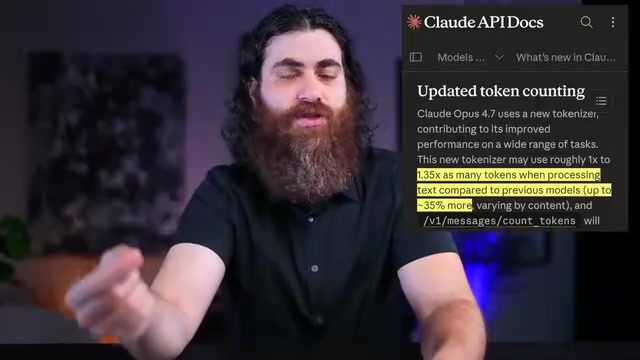
- Anthropic Opus 4.7 is nominally priced the same as 4.6, but introduced a new tokenizer that increased response length by 35% — a stealth price hike
- OpenRouter's research shows that the actual cost of using GPT 5.5 is 49% to 92% higher than GPT 5.4
A tokenizer is the algorithmic component that segments raw text into token sequences, and different versions can produce significantly different segmentations for the same text. Swapping tokenizers is an extremely covert form of price increase — users see the same listed price, but the actual number of tokens they pay for increases by 35%, effectively a 35% price hike. This mechanism is almost completely opaque to ordinary users; only heavy API users can detect it by comparing bills. Third-party platforms like OpenRouter have exposed this phenomenon through cross-model cost comparisons.
What does this mean? The AI capabilities that actually generate value are becoming increasingly expensive. Price drops on low-end models are nothing more than an elaborate misdirection, making the public believe AI is becoming universally accessible.
The Rocket Ship Only Has Three Seats: The Gulf Between AI Elites and Everyone Else
Former Google CEO Eric Schmidt recently gave a commencement speech at Arizona State University that perfectly illustrated the widening chasm between AI industry elites and ordinary people.
He told the graduates: "Say yes to the rocket ship! When someone asks you to get on a rocket ship, don't ask which seat."

The problem is, this rocket ship only has three seats, and Dario Amodei and Sam Altman took them long ago. The rocket has already launched. Schmidt is shouting "Come on up!" from the window, while the young people below can only look up — there are simply no seats left.
Even more ironic was the audience's reaction. Every time Schmidt mentioned AI, the crowd started heckling. This wasn't whispering — it was loud booing. These soon-to-be graduates facing a tough job market had lost all patience with AI elites preaching to them.
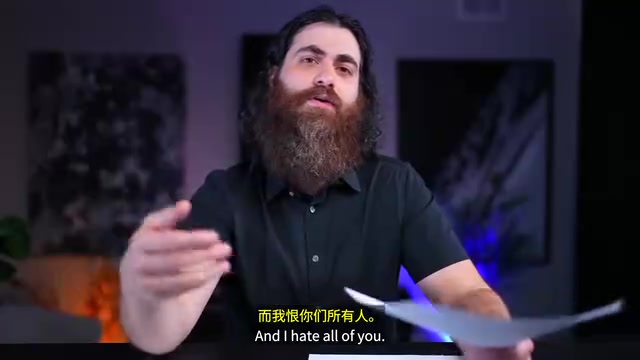
This may be the signal of a bubble bursting — when a tech mogul worth $30 billion gets collectively booed by young people at a commencement ceremony, it means the "AI for everyone" narrative has completely lost its persuasive power.
Even Top AI Experts Are "Voting with Their Feet"
One highly symbolic event: Andrej Karpathy, one of the most prominent researchers in AI, announced he was joining Anthropic — simply to gain access to their models.
Karpathy's résumé speaks to the significance of this move: he was a lecturer for Stanford's computer vision course, then joined OpenAI to work on early GPT research, and later served as Tesla's AI Director, leading the development of the autonomous driving perception system. His YouTube tutorial series Neural Networks: Zero to Hero is regarded as a foundational resource by millions of developers worldwide. The fact that someone with this caliber of academic credentials and industry experience chose to join Anthropic primarily to gain model access profoundly reveals just how scarce and concentrated cutting-edge AI capabilities have become.
What does this mean? Even top AI experts can't afford or access the most advanced AI capabilities as individuals — they have to join a company to get access. If this trend continues, Anthropic and OpenAI could become the only two "employers" that matter — not because they offer the best compensation, but because they monopolize the most powerful tools.
AI Psychosis: Fixing Bugs Faster Instead of Producing Fewer Bugs
Mitchell Hashimoto, founder of HashiCorp (and creator of the popular terminal app Ghostty), made a sharp observation: a large number of companies are suffering from "AI psychosis."
Hashimoto is an iconic figure in the DevOps infrastructure space — HashiCorp developed Terraform, Vault, Consul, and other open-source tools used by tens of thousands of enterprises worldwide, giving him deep frontline insight into engineering practices. His observation about "AI psychosis" isn't an outsider's perspective — it comes from real engineering experience.
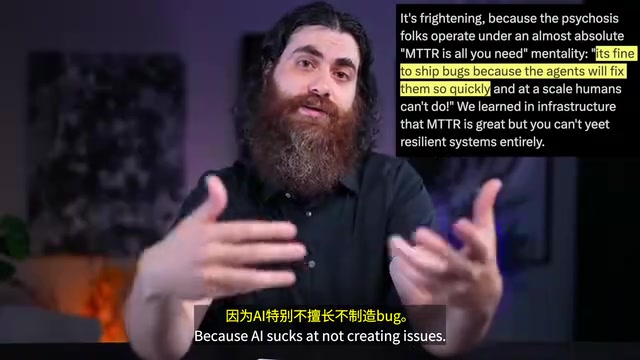
These companies are optimizing for "fixing bugs faster" rather than "producing fewer bugs." Because AI is particularly bad at not creating bugs — it's essentially a bug-manufacturing machine. But it is genuinely excellent at fixing bugs quickly.
This creates an absurd loop:
Use AI to write code → produce tons of bugs → use AI to fix bugs → produce new bugs → keep using AI to fix…
But from a business perspective, this logic actually holds up. Many companies spend enormous effort developing and shipping features that ultimately don't improve the bottom line. If you can build something in one-tenth the time, even with more bugs, ship it first to validate market demand, and fix issues later — that's actually the more rational strategy.
Where Does This Leave Ordinary People?
Airbnb CEO Brian Chesky offered advice that sounds right but feels somewhat hollow: "As long as you're a smart person who's willing to adapt and change, no matter which direction things go, you'll be totally fine."
For young people, the realistic strategies might be:
- Use AI to rapidly validate ideas: You don't have hundreds or thousands of dollars a day to spend on tokens, but you can use AI to iterate quickly and find Product-Market Fit (PMF). PMF, coined by venture capitalist Marc Andreessen in 2007, describes the state where a product precisely meets a real market need — measured by metrics like user retention and the survey question "How disappointed would you be if this product disappeared?" In the AI era, the cost of rapid prototyping to validate PMF has dropped dramatically, but competitive barriers have fallen in parallel, compressing the window of first-mover advantage.
- Validate before you invest: In the past, building an app might take a year; now you can create a prototype in 30 minutes. Check whether market demand exists first, then decide whether to invest time in polishing the code.
- Accept asymmetric competition: Those who can afford to spend on tokens can iterate far faster than you. This is reality, not something complaining can change.
But none of these suggestions can avoid a fundamental problem: AI is becoming a game exclusively for and dominated by the wealthy. Premium model prices are rising, access is tightening, and there's virtually no incentive to make it cheaper.
Final Thoughts
We are witnessing a paradox: AI is marketed as the poster child for "democratized" technology, but its trajectory points toward unprecedented centralization. The most powerful models are controlled by a handful of companies, usage costs keep climbing, and even top experts have to join these companies just to gain access.
When a former Google CEO gets booed by young people at a commencement ceremony, it's not just an awkward social moment — it's a microcosm of the entire industry's trust crisis. The AI "rocket ship" is indeed taking off, but there are far fewer seats than we've been told.
Key Takeaways
- Premium AI model prices keep rising: GPT 5.5's actual cost is 49%–92% higher than GPT 5.4, and the industry maintains two price lists to create the illusion of falling prices
- Former Google CEO's commencement speech was met with boos, revealing that the "AI for everyone" narrative has lost public trust
- Even top AI expert Andrej Karpathy had to join Anthropic to access cutting-edge models, showing AI tools are trending toward extreme centralization
- Companies are suffering from "AI psychosis": optimizing for fixing bugs faster rather than producing fewer, creating an absurd AI development loop
- AI is becoming a game for the wealthy, with rising premium model costs and no incentive to lower prices
Related articles
 Industry Insights
AI Product Development in Practice: Model Selection, Building Moats, and Paths to Commercialization
Practical strategies for AI product development: why not to train models from scratch, when to use APIs vs. fine-tuning, building product moats, and the full path from evaluation systems to commercialization.
 Industry Insights
No Product Fits Your Needs? Building It Yourself Is the Best Starting Point for Indie Developers
Can't find a product that fits? Building from personal pain points is the best entry for indie developers. Niche needs + AI tools = rapid product creation.
 Industry Insights
OpenAI Codex Tutorials Mass-Copied on Bilibili, Highlighting AI Content Farm Problem
At least 9 Bilibili accounts mass-published identical OpenAI Codex tutorial videos, exposing content farm operations in the AI tools space.