AI Conversational Programming vs. RPA: Revolution or Complementary? A Deep Dive into Capability Boundaries

AI conversational programming and RPA coexist as complements; complex automation still needs RPA for stability.
AI conversational programming tools excel at simple tasks but suffer severe stability issues with complex business workflows due to the "error accumulation effect." Many users, after being enlightened about automation by AI, return to RPA tools when implementation proves difficult. RPA remains irreplaceable thanks to its decade-plus of deterministic execution and complex logic handling. The future of automation will likely be a hybrid architecture combining AI intent understanding with RPA's stable execution.
Introduction: The Industry Shock of Conversational Programming
Many significant changes have occurred recently in the AI field, and among those with the greatest impact on the RPA (Robotic Process Automation) industry is the emergence of conversational programming tools like "Xiaolongxia" (Crayfish). Operating computers, accessing files, and executing automated actions through natural language conversation—this was once the exclusive domain of RPA, and now AI seems poised to replace it entirely.
RPA (Robotic Process Automation) as a technology originated in the early 2000s, initially driven to commercialization by companies like Blue Prism, UiPath, and Automation Anywhere. Its core principle is automating repetitive, rule-based business processes by simulating human operations on computers (such as clicking, typing, copy-pasting, etc.). RPA doesn't require modifying underlying system code but operates at the UI layer, enabling it to integrate across different systems and applications. In the Chinese market, vendors like Yingdao (影刀), Laiye, and Hongji are major players, widely deployed in scenarios such as financial reconciliation, report generation, and customer service ticket processing.
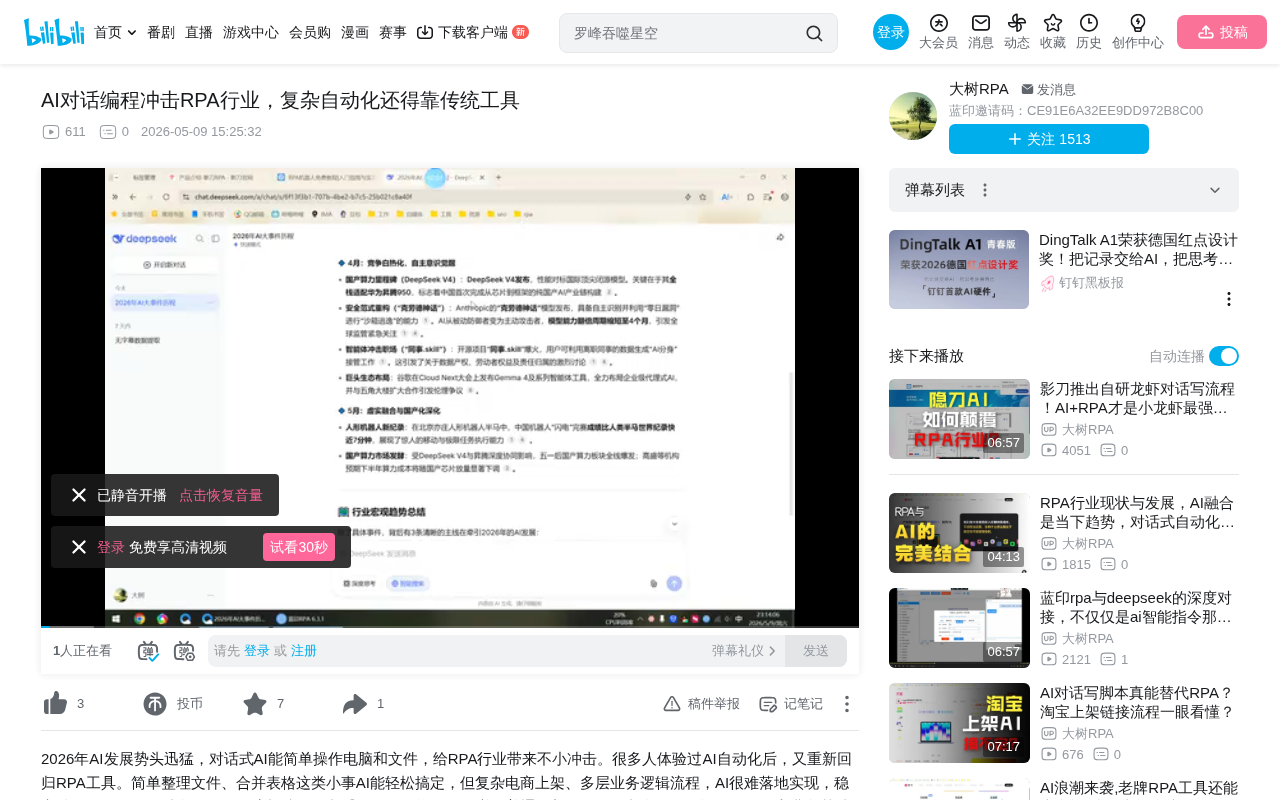
But is this really the case? An in-depth analysis from Bilibili creator "Dashu AI" offers a surprising answer: Many users actually returned to RPA tools after experiencing AI conversational programming.
Where Are the Capability Boundaries of AI Conversational Programming?
The Technical Essence of Conversational Programming Tools
Conversational programming tools like "Xiaolongxia" represent a new automation paradigm based on Large Language Models (LLMs). The technical architecture of these tools typically comprises three layers: a natural language understanding layer (parsing user intent), a code generation layer (converting intent into executable scripts), and an execution layer (performing actions through OS APIs or browser automation frameworks). Other typical representatives include OpenAI's Code Interpreter, Anthropic's Computer Use feature, and China's Manus. Their core advantage lies in zero-configuration startup—users don't need to learn specific orchestration syntax or drag-and-drop interfaces; they simply describe their needs in everyday language.
Simple Tasks: AI Handles Them with Ease
For simple, well-defined tasks, AI conversational programming indeed performs excellently. For example:
- Consolidating 100 articles from a folder into one document
- Extracting specific rows of data from three spreadsheets
- Simple file organization and format conversion
These operations have clear logic and limited steps—describing them in natural language is enough for AI to complete them, sometimes even more conveniently than traditional RPA configuration.
Complex Tasks: AI Conversational Programming Falls Short
But when task complexity increases, the situation changes entirely. Take "listing products on Taobao" as an example—this involves login verification, page navigation, form filling, image uploading, specification settings, and dozens of other steps, plus handling various exceptions (such as network timeouts, CAPTCHA pop-ups, page structure changes, etc.). Having AI complete such complex workflows through conversation often results in it "completely breaking down."
There's a technical bottleneck known as the "error accumulation effect": even if AI achieves 95% accuracy at each step, in a process containing 10 steps, the overall success rate drops to approximately 60% (0.95 to the power of 10 ≈ 0.60). The more steps involved, the faster overall reliability degrades—this is the core challenge facing current AI Agent technology.
The fundamental issues are:
- Depth of business understanding: AI needs to truly understand business logic, not merely execute instructions
- High taming cost: Users need to explain every single step clearly, making the process extremely difficult
- Insufficient stability: Conversational programming is error-prone in long workflows, lacking reliable error-handling mechanisms
Why RPA Remains Irreplaceable
A Decade of Accumulated Technical Stability
As a mature automation tool ecosystem, RPA has been developing for over a decade. Its core value lies in:
- Stable execution: Battle-tested execution engines with deterministic behavior patterns
- Complex logic support: Comprehensive conditional branching, loops, and exception handling mechanisms, supporting try-catch style error recovery
- Web operation capabilities: Specialized solutions for various web scenarios, including element locating, iframe handling, dynamic loading waits, etc.
Unlike AI's probabilistic output, every step of RPA operation is deterministic—the same input invariably produces the same output. This determinism is crucial in enterprise applications, especially in scenarios involving financial data, customer information, and other areas where errors are unacceptable.
These capabilities are not easily replaceable by AI conversational programming. As Dashu AI states, "What can truly run stably is still RPA."
AI Actually Brings New Users to RPA
An interesting phenomenon is that the popularization of AI conversational programming has actually brought new users to the RPA industry. Many people were "enlightened" by AI about automation awareness—they recognized that automation can improve efficiency, but discovered during actual implementation that AI isn't omnipotent, ultimately turning to more stable RPA tools.
This phenomenon isn't uncommon in technology diffusion—the emergence of new technology often expands market awareness for the entire category. Just as the popularity of smartwatches actually boosted traditional mechanical watch sales because more people started paying attention to the "wrist device" category. AI conversational programming plays the role of "market educator" in the automation space.
This explains why some RPA vendors have actually experienced business breakthroughs recently—AI completed the market education for them.
Changes and Challenges in the RPA Industry Landscape
Leading Companies Face Dual Pressure
For RPA industry leaders (such as Yingdao), the challenges are twofold:
- Competing with AI on capabilities: Users expect RPA tools to also offer conversational programming, lowering the learning curve
- Competing with AI on cost: The token economy model puts price pressure on traditional subscription models
Regarding the token economy model—this is the billing method for LLM services, charging based on the number of input and output tokens (roughly equivalent to word fragments). For example, GPT-4o charges approximately $5 per million input tokens, while DeepSeek's pricing is as low as less than 1 RMB per million tokens. This pay-per-use model contrasts sharply with RPA's traditional annual subscription model (typically tens of thousands to hundreds of thousands of RMB per year). For low-frequency use cases, the token model costs extremely little; but for high-frequency, large-batch automation tasks, cumulative token consumption may actually be more expensive. This pricing differential is reshaping users' cost expectations for automation tools.
This "wanting it all" situation puts enormous transformation pressure on leading companies.
The Right Strategy: Embrace AI Rather Than Fight It
Wise RPA vendors choose to integrate with AI rather than oppose it. For example, rapidly connecting with DeepSeek after its launch and actively exploring new directions like AI Agents.
DeepSeek is a series of large language models from China's DeepSeek company. DeepSeek-V3 and DeepSeek-R1 attracted industry attention for achieving performance close to GPT-4 levels at extremely low cost. Typical applications of RPA vendors integrating DeepSeek include: using AI to understand unstructured document content before triggering RPA workflows, using natural language to generate RPA scripts to lower development barriers, and calling AI during RPA execution for intelligent judgment (such as recognizing CAPTCHAs, understanding email intent, etc.).
AI Agent is one of the hottest directions in the current AI field, referring to AI systems capable of autonomously perceiving environments, formulating plans, executing actions, and adjusting strategies based on feedback. Unlike simple conversational AI, Agents possess memory, tool invocation, and multi-step reasoning capabilities. In the automation domain, the AI Agent vision is: users only need to describe the final goal, and the Agent automatically decomposes tasks, selects tools, and handles exceptions. This fusion model is known in the industry as "Intelligent Automation" and is listed by Gartner as a core component of the Hyperautomation trend.
The future of automation tools will likely be a hybrid model of "AI understanding intent + RPA stable execution"—AI handles understanding ambiguous natural language instructions and converting them into precise execution plans, while RPA reliably executes each step in a deterministic manner.
Practical Advice for Regular Users
What Foundation Do You Need to Use AI Automation?
A key insight is: To better tame AI, you need to have a certain foundation.
- If you have zero understanding of code and business logic, relying purely on AI conversation to complete complex automation is currently unrealistic
- If you understand code and business, AI can indeed dramatically boost efficiency—you can describe requirements more precisely and quickly locate and fix problems when AI makes mistakes
- If you're a beginner, RPA's visual orchestration (drag-and-drop workflow designers) is actually easier to get started with, because the WYSIWYG interface reduces the demand for abstract thinking
The core logic here is: AI conversational programming essentially transforms the act of "programming" from writing code to writing prompts, but "programming thinking"—the ability to decompose complex problems into ordered steps—remains essential.
How to Choose Automation Tools for Different Scenarios
| Scenario | Recommended Tool | Reason |
|---|---|---|
| Simple file processing | AI conversational programming | Low startup cost, completable with a single sentence |
| Complex business workflows | RPA tools | Requires stable exception handling and process control |
| Long-term stable operation needed | RPA tools | Deterministic execution, unaffected by model updates |
| One-time data processing | AI conversational programming | No maintenance needed, use and discard |
| Multi-system interaction | RPA + AI hybrid | AI handles unstructured understanding, RPA handles cross-system operations |
Conclusion: Complementary, Not Replacement
Jensen Huang once said "programmers will eventually become typists," but at least at the current stage, this prediction is far from realized. AI conversational programming and RPA are not a zero-sum game but a complementary relationship—AI lowers the cognitive barrier to automation, while RPA ensures stable execution in complex scenarios.
From a technological evolution perspective, this complementary relationship will likely persist for a considerable time. Even as AI reasoning capabilities continue to improve, enterprise demand for "predictability" and "auditability" won't disappear. An AI Agent might occasionally complete the same task via different paths, but enterprise compliance requirements often demand that each execution follows exactly the same steps—this is precisely where RPA's core advantage lies.
For practitioners and users, the most rational choice isn't to bet on one side, but to understand the capability boundaries of both and use the right tool for the right scenario. The future winners will undoubtedly be products that perfectly fuse AI intelligence with RPA stability.
Key Takeaways
- AI conversational programming excels at simple tasks but suffers from severe stability issues when facing complex business workflows (such as e-commerce product listing)
- Many users, after being enlightened about automation by AI, return to RPA tools due to implementation difficulties
- RPA remains irreplaceable in complex scenarios thanks to its decade-plus of accumulated stability and complex logic processing capabilities
- RPA industry leaders face dual pressure of competing with AI on both capabilities and cost; the right strategy is to embrace integration rather than resistance
- Taming AI for complex automation requires users to have a foundation in code and business logic
- The future form of automation will likely be a hybrid architecture of "AI understanding intent + RPA stable execution"
Related articles
 Industry Insights
AI Product Development in Practice: Model Selection, Building Moats, and Paths to Commercialization
Practical strategies for AI product development: why not to train models from scratch, when to use APIs vs. fine-tuning, building product moats, and the full path from evaluation systems to commercialization.
 Industry Insights
No Product Fits Your Needs? Building It Yourself Is the Best Starting Point for Indie Developers
Can't find a product that fits? Building from personal pain points is the best entry for indie developers. Niche needs + AI tools = rapid product creation.
 Industry Insights
OpenAI Codex Tutorials Mass-Copied on Bilibili, Highlighting AI Content Farm Problem
At least 9 Bilibili accounts mass-published identical OpenAI Codex tutorial videos, exposing content farm operations in the AI tools space.