Risks of AI Account Rotation Tools Exposed: Security Threats Behind the Gray Market
Risks of AI Account Rotation Tools Exp…
AI quota anxiety fuels gray market account rotation tools fraught with legal and security risks.
As the gap between the powerful capabilities of top-tier AI models like Claude Opus and GPT-4.5 and their strict usage limits widens, gray market "auto account-switching" tools have emerged to bypass quotas through multi-account rotation. However, these tools carry serious risks including terms of service violations, potential legal liability, data leaks, and privacy exposure. Users should opt for compliant alternatives such as pay-per-use API access, subscription upgrades, tiered model usage, or local deployment of open-source models to avoid a "Tragedy of the Commons" that harms the entire AI ecosystem.
AI Quota Anxiety Spawns a Gray Market Tool Chain
Recently, platforms like Bilibili have seen a wave of videos promoting so-called "auto account-switching" tools, claiming that by rotating through multiple accounts, users can "unlimited" access high-end AI models like Claude Opus and GPT, bypassing the official usage limits.
These tools typically consist of a local client and a browser extension. Their core function is managing a large pool of accounts — when one account's quota is exhausted, the tool automatically switches to the next, delivering a seamless, uninterrupted experience for the user.

This phenomenon is no accident. As top-tier models like Claude Opus 4 and GPT-4.5 have been released one after another, the tension between their powerful capabilities and strict usage limits has intensified, fueling widespread "quota anxiety" among users and creating fertile ground for gray market operations.
To understand the root of this anxiety, you need to grasp the inference cost structure of top-tier models. Take Claude Opus 4 as an example — it's a "reasoning-enhanced" model that activates Extended Thinking when handling complex tasks, performing extensive internal reasoning steps before delivering a final answer. This process consumes far more computational resources than ordinary conversations — each request may require thousands of GPU cores running parallel computations for seconds or even tens of seconds, with the compute cost of a single complex reasoning task reaching 20–50x that of a standard model. GPT-4.5 is similar: its trillion-scale parameter count means every forward pass demands enormous memory bandwidth and computational throughput. This is precisely why service providers must use quota mechanisms to control overall operational costs and ensure infrastructure isn't exhausted by a handful of heavy users.
How Account Rotation Tools Work
Account Pools and Auto-Rotation Mechanisms
Based on publicly available information, the core logic of these tools is fairly straightforward:
- Account pool management: Maintains a large number of AI service accounts, allowing users to view each account's quota usage
- Auto-switching: When the current account hits its limit, the extension automatically switches to the next available account
- Freeze function: Users can manually freeze certain accounts to exclude them from the rotation
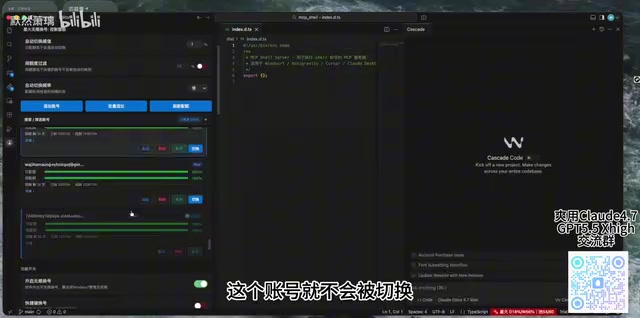
From a technical implementation perspective, the account switching in these tools is essentially manipulation of browser sessions. After each AI service account logs in, the server issues a set of identity credentials, typically stored in the browser as Cookies or JWTs (JSON Web Tokens). The rotation tool's core operation is maintaining a local credential database. When it detects that the current account has triggered a quota limit (usually by intercepting a 429 status code or specific error message from the API response), it automatically replaces the browser's identity credentials to achieve "seamless switching." This also means the tool must have advanced permissions to read and write browser Cookies, and to intercept and modify network requests — permissions that could have devastating consequences if abused.
Extension Coordination System
The tools typically consist of two parts: local software and a browser extension. The local software handles account management and quota tracking, while the browser extension implements auto-switching, automatic continuation after response truncation, and other features on the web side.
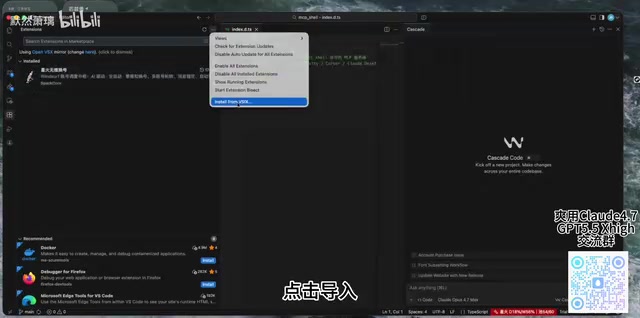
Users can enable different auxiliary features based on their needs, such as automatic continuation after response truncation. "Automatic continuation after response truncation" means that when an AI model's response is cut off due to length limits, the extension automatically sends a "continue" command to retrieve the remaining content. While this seems convenient, it requires the extension to have the ability to inject scripts into pages and simulate user actions — capabilities that are classified as high-risk permissions in the browser security model, essentially no different from the techniques used by malicious browser extensions.

Risks You Cannot Afford to Ignore
Legal and Compliance Risks
Violating terms of service is the most immediate issue. The user agreements of companies like Anthropic and OpenAI explicitly prohibit account sharing, transfer, and automated bindingactivities. Using such tools means:
- You could face mass account bans at any time, losing all conversation history and work output
- In some jurisdictions, circumventing technical protection measures may run afoul of computer fraud-related laws. For example, the U.S. Computer Fraud and Abuse Act (CFAA) classifies "exceeding authorized access" to computer systems as illegal, and bypassing usage quotas could potentially fall under this category. China's Cybersecurity Law and Data Security Law similarly establish clear legal liability for unauthorized access to network services and circumvention of technical protection measures
- The tool provider's business model itself may constitute unfair competition or infringement
Data Security and Privacy Risks
This is the most easily overlooked yet most serious concern:
- All your conversation content (which may include code, trade secrets, and personal information) passes through a third-party tool
- Shared accounts mean other users may be able to see your conversation history. This is because AI services typically store conversation history tied to the account. When multiple people share the same account, subsequent users may see the previous user's complete interaction history, including submitted code snippets, business documents, and even personal private information
- The local client and browser extension have elevated permissions, creating the potential for data leaks or even malicious behavior. These tools are typically not open source, so users cannot audit their code. The operations they may perform in the background — such as uploading browsing history, stealing login credentials from other websites, or injecting cryptomining scripts — are completely opaque
- Account origins are unclear and may involve stolen accounts, credit card fraud, and other upstream criminal activities. The large volume of cheap AI accounts on the gray market often comes from credential stuffing using leaked credential databases, or from registering paid subscriptions with stolen credit card information. Users of these accounts may unknowingly become downstream participants in a criminal chain
Unstable User Experience
The promise of "unlimited usage" is itself a false premise:
- AI service providers continuously upgrade their anti-abuse detection systems, and these tools could stop working at any time. Modern anti-abuse systems are far more sophisticated than most users realize — they don't just check request frequency for a single account. They comprehensively analyze device fingerprints (including dozens of dimensions such as browser version, screen resolution, installed fonts, and WebGL rendering characteristics), IP reputation scores, login geolocation jump patterns, mouse movement and keyboard input behavioral characteristics, and more. When the system detects the same device fingerprint associated with multiple accounts in a short period, or multiple accounts exhibiting highly similar usage patterns, it triggers risk control mechanisms — ranging from verification challenges to outright banning of all associated accounts
- Account pool quality varies wildly, and frequent switching can result in loss of context
- The stability of the tool itself cannot be guaranteed, with a high risk of failure at critical moments
Legitimate Solutions for Quota Anxiety
Rather than risking gray market tools, consider these compliant alternatives:
-
Pay-per-use API access: Call models through the official API, billed per token, with no hard quota limits and transparent, controllable costs. A token is the basic unit that large language models use to process text, roughly equivalent to one English word or 2–3 Chinese characters. Using Anthropic's API pricing as an example, Claude Sonnet's input price is approximately $3 per million tokens, with output at about $15; Claude Opus pricing is several times higher. For moderate users, average monthly API spending typically falls between $20–100, comparable to subscription costs but without the anxiety of "hitting the wall." Developers can use aggregation platforms like OpenRouter to access multiple model APIs through a unified interface, further simplifying the workflow
-
Upgrade your subscription plan: Both Anthropic and OpenAI offer higher-tier subscriptions (such as Claude Max and ChatGPT Pro) with significantly increased quotas. Claude Max, for example, costs $100 or $200 per month, with Opus usage quotas of 5x and 20x the standard Pro plan respectively — far better value for heavy users than the hidden costs of gray market tools
-
Allocate model usage wisely: Not every task requires a top-tier model. Use Sonnet or GPT-4o-mini for everyday tasks, and reserve Opus or GPT-4.5 for critical work. This tiered usage strategy is known in the industry as "Model Routing," and many professional users and enterprises have already adopted it as standard practice — simple text polishing and format conversion go to lightweight models, while complex code architecture design and deep analytical reasoning call for top-tier models. This saves quota without compromising work quality
-
Deploy open-source models locally: Open-source models like Llama, Qwen, and DeepSeek have become remarkably capable, and local deployment comes with absolutely no quota limits. Currently, with inference frameworks like llama.cpp, Ollama, and vLLM, users can run quantized open-source models on consumer-grade hardware. Quantization is a technique that compresses model parameters from high-precision floating point (e.g., FP16, 2 bytes per parameter) to low-precision representations (e.g., INT4, only 0.5 bytes per parameter), reducing VRAM requirements to one-quarter of the original while retaining most of the model's capabilities. For example, a single RTX 4090 with 24GB of VRAM can smoothly run the 4-bit quantized version of Qwen3-32B, which performs close to early GPT-4 levels on tasks like code generation and Chinese language understanding. For users without high-end GPUs, CPU-only inference is also an option, though it will be considerably slower
Industry Reflection: Quota Mechanisms and the Tragedy of the Commons
From the AI service provider's perspective, usage quotas are not purely a commercial strategy. The inference costs of top-tier models are extremely high — a single complex reasoning task with Claude Opus 4 can cost dozens of times more than a standard model. Quota mechanisms are fundamentally about finding a balance between service quality, cost control, and user fairness.
The proliferation of gray market tools will ultimately push service providers to strengthen anti-abuse measures, potentially degrading the experience for legitimate users as well — a classic "Tragedy of the Commons."
The "Tragedy of the Commons" is a concept introduced by economist Garrett Hardin in 1968: when a resource is open to everyone and lacks effective management, each rational individual tends to maximize their own usage, ultimately depleting the resource and harming everyone. In the context of AI services, the provider's GPU compute capacity is this "commons" — gray market tool users consume massive compute resources through account rotation, forcing providers to tighten quotas, strengthen verification, and raise prices. In the end, all users pay the price. This logic plays out repeatedly in digital services: early video platforms had to implement aggressive anti-hotlinking measures due to rampant hotlinking, which also restricted legitimate embedding and sharing; cloud providers gradually eliminated generous free tiers due to abuse of free quotas. Every time "free-riding" behavior scales up, it accelerates the degradation of shared resources.
As users and beneficiaries of AI technology, respecting terms of service and choosing compliant usage methods is not only necessary for protecting yourself — it's also a responsibility for maintaining the healthy development of the entire ecosystem.
Key Takeaways
- Gray market tools bypass AI model usage limits through multi-account rotation, posing serious legal compliance and data security risks
- User conversation content passes through third parties, exposing users to privacy leaks and data theft
- Compliant alternatives include pay-per-use API access, upgrading subscription plans, smart model allocation, and local deployment of open-source models
- The proliferation of gray market tools may push providers to strengthen anti-abuse measures, ultimately harming the experience of legitimate users
- Usage limits are fundamentally a balancing mechanism between service quality, cost control, and user fairness
Related articles
 Industry Insights
AI Product Development in Practice: Model Selection, Building Moats, and Paths to Commercialization
Practical strategies for AI product development: why not to train models from scratch, when to use APIs vs. fine-tuning, building product moats, and the full path from evaluation systems to commercialization.
 Industry Insights
No Product Fits Your Needs? Building It Yourself Is the Best Starting Point for Indie Developers
Can't find a product that fits? Building from personal pain points is the best entry for indie developers. Niche needs + AI tools = rapid product creation.
 Industry Insights
OpenAI Codex Tutorials Mass-Copied on Bilibili, Highlighting AI Content Farm Problem
At least 9 Bilibili accounts mass-published identical OpenAI Codex tutorial videos, exposing content farm operations in the AI tools space.