The Lock-In Rule for AI Developers: How Deep Work Determines Project Success or Failure

In the AI era, deep focus (Lock In) is becoming developers' scarcest competitive edge.
This article explores the "Lock In" culture gaining traction in the AI developer community, arguing that deep focus has become the most critical competitive advantage amid rapid AI iteration and shrinking competitive windows. As AI infrastructure matures, even individual developers can quickly build products, shifting the competitive moat from technical ability to execution speed. The article offers four actionable practices — setting sprint cycles, reducing decision fatigue, establishing accountability, and maintaining physical health — to help developers effectively enter deep work states.
Introduction: The Deeper Meaning Behind a Short Tweet
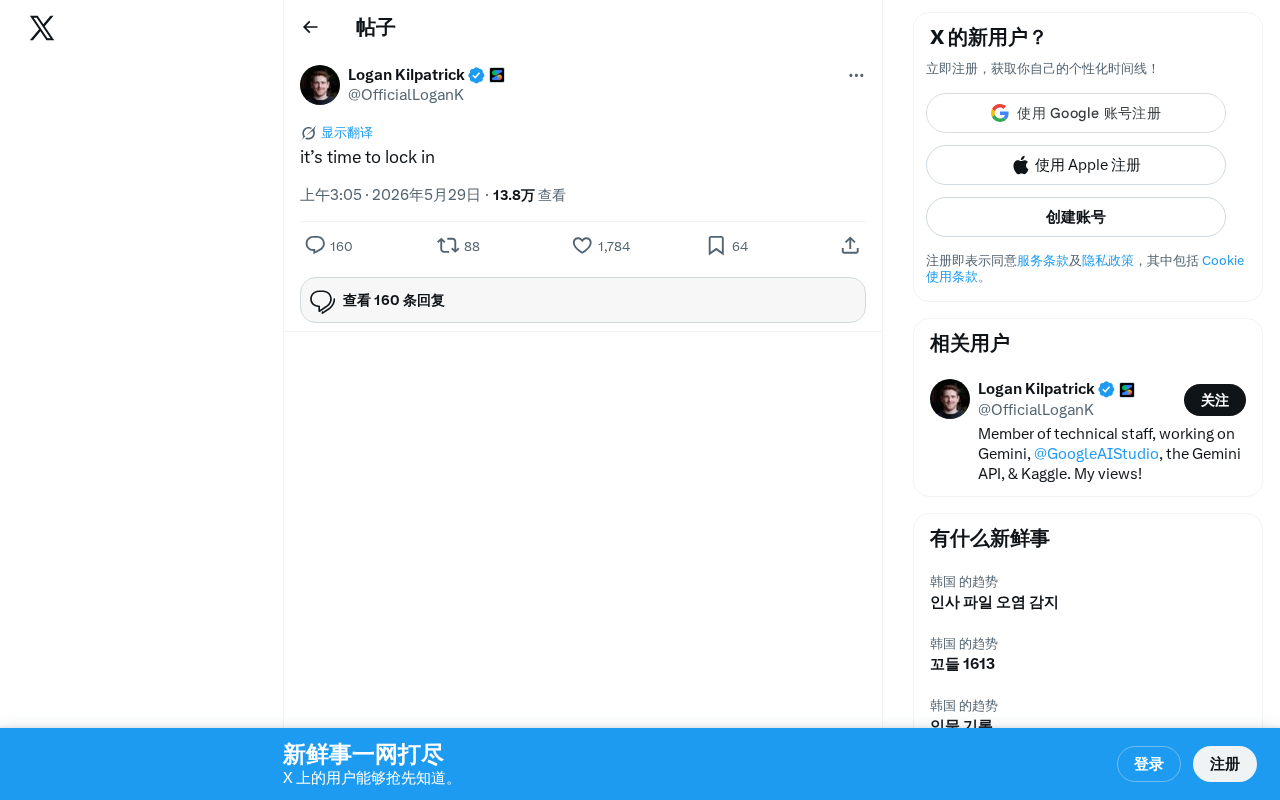
Recently, a short tweet sparked heated discussion in the AI developer community — "it's time to lock in." This seemingly simple statement reflects a key trend in the AI industry: in an era of rapid technological iteration, deep focus is becoming the scarcest and most valuable capability for developers and entrepreneurs.
What Is Lock-In Culture
A Focus Movement Spreading from Silicon Valley to the World
"Lock in," in the context of the tech world, means eliminating all distractions and fully committing to a project or goal. This concept is especially popular in AI startup circles, with more and more developers choosing to enter a "retreat mode" during critical periods.
The expression was originally widely used in competitive sports, referring to the highly focused mental state athletes enter before key competitions, blocking out all external distractions. In the early 2020s, Silicon Valley entrepreneurs borrowed it for the tech context, and it gradually evolved into a distinctive subculture. Its psychological foundation traces back to the "Flow" theory proposed by psychologist Mihaly Csikszentmihalyi — when individuals fully immerse themselves in a task with an appropriate level of challenge, they enter an optimal state of high efficiency and enjoyment. Lock-in culture is essentially the active pursuit and institutionalized practice of the flow state.
The rise of this culture is no coincidence. The competitive window in the AI field is extremely short — a new model can go from release to being surpassed by competitors in just a few weeks. In such an environment, the ability to produce high-intensity output in a short period often directly determines whether a project succeeds or fails.
Why Deep Work Matters Even More in the AI Era
Research by Professor Gloria Mark at the University of California, Irvine shows that programmers need an average of 23 minutes to regain their previous level of focus after being interrupted. For AI developers, this problem is particularly acute — debugging models, optimizing architectures, and analyzing training data all require extended periods of continuous deep thinking.
The deeper issue lies in the "Attention Residue" effect — a concept introduced by Professor Sophie Leroy at the University of Minnesota that reveals a critical fact: when people switch from Task A to Task B, the brain doesn't immediately and fully disengage from Task A. The residual cognitive load significantly reduces the quality of Task B execution. Cal Newport, a computer science professor at Georgetown University, systematically discussed this phenomenon in his book Deep Work, arguing that in the knowledge economy, the ability to engage in prolonged, uninterrupted deep thinking is becoming increasingly scarce and therefore increasingly valuable. For AI developers, model debugging and architecture design involve a large number of variables and dependencies that must be simultaneously held in working memory, making the destructive impact of attention residue particularly severe.
The four core elements of deep work:
- Time block protection: Designate uninterrupted continuous work periods and reject fragmented schedules
- Information diet: Proactively reduce the frequency of social media and news consumption
- Clear objectives: Set specific deliverables and acceptance criteria for each focus session
- Environment design: Create physical spaces and digital environments conducive to concentration
Why Now Is the Best Time to Lock In
AI Infrastructure Is Maturing Rapidly
Today's AI development environment is vastly different from two years ago. Open-source model quality has improved dramatically, API costs continue to drop, and development toolchains are increasingly refined. This means a focused small team or even an individual developer can now build AI products that previously required large teams.
Specifically, this maturity manifests across multiple layers. At the model layer, open-source models like Meta's LLaMA series, Mistral, and Qwen have reached performance levels approaching or even surpassing early closed-source models on specific tasks. At the toolchain layer, orchestration frameworks like LangChain and LlamaIndex have greatly simplified the construction of complex architectures such as RAG (Retrieval-Augmented Generation — a technical architecture that lets large language models retrieve from external knowledge bases before answering questions to improve accuracy); the Hugging Face ecosystem provides one-stop solutions from model hosting to inference deployment. At the cost layer, API call prices have dropped by orders of magnitude over the past year — taking GPT-4-level capabilities as an example, the cost per million tokens was around tens of dollars in early 2023 and dropped to less than one dollar by late 2024. Additionally, frontend tools like Vercel AI SDK and Streamlit enable AI application prototyping in hours rather than weeks.
The maturation of infrastructure has lowered the technical barrier but raised the execution barrier — whoever can commit faster and deeper will be the first to turn ideas into products. The core competitive moat has shifted from "can it be done" to "how fast and how deep."
The Competitive Window Is Closing Rapidly
As major companies rush into the AI application layer, the window of opportunity for independent developers and small teams is closing at an accelerating pace. Products that can iterate quickly in the short term and capture user mindshare will gain an insurmountable first-mover advantage. The cost of hesitation and distraction has never been higher.
First-mover advantage has a unique amplification effect in the AI application space. Unlike traditional software, AI products often possess data flywheel characteristics — more users generate more interaction data, which in turn is used to fine-tune and optimize models, thereby providing a better user experience and attracting even more users. This positive feedback loop allows products that acquire users first to rapidly build a data moat that latecomers find nearly impossible to cross. Notable examples include ChatGPT leveraging its first-mover advantage to surpass 100 million users in just two months, and Midjourney rapidly capturing market mindshare through community-driven image generation. For independent developers, quickly launching products in vertical scenarios not yet covered by large companies and leveraging early user data to establish differentiated advantages is currently the most viable competitive strategy.
Dense Opportunities Created by Technological Inflection Points
Every major model upgrade (such as iterations of the GPT series or Claude series) creates a wave of entirely new application possibilities. Seizing these technological inflection points requires developers to possess both rapid response capability and the ability to commit deeply — which is precisely the core proposition of lock-in culture.
Technological inflection points triggering application explosions is a pattern repeatedly validated in the tech industry. The App Store ecosystem after the iPhone launch, the SaaS wave after AWS became widespread, the O2O startup boom after mobile payments matured — all followed the cycle of "foundational capability leap → application-layer innovation window opens → first movers capture outsized returns → window gradually closes." In the AI field, each step-function improvement in model capabilities unlocks a batch of previously infeasible application scenarios. For example, GPT-4's multimodal capabilities spawned visual analysis applications, Claude's extended context window (from 100K to 200K tokens) made it possible to analyze entire books and large codebases, and improvements in reasoning capabilities (such as the OpenAI o1 series) opened new tracks in complex decision-making and scientific research assistance. The dense occurrence of these inflection points means we are currently in the golden window for AI application innovation.
How to Lock In Effectively
Four Actionable Practices
-
Set clear sprint cycles: Use 2–4 week focus periods, with specific milestones and delivery criteria for each cycle, avoiding open-ended vague commitments. This approach borrows from the Sprint concept in agile development, using timeboxing to create urgency and focus.
-
Reduce decision fatigue: Finalize your tech stack and architecture decisions before the sprint begins, and stop second-guessing choices during execution. Decision Fatigue is a classic concept in behavioral psychology, validated through extensive experiments by social psychologist Roy Baumeister and others. Research shows that self-control and decision-making ability depend on limited cognitive resources — every decision made (regardless of size) depletes these resources, leading to declining quality in subsequent decisions. In AI development, choosing which foundation model to use, which vector database to adopt, what deployment strategy to employ… if these decisions are repeatedly re-evaluated during execution, it not only wastes time but severely erodes the cognitive bandwidth available for core development work. Many successful Silicon Valley entrepreneurs adopt a "pre-decision" strategy — completing all technical choices before the sprint and not questioning existing decisions during execution unless encountering insurmountable obstacles. This follows the same logic as Steve Jobs wearing the same black turtleneck to reduce daily decisions.
-
Establish accountability mechanisms: Find like-minded partners to sync progress with each other. External pressure is an effective weapon against procrastination. Whether it's the online Build in Public movement or offline hackathon-style collaboration, social commitments can significantly boost execution.
-
Maintain physical health: Regular sleep schedules and moderate exercise form the physiological foundation for sustained high-intensity output. Efficiency gained by burning out your body is not sustainable. Neuroscience research shows that aerobic exercise promotes the secretion of BDNF (Brain-Derived Neurotrophic Factor), directly enhancing cognitive function and creativity, while adequate sleep is a critical process for the brain to consolidate learning and clear metabolic waste.
Conclusion
In an age of information overload, focus itself is a competitive advantage. As the entire AI industry accelerates forward, locking in is not just a work style — it's a strategic choice. Rather than burning through your attention in an endless stream of information, pick a direction and go all in.
What truly separates people has never been who knows more, but who can settle down at the critical moment and actually ship.
Related articles
 Industry Insights
AI Product Development in Practice: Model Selection, Building Moats, and Paths to Commercialization
Practical strategies for AI product development: why not to train models from scratch, when to use APIs vs. fine-tuning, building product moats, and the full path from evaluation systems to commercialization.
 Industry Insights
No Product Fits Your Needs? Building It Yourself Is the Best Starting Point for Indie Developers
Can't find a product that fits? Building from personal pain points is the best entry for indie developers. Niche needs + AI tools = rapid product creation.
 Industry Insights
OpenAI Codex Tutorials Mass-Copied on Bilibili, Highlighting AI Content Farm Problem
At least 9 Bilibili accounts mass-published identical OpenAI Codex tutorial videos, exposing content farm operations in the AI tools space.