Thinking Can Be Outsourced, Understanding Cannot: The Most Overlooked Cognitive Blind Spot of the AI Era

In the AI era, thinking can be outsourced, but understanding must be cultivated on your own.
Starting from a viral tweet, this article explores the fundamental difference between "thinking" and "understanding" in the AI era. Thinking is an information processing activity that AI can replace, while understanding is an internalized, transferable deep cognitive capability. The article identifies three cognitive traps AI users commonly fall into: mistaking AI answers for personal understanding, cognitive atrophy from disuse, and a vicious cycle of declining judgment. The author recommends thinking independently before consulting AI, treating AI as a thinking partner rather than a replacement, and safeguarding understanding as the scarcest form of human capital in the AI age.
A Single Sentence That Sparked Deep Reflection
Recently, a tweet resonated widely among AI practitioners:
"You can outsource your thinking, but you can't outsource your understanding."
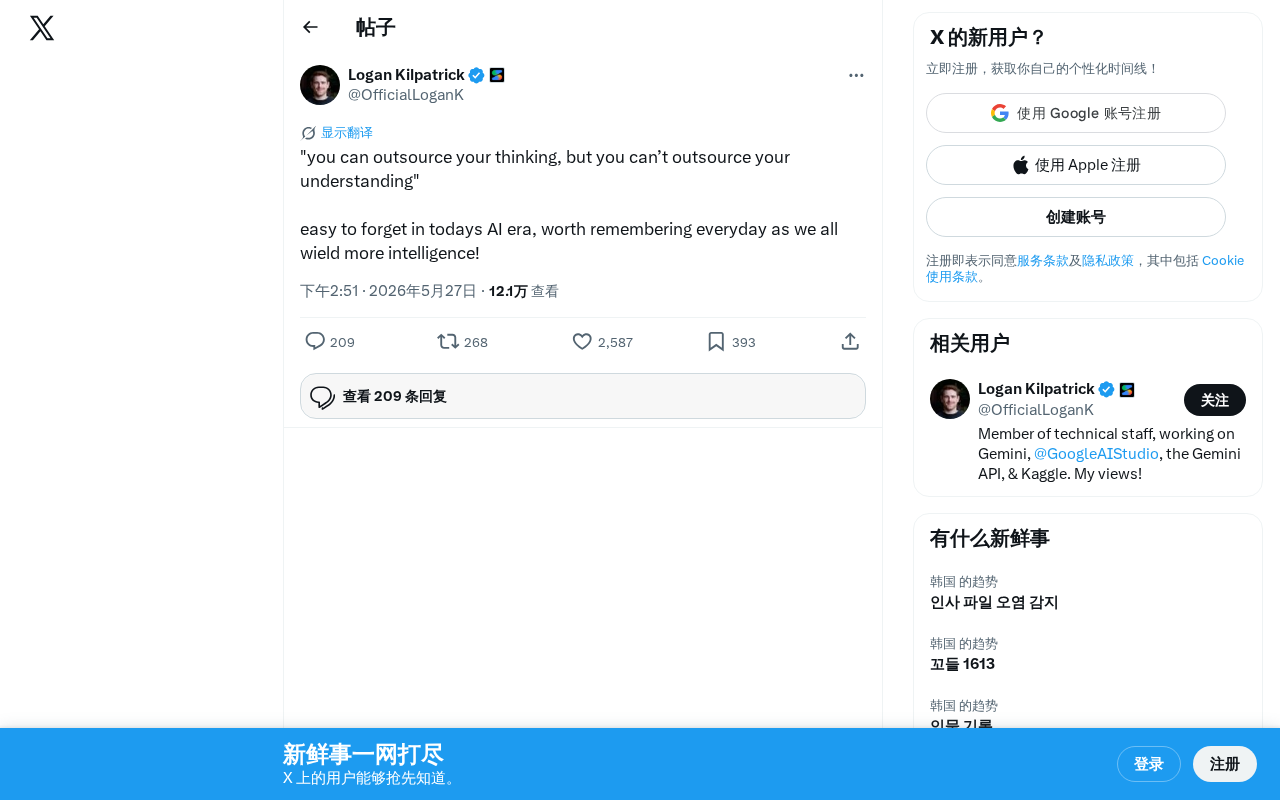
The author added: "In today's AI era, this is easy to forget, but worth remembering every day — especially as each of us navigates increasingly powerful intelligent tools."
The statement seems simple, yet it strikes precisely at the most overlooked blind spot in today's AI applications. As large models like ChatGPT, Claude, and Gemini become standard tools in daily work, and "AI-assisted" workflows permeate nearly every knowledge work process, are we unknowingly losing something far more precious?
Thinking vs. Understanding: A Critically Underestimated Distinction
To grasp the deeper meaning of this statement, we first need to clarify the fundamental difference between "thinking" and "understanding."
From a cognitive science perspective, this distinction has deep theoretical roots. Bloom's Taxonomy classifies cognitive abilities into six levels from low to high: remembering, understanding, applying, analyzing, evaluating, and creating. What AI currently excels at is primarily concentrated at the remembering and analyzing levels — it can rapidly retrieve massive amounts of information and identify patterns. But true "understanding" involves deeply integrating new knowledge with existing cognitive frameworks to form transferable mental models. Mental models are the core asset of human cognition, enabling us to make sound judgments in entirely new, never-before-encountered situations — precisely the capability that current AI architectures struggle to truly replicate.
Thinking is largely an information processing activity — collecting data, analyzing patterns, deriving conclusions, and generating solutions. These steps can indeed be efficiently replaced or even surpassed by AI. GPT-4 can produce a market analysis report in seconds, Claude can help you parse complex legal texts, and Copilot can write fully functional code modules for you.
Understanding, on the other hand, is a deeper cognitive state. It means you truly "know" why something is the way it is, how it connects to your existing knowledge system, and how it might change across different contexts. Understanding is internalized, structured, and transferable. It's not an output — it's a sedimentation of cognitive capability.
Here's a concrete example: AI can write an efficient sorting algorithm for you (outsourcing the thinking), but if you don't understand the concept of time complexity or why quicksort is preferred over merge sort in certain scenarios, you'll be helpless the moment the problem changes slightly.
It's worth noting that this difference is also reflected at the technical level. The core working principle of large language models (LLMs) like GPT-4, Claude, and Gemini is next-token prediction based on the Transformer architecture — they learn statistical correlation patterns between words by training on massive text datasets, enabling them to generate fluent, seemingly logical text. But this "statistical correlation" is fundamentally different from human "causal understanding": the model doesn't truly "know" what it's saying; it's merely predicting the most probable next word at a probabilistic level. This is exactly why LLMs produce "hallucinations" — they can confidently output completely incorrect information because that information appears reasonable within statistical patterns. Understanding this underlying mechanism is precisely the prerequisite for using AI tools effectively.
The Three Cognitive Traps AI Users Most Commonly Fall Into
Trap 1: The Output Illusion — Mistaking AI's Answers for Your Own Understanding
This is the most common and most dangerous trap. When AI delivers a seemingly perfect answer, we easily fall into the illusion of "I get it." In reality, we've merely "seen the answer," not "understood the answer."
This distinction is nearly imperceptible in everyday use, but the gap becomes glaringly obvious when critical decisions need to be made, unexpected situations arise, or creative work is required.
From a technical standpoint, AI hallucination is one of the core challenges facing all large language models today. According to a 2024 Stanford University study, even the most advanced models still have hallucination rates fluctuating between 3% and 15% on factual tasks, and errors tend to be even more subtle in specialized domains (such as medicine, law, and finance). What makes this even trickier is that AI-generated misinformation is typically wrapped in fluent, confident language, making it nearly impossible for users without domain expertise to detect. This means: you need sufficient domain understanding to catch AI's mistakes, but if you rely entirely on AI to build that understanding, you'll never be able to establish this line of defense.
Trap 2: Cognitive Atrophy — The Brain Follows the "Use It or Lose It" Principle
A fundamental principle of neuroscience tells us that the brain follows the "use it or lose it" rule. If deep thinking tasks are chronically delegated to AI, your analytical abilities, critical thinking, and creativity will gradually atrophy. This isn't alarmism — researchers have already begun studying the long-term impact of "cognitive outsourcing" on human thinking capabilities.
In fact, the scientific evidence in this area is already quite substantial. The brain possesses neuroplasticity — neural connections strengthen or weaken based on frequency of use. Columbia University psychologist Betsy Sparrow published a study in Science in 2011 that identified the "Google Effect": when people know information can be easily retrieved through a search engine, the brain automatically reduces the encoding intensity for that information in memory. Today's AI tools go a step further than search engines — they provide not just information retrieval but finished "products" of analysis and reasoning, meaning the scope and depth of cognitive outsourcing are expanding dramatically. What we outsourced to search engines was memory; what we may be outsourcing to AI is thinking itself, with potentially far more profound implications for human deep thinking capabilities.
Trap 3: Loss of Judgment — The More You Depend, the Harder It Is to Tell Right from Wrong
Here lies a paradox: the more you rely on AI to think, the harder it becomes to judge whether AI's output is correct. Understanding is the foundation of judgment. Without understanding, you cannot identify AI's hallucinations, biases, and errors, ultimately becoming a passive recipient of AI output rather than an active user.
In practice, this paradox creates a dangerous vicious cycle: dependence on AI → declining personal understanding → harder to spot AI errors → greater dependence on AI → further decline in understanding. The only way to break this cycle is to consistently maintain independent understanding and judgment in critical domains.
How to Protect Your Understanding in the AI Era
Recognizing the problem is only the first step; what matters is how you act. Here are four proven practical recommendations:
1. Think First, Then Consult AI
Before using AI, spend a few minutes forming your own preliminary judgment. Even if that judgment is rough, it serves as an anchor for your understanding. Then use AI's output to compare, supplement, and refine your thinking — not replace it.
2. Build the Habit of Asking "Why"
When AI provides an answer, don't stop at the result. Question its reasoning process, verify each logical step, and try to restate the core arguments in your own words. If you can't explain it clearly to someone else, you haven't truly understood it. This method is known in education as the "Feynman Technique" — named after Nobel Prize-winning physicist Richard Feynman, whose core idea is: if you can't explain a concept in simple language to someone else, you don't truly understand it yourself.
3. Deliberately Schedule "AI-Free Deep Thinking Time"
Set aside time each day for deep thinking without AI assistance — reading, writing, reasoning, reflecting. Just like physical fitness, cognitive abilities require continuous exercise to maintain.
4. Treat AI as a Thinking Partner, Not a Thinking Replacement
The ideal human-AI collaboration model is: humans are responsible for asking questions, setting direction, and making judgments; AI is responsible for accelerating execution, broadening perspectives, and providing materials. Understanding always stays on the human side.
This "thinking partner" positioning is known in academia as "Intelligence Augmentation" (IA). The concept can be traced back to computing pioneer Douglas Engelbart's 1962 framework for "augmenting human intellect" — he believed the ultimate value of computers was not to replace human thinking but to amplify human cognitive capabilities. In practice, the widely recognized efficient collaboration model is "Human-in-the-Loop": AI handles information gathering, preliminary analysis, and solution generation, while humans handle problem definition, quality control, value judgment, and final decision-making. This division of labor lets both sides play to their strengths while ensuring that human understanding and judgment always remain in the driver's seat.
The More Powerful the Intelligence, the More Precious Understanding Becomes
We are living in an unprecedented era — everyone holds powerful intelligent tools in their hands. But the power of tools does not automatically translate into the capability of the user.
As the tweet reminds us, when we "navigate increasingly powerful intelligence," what truly determines our value is not how much AI computing power we can invoke, but how much we ourselves understand.
In the AI era, understanding has not depreciated — it has become the scarcest form of human capital. Those who can deeply understand the essence of problems and make precise judgments with AI assistance will be the true winners of this era. There's a fundamental principle in economics: when substitutes for a resource become cheap and abundant, the complements to that resource actually appreciate in value. AI has made "the output of thinking" cheap, but this has made "understanding" — as the complementary capability needed to effectively use those outputs — all the more precious.
Thinking can be outsourced; understanding must be cultivated on your own. This is not a rejection of AI, but a reaffirmation of the value of human cognition.
Related articles
 Expert Opinions
Windsurf CEO Deep Dive Interview: Speed Is the Only Moat
Windsurf CEO Varun Mohan shares insights on AI coding IDE pivots, product methodology, async Agent challenges, and differentiation strategy vs Cursor. Speed is the only moat.
 Expert Opinions
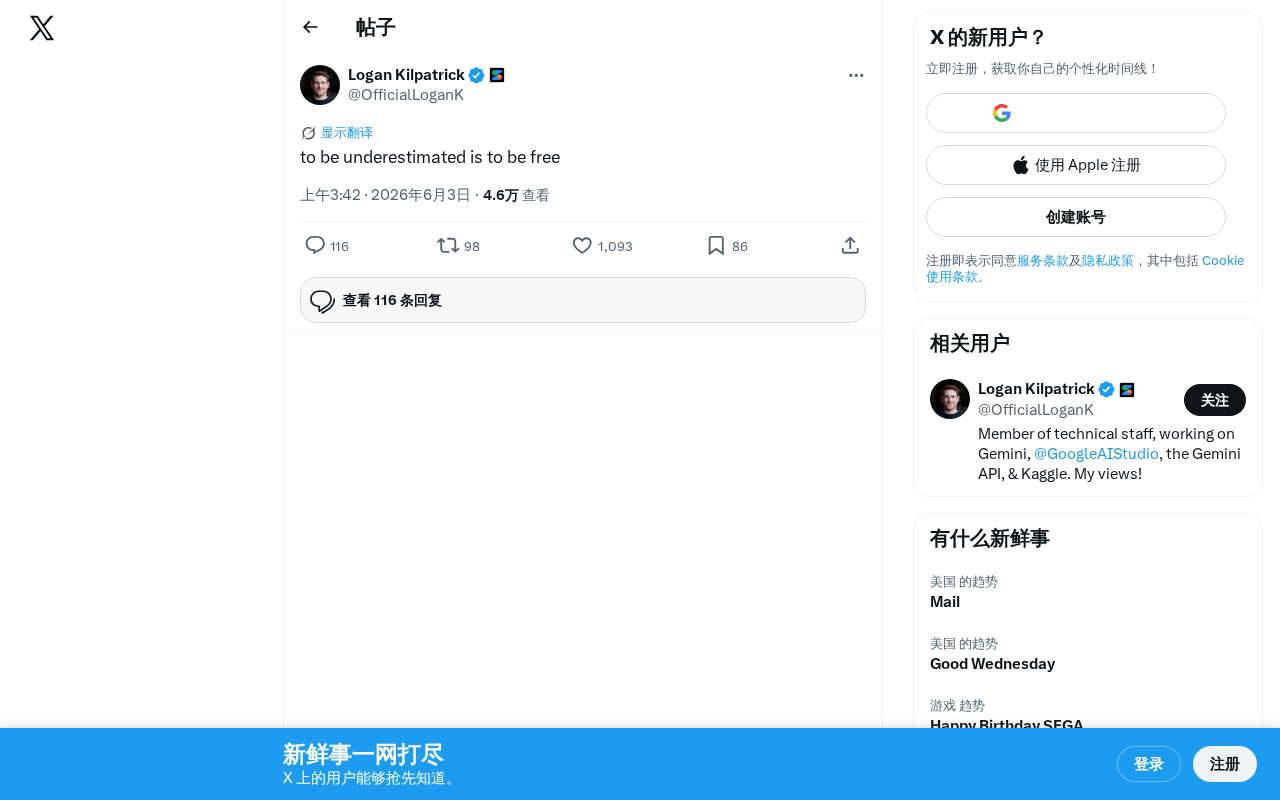
Being Underestimated Is Freedom: A Contrarian Competition Philosophy for the AI Era
Exploring the contrarian strategy of 'being underestimated is freedom' in AI. From OpenAI to DeepSeek to Cursor, why staying under the radar beats standing in the spotlight.
How the Protestant Work Ethic Was Hija…
How the Protestant Work Ethic Was Hijacked: From Protecting Workers to Oppressing Them
Philosopher Elizabeth Anderson reveals how the Protestant work ethic was twisted from a worker-protecting ideal into a tool of oppression—and what it means for the AI era.