Apple's AI Meltdown: The Siri Power Struggle and the Full Story Behind Apple Intelligence's Failure
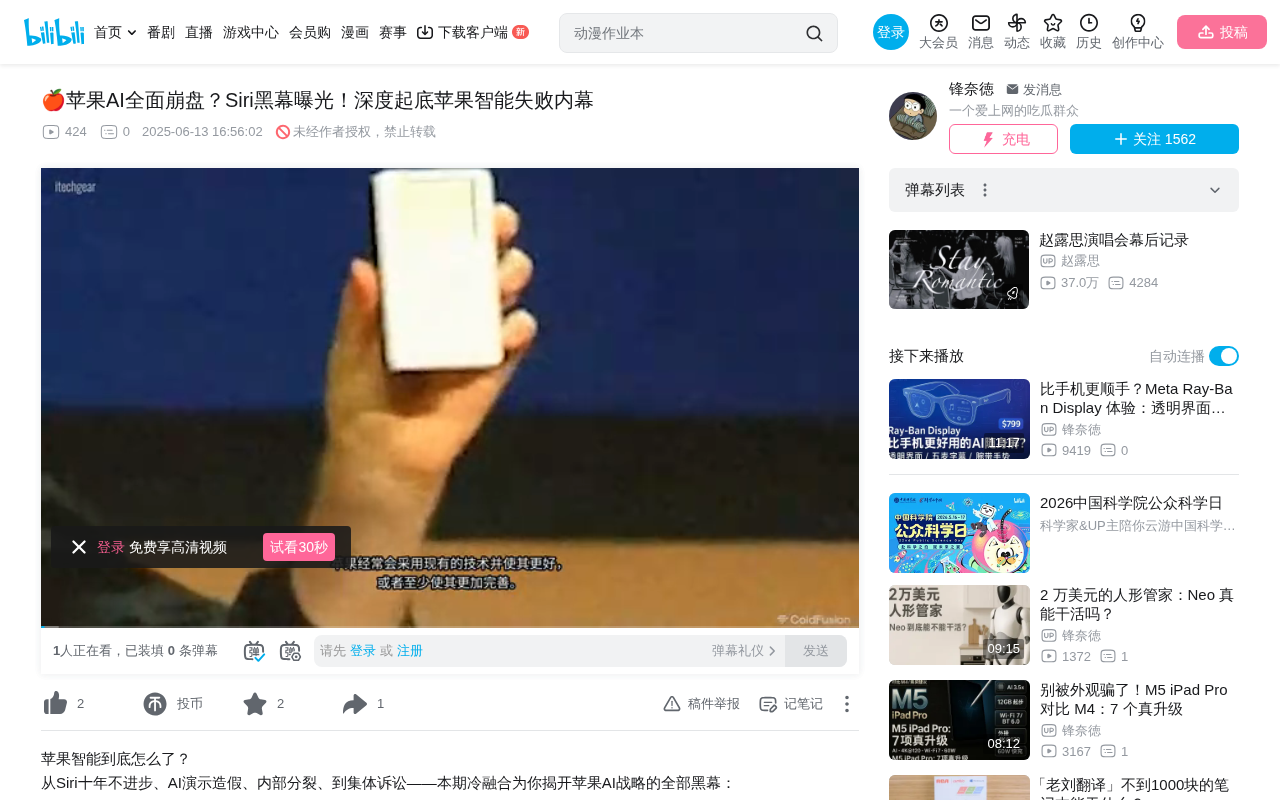
Apple has fallen behind in the generative AI race amid Siri's stagnation and severe internal dysfunction.
Apple's tried-and-true "late mover" strategy has completely backfired in the face of generative AI. Apple Intelligence has largely remained vaporware since its 2024 announcement, with WWDC demos exposed as faked — sparking class-action lawsuits. Siri has stagnated due to leadership chaos, an internal war between two competing AI teams, and insufficient compute investment, falling far behind ChatGPT and Google Gemini. In 2025, Apple was forced to replace its AI leadership, but the fundamental conflict between its culture of secrecy and the open, iterative nature of AI development remains unresolved.
Introduction: How the World's Most Valuable Tech Company Missed the AI Wave
Apple's playbook has always been to let others experiment first, then redefine the category with a more polished product. The iPhone wasn't the first touchscreen phone, and the Apple Watch wasn't the first smartwatch — but both made people feel like "someone finally got it right." This time, however, facing generative AI — the biggest technological shift in recent years — Apple's playbook has completely fallen apart.
According to an in-depth investigation by tech channel ColdFusion, Apple Intelligence has remained largely in the "vaporware" stage since its announcement in June 2024. Even more shocking, those impressive AI demos at last year's WWDC — Siri extracting flight information from emails, cross-referencing lunch plans, planning routes — were all pre-scripted and never actually ran on real devices. The only part that truly worked was the pulsing rainbow light band around the screen's edge.
The Faked WWDC Demo: Even Apple Engineers Never Saw It Run
According to a report by The Information in April of this year, Apple "faked" those polished demos at last year's WWDC. They didn't run on real devices, and even some of Apple's own engineers had never seen these features work in actual test builds.
More ironically, when Apple's software chief Craig Federighi ran the pre-release version on his own phone, he was reportedly stunned — the software couldn't accomplish even half of the features already shown to the public.
To make matters worse, Apple heavily marketed Apple Intelligence as a selling point for the iPhone 16, plastering it across TV commercials and billboards. Selling phones based on features that essentially didn't exist led directly to multiple class-action lawsuits. The legal filings stated: "Apple's advertising created a reasonable expectation among consumers that these transformative features would be available at the iPhone's launch… The actual product delivered extremely limited or entirely absent Apple Intelligence features, misleading consumers about its actual utility and performance."
Siri's Fourteen-Year Decline: From Futuristic Vision to Industry Punchline
Origins and Early Chaos (2011–2014)
Siri wasn't even Apple's original idea — it was an app Apple acquired for $200 million. Steve Jobs had grand plans for it, but he passed away shortly after Siri's launch. Afterward, Siri was handed to executive Richard Williamson, who reportedly clashed constantly with the team and only approved Siri upgrades once a year.
After the 2012 Apple Maps disaster, both Scott Forstall and Williamson were fired. Maps eventually improved, but Siri was left on the back burner.
Talent Acquisition and Internal Fractures (2016–2022)
Apple brought in Amazon research expert Bill Stasior and Google's AI lead John Giannandrea (known internally as JG). JG reported directly to Tim Cook and took full control of Apple's AI strategy. Yet under his leadership and that of his deputy Robbie Walker, it took the team two years just to simplify the wake word from "Hey Siri" to "Siri." Walker poured enormous effort into shaving milliseconds off Siri's response time while neglecting improvements in quality and emotional understanding.
Even more absurdly, some engineers began building an LLM-based "empathy layer" for Siri, but Walker ordered them to stop. The engineers thought the decision was foolish and secretly collaborated with another department behind Walker's back — a telling sign of just how fragmented Apple's internal culture had become.
The War Between Two AI Teams
Craig Federighi lacked confidence in JG's team and quietly assembled an independent AI team called "Intelligent Systems" within his own software division, hiring hundreds of engineers to essentially do parallel work to JG's team.
Apple now had two competing AI teams. They fought over resources, direction, and even marketing ownership. JG's department was mockingly nicknamed "Aimless" by Federighi's engineers. This internal warfare severely hampered Siri's progress.
The ChatGPT Shock: Ignored Warning Signs
When ChatGPT launched in November 2022, Apple Intelligence reportedly wasn't even a concept yet. JG underestimated the value of large language models, insisting they had "limited utility," and chose to continue developing Siri with internal tools. They eventually trained two models, but both fell far short of ChatGPT in performance and reliability.
To make things worse, Apple's AI engineers received only half of their promised chip budget in 2023, because the CFO told them to "do more with less." Apple's internal data centers had roughly 50,000 GPUs, many of which were over five years old. The AI team had to go begging to Google and Amazon for compute resources.
By contrast, while Google was equally blindsided by ChatGPT, it rapidly reorganized and launched Bard (later Gemini) within months. Today, Google has built an AI tool ecosystem spanning Android and the web. Gemini Live can hold natural conversations, handle mid-sentence interruptions, ask follow-up questions, switch between voice and text, and even use the camera to identify surroundings — capabilities that Siri can only dream of.
The 2025 Reckoning and What Lies Ahead
Leadership Shakeup
In March 2025, Bloomberg reported that Tim Cook had "lost confidence in AI chief John Giannandrea's ability to execute on product development." Apple stripped Siri's control from JG and Robbie Walker and handed it to Mike Rockwell — the executive behind Vision Pro and someone known for delivering polished, technically complex projects.
A Cultural Dilemma
The root of the problem isn't just a missed window of opportunity — it's a cultural clash. Apple's 21st-century legacy was built on simplicity, secrecy, and control, but AI development demands openness, messiness, and iteration. You can't achieve a "One More Thing" moment without being willing to experiment in public, and that kind of openness simply isn't in Apple's DNA.
WWDC 2025's Smoke and Mirrors
At WWDC 2025, Apple announced its biggest software design overhaul in over a decade — a unified glass-inspired design language across all platforms, inspired by VisionOS. Some keen observers believe this may have been a deliberate distraction from Apple Intelligence's ongoing failures.
Conclusion: Is Apple Losing Its Way?
Apple has promised that Siri will ship this fall with personal context awareness, screen understanding, and tighter app integration. But after so many broken promises, market trust has been severely eroded.
Frequent software bugs, a lackluster Vision Pro launch, and a comprehensively lagging AI strategy — these "un-Apple-like" problems are piling up, raising a pressing question: In the post-Jobs era, is Apple losing its ability to seamlessly fuse technology with experience? Is this merely a temporary rough patch, or a signal of something deeper in decline? The answer may not become clear until Siri actually delivers this fall.
Related articles
 Industry Insights
AI Product Development in Practice: Model Selection, Building Moats, and Paths to Commercialization
Practical strategies for AI product development: why not to train models from scratch, when to use APIs vs. fine-tuning, building product moats, and the full path from evaluation systems to commercialization.
 Industry Insights
No Product Fits Your Needs? Building It Yourself Is the Best Starting Point for Indie Developers
Can't find a product that fits? Building from personal pain points is the best entry for indie developers. Niche needs + AI tools = rapid product creation.
 Industry Insights
OpenAI Codex Tutorials Mass-Copied on Bilibili, Highlighting AI Content Farm Problem
At least 9 Bilibili accounts mass-published identical OpenAI Codex tutorial videos, exposing content farm operations in the AI tools space.