Building AI Chatbots for Foreign Clients: A Side Hustle Breakdown at $150–$800 Per Project
Build AI chatbots for foreign clients as a side hustle earning $150–$800 per project with no-code tools.
This guide breaks down a lucrative side hustle: building AI chatbots for overseas clients at $150–$800 per project using no-code platforms like Chatbase, Tidio, and Botpress. No programming or English fluency is needed — AI tools handle translation and communication. The article covers pricing models (one-time fees + recurring monthly maintenance), a five-step path from zero to first client, realistic income expectations ($500–$5,000+/month), and five common pitfalls to avoid.
The Core Business Logic: Profiting from the Gap Between Labor Costs and AI Replacement
You've probably seen a small chat widget in the bottom-right corner of many foreign websites — visitors click it, ask a question, and the system responds automatically. That's an AI chatbot, essentially a 24/7 smart customer service agent that never clocks out.
In the past, most of these widgets were "dumb" — they could only pop up a few preset FAQ responses. Traditional FAQ bots relied on keyword matching and decision-tree logic, requiring users to type exact keywords to trigger the right answer. Any slight variation in phrasing would result in irrelevant responses. But now, with Large Language Models (LLMs) integrated, everything has changed — chatbots now have genuine semantic understanding. Instead of rigidly matching keywords, they can actually "comprehend" user intent. Through RAG (Retrieval-Augmented Generation) technology, you can feed the bot a company's product documentation, FAQs, terms of service, and more. When answering questions, the model first retrieves relevant content and then generates a response, ensuring both accuracy and natural language fluency. That's why it can handle all kinds of questions as flexibly as a human agent.
Why are foreign clients willing to pay for this? The answer is simple — human labor is expensive.
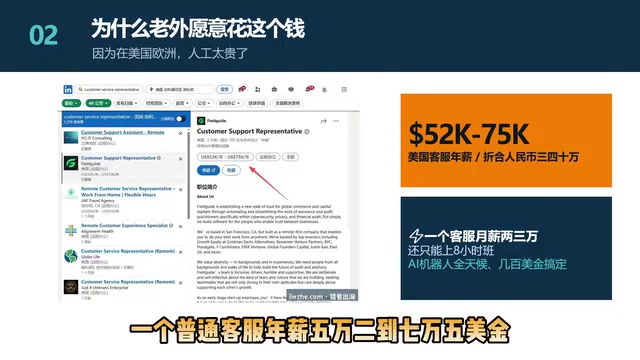
According to public salary data on LinkedIn, a typical customer service position in the U.S. pays between $52,000 and $75,000 per year. When you help a small business owner set up an AI chatbot for a one-time fee of a few hundred dollars, you're enabling them to automatically greet customers, answer questions, and collect potential leads' contact information. Spending a few hundred dollars to save $2,000–$3,000 per month in labor costs — any business owner can do that math.
So the business logic behind this project is crystal clear: You're profiting from the gap between "expensive foreign labor" and "AI's ability to replace that labor." AI saves the boss a fortune, and you take a slice of those savings.
Pricing Model: One-Time Setup Fee + Recurring Monthly Fee
This type of service typically uses two pricing structures:
- One-time setup fee: $150 to $800 per project, paid upon delivery
- Monthly maintenance fee: $30 to $200 per month for ongoing content updates and answer optimization
The latter is where the real value lies — it follows the SaaS (Software as a Service) business model. In the SaaS model, recurring revenue (MRR, Monthly Recurring Revenue) is the core metric for measuring business health. Say you add 3 new clients per month, each paying $100/month in maintenance fees. After six months, you'd have 18 clients generating $1,800 per month in stable income — even if you don't take on a single new project that month, the money still comes in. This is the "compound effect" at work in a service business. Maintenance typically includes: updating the knowledge base (when clients launch new products or change policies), optimizing answer quality (adjusting wording based on conversation logs), and providing monthly data reports (conversation volume, common question statistics, lead counts). Once you've accumulated 10 or 20 long-term clients, the monthly maintenance fees become a steady stream of passive income.
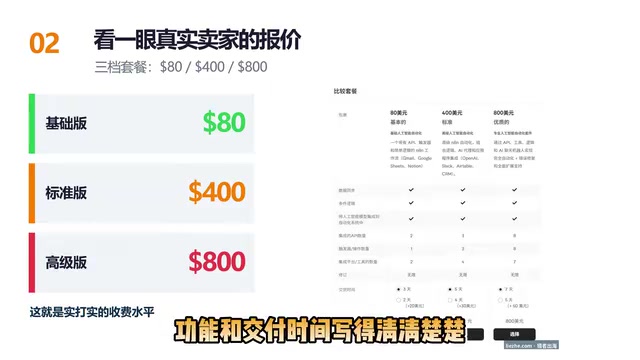
Looking at real seller pricing, services are typically offered in three tiers: a basic package around $80, a standard package around $400, and a premium package around $800, with clearly defined feature scopes and delivery timelines. This tiered pricing strategy attracts budget-conscious small clients while capturing higher margins from larger ones.
Barrier to Entry: No Coding or English Fluency Required
Many people hear "build an AI chatbot" and assume coding is required. That's no longer the case. There are plenty of no-code platforms available (such as Chatbase, Tidio, Botpress, etc.) where the workflow is drag-and-drop, upload your materials, and let the platform auto-train the bot. If you can use a computer and copy-paste, you can get it done.
The reason these platforms are accessible to non-technical users is that they encapsulate complex underlying technologies into visual interfaces. Take Chatbase as an example: users simply upload PDFs, webpage links, or plain text, and the platform automatically handles text chunking, vectorization (Embedding), and storage in a vector database. When a visitor asks a question, the system first retrieves the most relevant content fragments from the vector database, then passes them as context to GPT or other large models to generate a response. Tidio leans more toward marketing scenarios, with built-in visitor behavior tracking and automated marketing workflows. Botpress offers a more flexible conversation flow designer, suitable for scenarios requiring complex business logic. These platforms typically charge based on message volume or conversation count, with monthly fees ranging from tens to hundreds of dollars.
English isn't a real barrier either. You can feed clients' English messages directly to AI for translation into your native language, understand the requirements, and then have AI write professional English replies for you. Quotes, service descriptions, contract templates — AI can draft all of them. In this project, AI isn't just the product you're selling to clients; it's your own core tool.
Startup costs are also minimal: a setup for accessing overseas networks, an AI tool subscription, a chatbot platform account, and an account that can receive USD payments. The total initial investment is just a few dozen dollars.
Five Steps from Zero to Your First Client
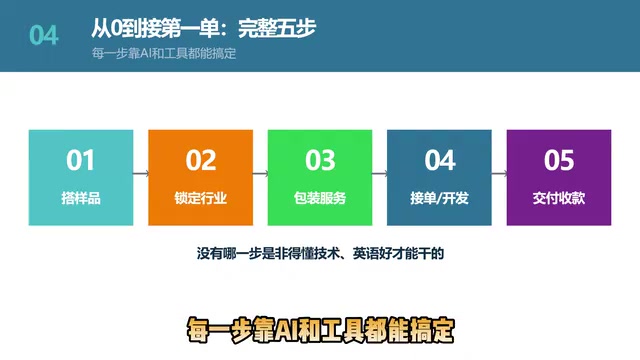
Step 1: Build Samples First — Never Show Up Empty-Handed
This is the most critical step. Without a portfolio, why would any client trust you? Pick any industry, feed publicly available information into the platform, and you can build a working demo in an hour or two. Create several samples across different industries to form your portfolio.
Step 2: Focus on One Niche Industry
For example, specialize in dental clinics, real estate agencies, or gyms. After building the first one, the second and third only require swapping out the content, making each project faster and more efficient. Plus, you can position yourself as an "industry expert," giving you more confidence in your pricing.
Step 3: Polish Your Service Page
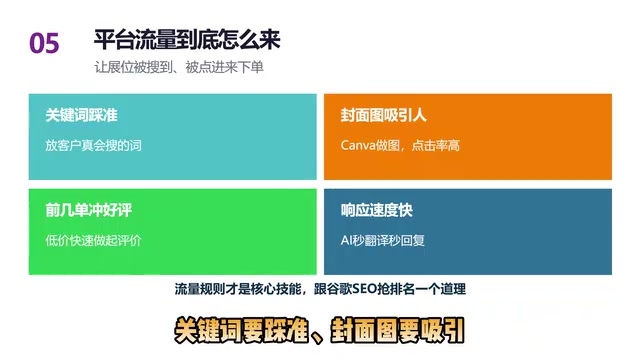
On freelancing platforms, your service page is your "storefront." Nail the right keywords (e.g., "AI chatbot for dental clinics"), use a professional and eye-catching cover image, and write service descriptions that highlight the value clients will receive rather than technical details.
Here it's important to understand the operational differences between the two major platforms: Fiverr and Upwork. Fiverr uses a "seller showcase" model — you package your service into a standardized "Gig" (similar to a product listing), and clients search and order directly, much like running a shop on an e-commerce platform. Upwork uses a "buyer posting" model — clients post project requirements and freelancers bid competitively, more like a tender platform. For standardizable services like AI chatbot setup, Fiverr's model is more friendly because you can pre-design packages and showcase samples, shortening the client's decision path. Upwork is better suited for highly customized, higher-budget projects. Both platforms charge service fees (Fiverr takes 20% from sellers; Upwork uses a tiered commission based on cumulative earnings), which you need to factor into your pricing.
Step 4: Multi-Channel Client Acquisition — Both Active and Passive
Don't limit yourself to just Fiverr and Upwork. Client acquisition channels fall into two categories:
- Passive acquisition: Set up your storefront on freelancing platforms and wait for clients to find and order from you
- Active outreach: Search LinkedIn for business owners in your target industry, check whose websites don't have an AI chatbot yet, and send them a direct message with a free demo attached
LinkedIn, as the world's largest professional networking platform with over 1 billion users, is home to a massive number of small business owners and decision-makers. The core logic of active outreach is "precise targeting + leading with value." You can use LinkedIn's search function to filter target clients by industry, job title, and region (e.g., search "dental clinic owner" + "Texas"), then check their company websites one by one — if there's no chat widget in the bottom-right corner, they're a potential client. When messaging, don't pitch directly. Instead, first point out a specific issue on their website (e.g., "I noticed your website doesn't have a live chat feature, which might mean you're losing after-hours visitors"), then attach a free demo link customized for their industry. This "lead with value before discussing collaboration" approach is very well-received in Western business culture.
Have AI write your outreach messages — the conversion rate is higher than you'd expect. Walking on two legs is always more stable than one.
Step 5: Deliver, Get Paid, and Build Your Reputation
The core goal of your first few projects isn't to make big money — it's to earn great reviews. Respond quickly and deliver quality that exceeds expectations. Once positive reviews accumulate, the platform's algorithm will give you more visibility, and landing future clients becomes increasingly effortless.
Income Expectations and Common Pitfalls
Realistic Income Expectations
- Beginner phase (1–2 months): Mainly building experience and reviews; income is unstable
- Growth phase: $500 to $2,000 per month
- Stable phase: Setup fees plus monthly maintenance fees stacking up to $2,000–$5,000+ per month
The prerequisite is that you actually execute, rather than staying in the "just learning about it" stage.
Five Common Pitfalls
- Taking orders without samples: Clients can't see a finished product, so conversion rates are extremely low
- Overthinking the tech and never starting: Always feeling "not ready yet," when in reality, learning by doing is the fastest path
- Not planning your payment method: Beginners should start with the platform's built-in payment system to avoid the complexity of setting up cross-border payment accounts
- Accepting every industry: Seems like more opportunities, but each project requires starting research from scratch, making you highly inefficient
- Relying on a single channel: Putting all your eggs in one basket is risky — one platform policy change and your income stream dries up
A Sober Assessment: Who Is This Project For?
Objectively speaking, the technical barrier for this project has been dramatically lowered by tools, but it's not a "passive income" goldmine. The core competencies you need are: service mindset and client communication skills. Understanding client needs, delivering on time with high quality, and maintaining long-term relationships — these are what determine how far you can go.
It's also worth noting that as no-code tools become more widespread, competition in this space is intensifying. Getting in early, focusing on a niche industry, and building a reputation moat are the key strategies for staying ahead.
One sentence summary: The barriers of technology and language have been leveled by tools — the rest comes down to execution.
Related articles
Hermes Agent Deployment Guide: Building a Mobile AI Coding Workflow with Telegram
Learn how to deploy Hermes Agent on a VPS with Telegram Bot integration for mobile AI coding. Covers Docker setup, GitHub integration, auto-deployment, and comparison with OpenClaw.
AI Tool Fable Ports Classic FPS to Browser in Two Hours — With Full Multiplayer
A developer used AI coding tool Fable to port Return to Castle Wolfenstein to the web browser in just two hours with full multiplayer, revealing AI's power in system-level engineering.

Building a Cold Chain Logistics Optimization Research Project with Codex: A Complete Workflow from Scratch to PDF Paper
Learn how to use OpenAI Codex to build a complete cold chain logistics optimization research project from scratch, including simulated annealing implementation, experiments, figures, and LaTeX paper compilation.