Career Switching to AI with Zero Background: Is a Three-Month Fast Track Really Feasible?
Switching to AI from zero background requires realistic expectations — three months is just the beginning.
This article analyzes the feasibility of switching to AI with zero background, noting that enterprise AI roles split into technical R&D and application deployment layers, with the latter being more accessible for non-technical professionals. Three months of daily two-hour study can complete the introductory phase, but building programming thinking requires 200-500 hours of deliberate practice, and real job competitiveness demands sustained effort. Different backgrounds should choose appropriate directions: technical backgrounds can enter AI application development, while non-technical backgrounds can consider AI Product Manager roles. Success depends on clear goals, project-driven learning, and realistic expectations.
Introduction: Rational Thinking Amid AI Career Transition Anxiety
As large model technology explodes, more and more professionals from non-technical backgrounds are considering a career switch to the AI field. Claims like "zero coding, zero background, switch to AI in three months" appear frequently on social media — but is this a viable path or just anxiety-driven marketing?
Since ChatGPT's release in late 2022, Large Language Model (LLM) technology has experienced unprecedented explosive growth. OpenAI's GPT-4, Google's Gemini, Anthropic's Claude, Meta's LLaMA series, and domestic models like ERNIE Bot and Tongyi Qianwen have launched successively, driving a restructuring of the entire AI industry chain. According to McKinsey's 2024 report, generative AI is expected to bring $2.6 trillion to $4.4 trillion in annual value to the global economy. This technological revolution has created numerous new positions while also triggering career transition anxiety — people fear being replaced by AI while simultaneously eyeing the salary premiums and career opportunities in the AI field.
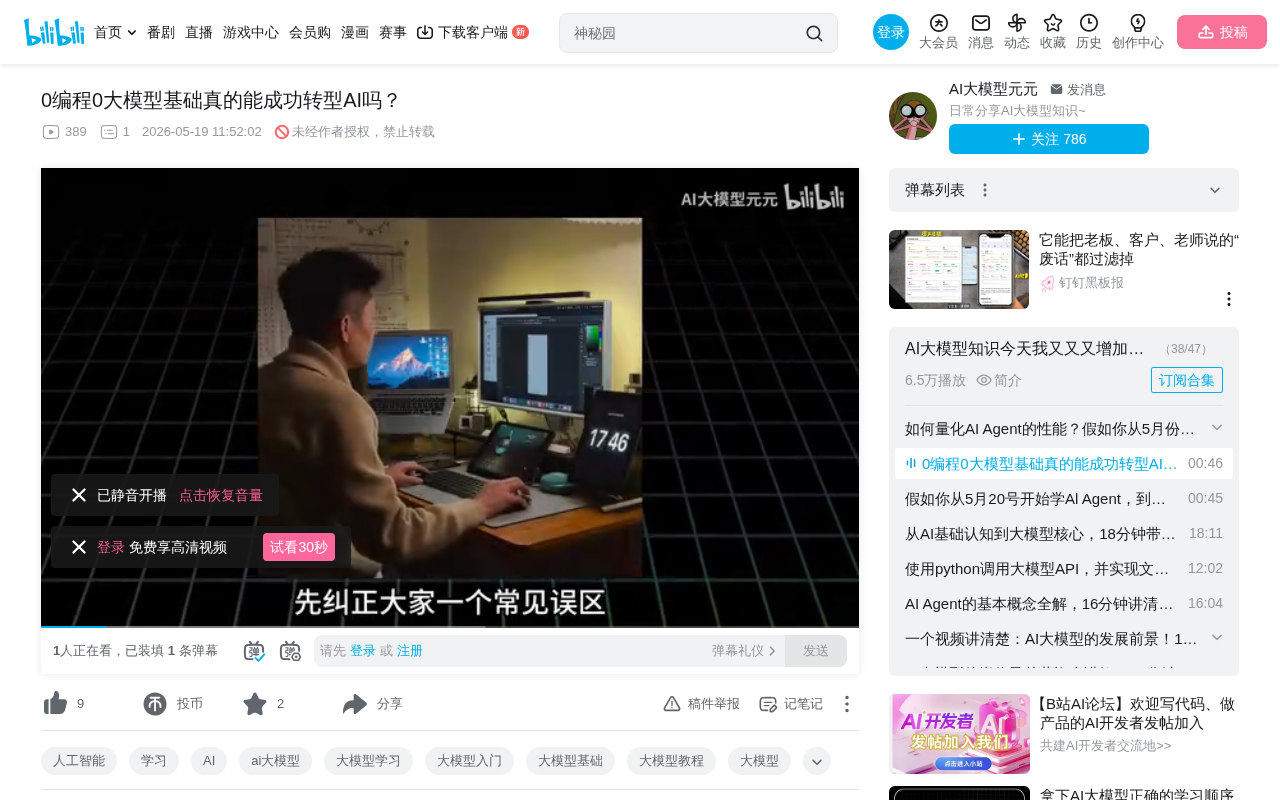
Recently, a content creator on Bilibili shared their experience learning AI large models from scratch, claiming that through two hours of daily study, they grew from a complete beginner to a practical AI talent within three months. This case deserves deeper analysis — we should recognize what's reasonable while being wary of oversimplification.
What Kind of AI Talent Do Companies Actually Need?
Insights from 300+ Job Descriptions
The content creator made a valuable observation: after analyzing over 300 job descriptions for large model-related positions, they found that companies don't actually need "theory-only technicians who can only solve textbook problems" — they need practical talent who can iterate and deploy projects using large models.
Systematically analyzing job descriptions is a classic methodology in career planning, with the core idea being to reverse-engineer learning paths from employers' real needs. Current AI-related positions can be roughly divided into four layers: the infrastructure layer (chips, computing architecture), the model R&D layer (pre-training, fine-tuning, alignment), the middleware layer (framework development, model deployment optimization), and the application layer (AI product design, application development, solutions). The deeper the layer, the higher the requirements for mathematics and computer science foundations; the closer to the application layer, the more emphasis on business understanding and engineering integration capabilities.
This assessment has merit. The current AI industry indeed has two distinct talent gaps:
- Technical R&D layer: Requires deep algorithmic and mathematical foundations, extremely high barrier to entry
- Application deployment layer: Requires understanding the capability boundaries of large models and combining them with business scenarios, relatively lower barrier
For those switching careers with zero background, the latter is clearly the more realistic entry point. Roles like AI Product Manager, Prompt Engineer, and AI Application Developer have far lower requirements for traditional programming and mathematics compared to algorithm research positions.
Correcting Common Misconceptions
Many people have cognitive biases about AI learning, believing they must master linear algebra, probability theory, and deep learning fundamentals before entering the field. In reality, with the maturation of large model APIs and various low-code/no-code tools, the entry barrier at the application layer is indeed decreasing.
Large model APIs (Application Programming Interfaces) refer to standardized interfaces where model providers package trained large model capabilities — developers only need to send HTTP requests to invoke model capabilities without understanding the model's internal architecture. OpenAI API, Azure OpenAI Service, Baidu's Qianfan Platform, and others all provide such services. Meanwhile, low-code platforms like Dify, Coze, and FastGPT allow users to build AI applications through visual drag-and-drop interfaces, further lowering technical barriers. The maturity of these tools has indeed made "building AI applications without writing code" possible, but it also brings new challenges: when applications encounter problems, people lacking foundational understanding often struggle to locate and resolve issues.
However, this doesn't mean you can completely skip foundational knowledge — understanding basic principles helps you better use tools and troubleshoot problems.
Feasibility Analysis of the Three-Month Transition Plan
What's Reasonable
- Starting with Python basics: Python is the universal language in AI, with concise syntax that's genuinely suitable for beginners
- Project-driven learning: Directly targeting practical projects is more efficient than pure theoretical study
- Two hours daily pace: A sustainable learning intensity for working professionals
- Clear target positions: Understanding the industry landscape first, then determining direction, avoids blind learning
What to Be Cautious About
- "Mastery in three months" is overly optimistic: Even for application-layer positions, three months only counts as getting started — there's still considerable distance to "practical talent"
- Individual differences are ignored: Learning ability, existing knowledge base, and available time vary enormously between people
- Job market reality: When companies hire, career switchers with zero background compete against those with formal training — three months of study alone is unlikely to establish a competitive advantage
- Insufficient expectation of difficulties: Building programming thinking and debugging skills requires substantial time accumulation
From a cognitive science perspective, developing Computational Thinking involves the coordinated development of multiple cognitive abilities: abstraction (simplifying complex problems into manageable models), decomposition (breaking large problems into smaller ones), pattern recognition (finding commonalities between problems), and algorithm design (designing steps to solve problems). Research shows that cultivating these abilities typically requires 200-500 hours of deliberate practice. This explains why "three months at two hours daily" (approximately 180 hours) for someone with absolutely zero background may just barely reach the stage of initial programming thinking formation — still quite far from proficient application.
AI Career Transition Advice for Different Backgrounds
Technical-Adjacent Backgrounds (e.g., Frontend, QA, DevOps)
This group can transition to AI application development relatively smoothly, as their existing programming foundation allows them to quickly get hands-on with large model API calls, RAG system building, and other practical projects.
RAG (Retrieval-Augmented Generation) is one of the most mainstream technical architectures in enterprise AI applications today. Its core approach is: splitting documents from enterprise private knowledge bases into small chunks, converting text into high-dimensional vectors via Embedding models and storing them in vector databases (such as Milvus, Pinecone, Weaviate, ChromaDB, etc.). When a user asks a question, the most relevant document fragments are first retrieved from the vector database, then passed as context to the large model for answer generation. This architecture solves the problem of the large model's knowledge cutoff date and avoids model "hallucinations" — it's the standard solution for enterprise knowledge Q&A, intelligent customer service, and similar scenarios.
Recommended focus areas: frameworks like LangChain/LlamaIndex, vector databases, and Prompt Engineering.
LangChain and LlamaIndex are currently the two most popular open-source frameworks in AI application development. LangChain provides a complete toolchain for connecting large models with external data sources, tools, memory systems, and other components, supporting the construction of complex AI Agents and workflows. LlamaIndex focuses more on data indexing and retrieval scenarios, offering rich data connectors and indexing strategies, making it particularly suitable for building RAG applications. Both frameworks are Python-based with relatively friendly API designs, making them important learning targets for career switchers entering AI application development. Mastering these frameworks means being able to quickly build prototype systems — which is exactly what "practical ability" means in enterprise hiring.
Product/Operations/Non-Technical Backgrounds
As mentioned in the video regarding those "with no connection to programming," AI Product Manager is a direction worth considering. Core competency requirements include: understanding the capabilities and limitations of large models, designing reasonable AI product solutions, and having basic technical communication skills. You don't need to write code, but you need to understand technical logic.
Among these skills, Prompt Engineering is one of the most accessible professional skills for non-technical backgrounds, but it's far more than just "writing good prompts." It's a systematic methodology for studying how to communicate efficiently with large models, including advanced techniques such as: Few-shot Learning, Chain-of-Thought reasoning, ReAct (Reasoning + Acting), Tree-of-Thought, and more. Professional Prompt Engineers need to understand technical details like the model's token mechanism, temperature parameters, and context window limitations, as well as master practical skills like system prompt design, output format control, and safety measures (preventing prompt injection attacks). While this role doesn't require deep programming ability, it demands strong logical thinking and systematic reasoning capabilities.
Students
Abundant time is the biggest advantage. Rather than rushing, spend 6-12 months on systematic learning — master both practical skills and build a solid theoretical foundation. This approach creates much stronger competitiveness in the job market.
A Rational View of AI Career Transitions: Setting Reasonable Expectations
Switching to AI isn't impossible, but requires setting reasonable expectations:
- Getting started can be quick, but going from beginner to employable requires sustained accumulation
- Tools are lowering barriers, but understanding principles remains important
- Choosing the right direction matters more than blind effort — research target positions before creating a study plan
- Practical projects are the best resume items, more convincing than certificates or course completion counts
Ultimately, whether a career transition succeeds depends on: clear goal positioning + sustained learning investment + real project accumulation. Three months can complete the onboarding phase, but a true career transition is a process of continuous iteration.
Key Takeaways
- Enterprise AI positions value practical deployment ability over pure theoretical knowledge; application-layer roles are more accessible for career switchers with zero background
- Two hours of daily study for three months can complete the introductory phase, but there's still a gap before achieving real job-market competitiveness
- Non-technical backgrounds can consider the AI Product Manager direction; technical backgrounds can quickly enter AI application development
- Keys to successful transition: identify target positions, learn through projects, and continuously accumulate practical experience
- Be wary of oversimplified marketing claims; establish reasonable expectations about learning difficulty and time investment
Related articles
 Industry Insights
AI Product Development in Practice: Model Selection, Building Moats, and Paths to Commercialization
Practical strategies for AI product development: why not to train models from scratch, when to use APIs vs. fine-tuning, building product moats, and the full path from evaluation systems to commercialization.
 Industry Insights
No Product Fits Your Needs? Building It Yourself Is the Best Starting Point for Indie Developers
Can't find a product that fits? Building from personal pain points is the best entry for indie developers. Niche needs + AI tools = rapid product creation.
 Industry Insights
OpenAI Codex Tutorials Mass-Copied on Bilibili, Highlighting AI Content Farm Problem
At least 9 Bilibili accounts mass-published identical OpenAI Codex tutorial videos, exposing content farm operations in the AI tools space.