CascadeFlow: Deep Dive into the AI Agent Cascading Runtime Optimization Framework
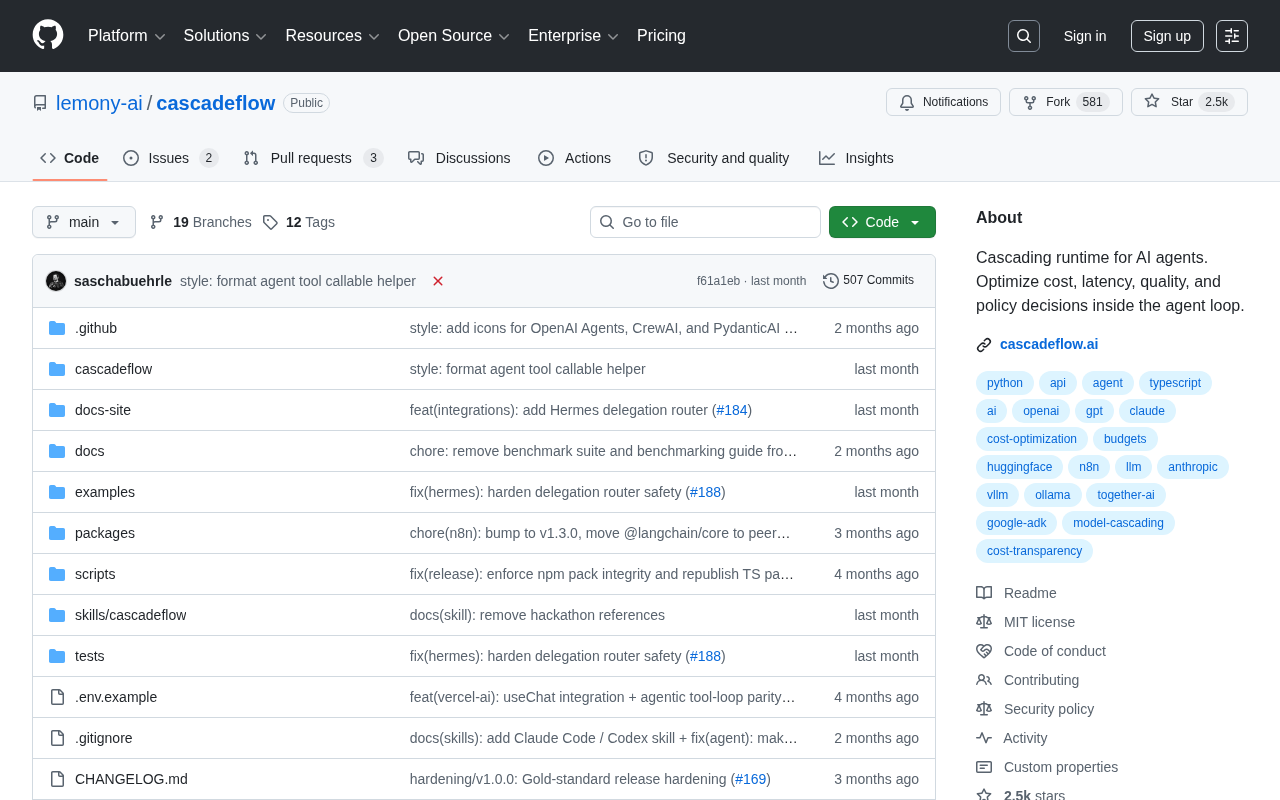
CascadeFlow optimizes AI Agent runtime by cascading models based on task complexity to balance cost, latency, and quality.
CascadeFlow is an open-source framework that embeds cascading runtime optimization within AI Agent execution loops. By dynamically routing requests to appropriate model tiers based on task complexity and budget constraints, it simultaneously optimizes cost, latency, quality, and policy compliance. With 2,500+ GitHub stars, it addresses the critical challenge of making production-grade Agent applications economically viable.
Project Overview
CascadeFlow is an open-source AI Agent cascading runtime framework developed by the lemony-ai team, focused on optimizing four core dimensions within the Agent execution loop: cost, latency, quality, and policy decisions. The project has garnered over 2,500 stars on GitHub with 583 forks, demonstrating strong community interest in the Agent runtime optimization space.
What is a Cascading Runtime
Core Concept
"Cascading" refers to the dynamic selection of different model tiers or strategy paths during an AI Agent's reasoning and execution process, based on task complexity, real-time requirements, and budget constraints. Put simply, not every request needs to be handled by the most powerful (and most expensive) model—simple tasks are routed to lightweight models, while only complex tasks get escalated to heavyweight models.
Cascading strategies have deep theoretical roots in machine learning. Long before the rise of deep learning, Cascade Classifiers were widely used—the most classic example being the Viola-Jones face detection algorithm, which progressively filters candidate regions through a series of classifiers arranged from simple to complex, where only samples passing the previous stage enter the next, more complex evaluation. This "coarse screening first, fine judgment later" philosophy has been adapted by CascadeFlow for LLM invocation scenarios. In the LLM domain, this strategy is also known as "Model Routing" or "Tiered Inference," with the core idea being to use smaller models or rule engines to first assess request complexity before deciding whether to invoke larger, more expensive models. FrugalGPT (a 2023 Stanford research paper) is an important academic pioneer in this direction, demonstrating that cascading strategies can reduce inference costs by up to 98% while maintaining GPT-4-level quality.
This approach isn't entirely new, but CascadeFlow systematically encapsulates it as a runtime layer embedded within the Agent's decision loop, freeing developers from manually writing complex routing logic.
Four-Dimensional Optimization Goals
CascadeFlow simultaneously optimizes four key metrics:
- Cost: Reduces unnecessary calls to expensive models through intelligent routing
- Latency: Enables fast responses for simple requests, avoiding full inference wait times
- Quality: Ensures complex tasks still receive high-quality outputs
- Policy: Supports custom rules such as compliance checks and safety filtering
CascadeFlow Technical Analysis
Python-Native Implementation
The project is written in Python, making it highly compatible with the current AI Agent ecosystem. Users of mainstream frameworks like LangChain, AutoGen, or CrewAI can integrate CascadeFlow at relatively low cost.
These three frameworks represent three important directions in the current AI Agent development ecosystem. LangChain is the earliest and most widely used LLM application development framework, providing foundational capabilities like chain-based invocation, tool integration, and memory management, with its LangGraph sub-project further supporting stateful multi-step Agent workflows. AutoGen, developed by Microsoft Research, focuses on multi-Agent collaboration scenarios, allowing multiple AI Agents to engage in conversational collaboration to complete complex tasks. CrewAI emphasizes role-based Agent team collaboration, simulating human team workflows by assigning each Agent a clear role, objective, and set of tools. While these three frameworks have different focuses, they all face a common challenge: as Agent workflow complexity increases, LLM call frequency and costs escalate dramatically. CascadeFlow, as a runtime layer, can complement these frameworks by optimizing underlying model invocation strategies without altering the upper-level business logic.
Optimization Embedded Within the Agent Loop
Unlike traditional API gateway-level model routing, CascadeFlow is designed to operate within the Agent's internal loop. This means it has access to richer contextual information—outputs from previous steps, cumulative cost of the current task, time budget already consumed—enabling more precise cascading decisions.
The Agent execution loop (Agent Loop) refers to the iterative decision-making process an Agent undergoes when completing a complex task. A typical Agent Loop includes the following steps: Perceive (receive input or environmental feedback) → Think (invoke LLM for reasoning and planning) → Act (execute tool calls or generate output) → Observe (evaluate action results) → Think again. This loop executes repeatedly until the task is completed or a termination condition is reached. Taking the ReAct (Reasoning + Acting) paradigm as an example, an Agent may need to go through 5-20 loop iterations to complete a complex task, with each iteration involving at least one LLM call. CascadeFlow's embedding within this loop means it can dynamically adjust model selection strategies at each iteration based on current context, rather than making a one-time static routing decision outside the loop. This fine-grained control capability is what fundamentally distinguishes it from traditional API gateway routing solutions.
Use Cases
This type of framework delivers the most value in the following scenarios:
- Multi-turn conversational Agents: Use lightweight models for initial turns to understand intent, upgrading to stronger models for critical turns
- Batch processing tasks: Maximize processing quality within a cost budget
- Production deployments: Balance quality and latency under SLA constraints
- Compliance-sensitive scenarios: Certain requests require specific policy checks
SLA (Service Level Agreement) is the core metric system for measuring service quality in production environments, typically encompassing availability (e.g., 99.9% uptime), response latency (e.g., P95 latency under 2 seconds), and throughput. For AI Agent applications, SLA constraints present unique engineering challenges: LLM inference latency is inherently high and highly variable—a single GPT-4-level model call may fluctuate between 1-30 seconds, and a complete Agent workflow involving multiple serial calls can accumulate and amplify this latency. Additionally, different LLM providers' APIs may experience rate limiting or temporary unavailability, further increasing the difficulty of meeting SLAs. CascadeFlow's cascading strategy has practical engineering value in this context: by routing the majority of requests to faster lightweight models, it can significantly reduce P95/P99 latency while preserving the ability to use high-performance models for the minority of complex requests.
Market Context and Practical Significance
As AI Agents transition from experimentation to production, cost control becomes an unavoidable issue. A complex Agent workflow may involve dozens of LLM calls, and if all use GPT-4-level models, costs will escalate rapidly. CascadeFlow provides an engineered solution that automates the principle of "using the right model for the right task."
Specifically, the cost problem of AI Agents is dramatically amplified at production scale. Using OpenAI's pricing as a reference, GPT-4o's input token price is approximately 6x that of GPT-4o-mini, and its output token price is approximately 4x. Assume a customer service Agent requires an average of 8 LLM calls per interaction, consuming about 2,000 tokens per call, handling 100,000 interactions daily—the monthly cost of using GPT-4o exclusively could reach tens of thousands of dollars. However, if a cascading strategy routes 70% of simple turns to GPT-4o-mini, using GPT-4o only for turns requiring deep reasoning, costs can be reduced by over 50%. This doesn't even account for further savings from using self-hosted open-source models (such as Llama 3, Mistral, etc.) as the lightest-weight tier in the cascade. This cost optimization is critical to the commercial viability of AI applications—many Agent applications that perform excellently at the prototype stage struggle to scale precisely because they cannot control inference costs in production environments.
From a community engagement perspective, the 2,500+ stars and nearly 600 forks indicate strong real-world demand among developers for Agent runtime optimization. This also reflects that AI engineering is maturing from the "it works" stage to the "it works well and economically" stage.
Conclusion
CascadeFlow represents an important direction in the evolution of AI Agent infrastructure: shifting focus from model capabilities alone to how these capabilities can be used efficiently and economically in real-world deployments. For teams building production-grade Agent applications, runtime optimization tools like this deserve close attention.
Related articles
AI Agent Core Architecture Breakdown: From Concept to Enterprise-Grade Intelligent Agent Development
Deep dive into AI Agent architecture: perception, brain, and action modules. Covers RAG memory systems, tool calling mechanisms, Chain of Thought reasoning, and enterprise agent development roadmap.
Hands-On Tutorial: Build an AI Agent from Scratch with 200 Lines of Python
Build an AI Agent from scratch with 200 lines of Python, covering prompts, memory, tool calling, RAG, and Skills — a practical guide for developers.
Anthropic Reverses Controversial Policy of Secretly Throttling AI Researchers Using Claude
Anthropic reverses its controversial policy of secretly throttling Claude Fable/Mythos responses to frontier LLM development requests after community backlash, raising critical questions about AI transparency.