ChatGPT Codex Now Rolls Over Unused Resets: AI Coding Finally Free from Quota Interruptions

ChatGPT Codex now rolls over unused resets, letting developers code without quota interruptions.
OpenAI has introduced a reset rollover mechanism for ChatGPT Codex, allowing unused quota to accumulate rather than expire. This update addresses a major developer pain point — being interrupted mid-flow by usage caps. Combined with free credits and referral rewards, the change signals Codex's evolution from a novelty into a professional-grade AI coding tool, while highlighting that user experience optimization is becoming the key differentiator in the increasingly competitive AI coding landscape.
The Core Change: Resets Go from "Use It or Lose It" to "Rollover Accumulation"
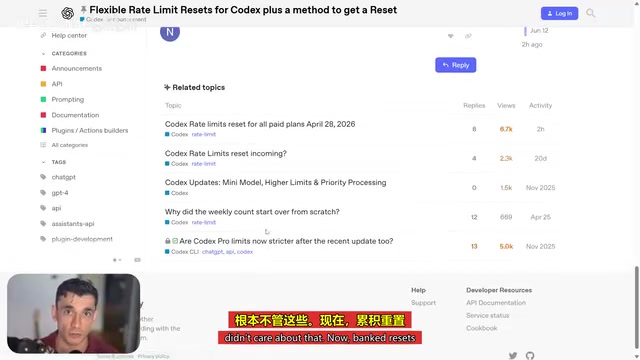
OpenAI recently pushed a seemingly minor but profoundly impactful update to ChatGPT Codex — a rollover mechanism for reset counts. In simple terms, your Codex usage quota used to expire and reset to zero at the end of each period, regardless of whether you'd used it all. Now, unused resets can be banked and called upon when you actually need them.
In the SaaS and API services space, rate limiting is a common resource management technique, typically implemented using Token Bucket or Sliding Window algorithms. The traditional fixed-window reset model means that at the end of each billing cycle, remaining quota is zeroed out regardless of how much the user consumed. This design makes it easy for service providers to predict peak resource demand, but it's extremely user-unfriendly. The rollover mechanism OpenAI introduced is essentially similar to the "data rollover" concept in the telecom industry — unused resources are no longer wasted but carried over into the next cycle. This isn't a first in cloud computing — AWS Reserved Instances and Azure prepaid credits have similar designs — but it's the first large-scale application in the AI coding tools space.
This change addresses a long-standing pain point in AI coding tools: hitting your usage cap right when you're in the zone, with no choice but to wait for a reset. Even worse, the reset timing was dictated by OpenAI — it would often reset when you didn't need it, and your quota would be gone when you actually did. It's like your meal voucher expiring right before you get hungry — a terrible experience.
Now, users can bank their resets and pull them out when racing against a deadline, fixing a critical bug at 2 AM, or running multiple agents simultaneously. Control has shifted from the platform back to the user.
Why This Codex Update Matters: Three Key Reasons
It Matches How Developers Actually Work
Developers naturally work in bursts — sometimes doing nothing all day, sometimes coding intensely for 12+ hours straight. The old fixed reset cycle completely ignored this rhythm. The rollover mechanism finally makes the tool adapt to how people work, rather than the other way around.
It Eliminates Quota Anxiety and Lets Developers Focus on Coding
When you know you've banked enough resets, you no longer agonize over questions like "Should I conserve my usage?" or "If I use it now, what about later?" This psychological certainty lets developers fully immerse themselves in coding instead of constantly calculating their quota.
Flow State is a concept introduced by psychologist Mihaly Csikszentmihalyi, describing the state of deep focus and enjoyment people enter when fully absorbed in an activity. Research shows that programmers need an average of 15–23 minutes of uninterrupted focus to enter a flow state, and once interrupted, re-entering flow can take just as long or even longer. A 2022 Microsoft Research study found that developers are interrupted more than 10 times per day on average, with the productivity loss from each interruption far exceeding the duration of the interruption itself. A forced stop due to quota exhaustion is a textbook example of this kind of destructive interruption — it doesn't just halt the coding itself but forces developers to shift their attention from technical problems to resource management.
Codex Is Evolving from a "Novelty Toy" into a "Professional Development Tool"
This is the most critical point. OpenAI is transforming Codex from a chatbot-like experience into a professional-grade tool that developers can use to run their businesses.
ChatGPT Codex is an asynchronous AI coding agent launched by OpenAI in 2025. It's fundamentally different from the earlier Codex API (released in 2021, fine-tuned on GPT-3, retired in 2023). The new Codex runs in a cloud sandbox environment and can independently execute complete software engineering tasks — including reading codebases, writing code, running tests, and submitting PRs. It's powered by OpenAI's latest codex-1 model, which was trained with reinforcement learning specifically optimized for following instructions, writing tests, and matching code style. Unlike GitHub Copilot, which primarily offers inline completions, Codex functions more like an autonomous "virtual developer" that can handle complex tasks running for hours in the background.
Here's a recap of Codex's core capabilities:
- Running long code tasks that take hours
- Multiple agents working simultaneously
- Reading entire codebases for contextual understanding
- End-to-end code writing and bug fixing
- Support for both Mac and Windows
Among these, multi-agent collaboration is a cutting-edge direction in AI engineering. In this architecture, multiple AI agents can process different modules of the same project in parallel — for example, one agent handles frontend UI development, another manages backend API logic, and a third writes test cases. This approach borrows from microservices architecture, decomposing large development tasks into parallelizable subtasks. However, running multiple agents in parallel means resource consumption multiplies, which is precisely why the reset rollover mechanism is especially important for power users — without sufficient accumulated quota, multi-agent collaboration is practically unsustainable.
Reset rollover makes these capabilities truly usable in a continuous, deep manner, rather than being artificially interrupted.
Codex in Action: Uninterrupted Continuous Development
Consider a typical development task: suppose you need to build a data dashboard for a community that tracks new member growth and displays it in a clean, modern style. The traditional approach might require hours of hand-written code, but with Codex, you just describe the requirements and it starts working immediately.

The problem was that tasks like these tend to be quota-intensive. Previously, you might hit the cap halfway through, forcibly breaking your train of thought. Now, with banked resets, you can simply draw from your reserves and maintain development continuity and flow state. This may seem like a small change, but the productivity boost is transformative — you can finally see things through to completion in one sitting.
Free Credits and Referral Rewards: How to Get More Resets
OpenAI has also rolled out two complementary incentive programs:
- Free reset credits: Every eligible user (Plus, Pro, Business subscribers) gets one free banked reset, claimable directly on the platform
- Referral reward program: Pro users can invite up to 3 friends, and when a friend sends their first Codex message, both parties earn an additional reset (valid for just over two weeks)
This is a classic win-win strategy: OpenAI gains new user growth, while existing users get more quota.
The AI Coding Competitive Landscape: Experience Optimization as the Key Differentiator
The AI coding space is fiercely competitive right now: OpenAI Codex, Anthropic Claude Code, GitHub Copilot, Cursor, and others are all vying for the same pool of developer users.

The 2025 AI coding tools market has formed a multi-layered competitive landscape. GitHub Copilot holds the largest market share thanks to its deep integration with the VS Code and GitHub ecosystem, leveraging models from both OpenAI and Anthropic under the hood. Cursor, as a standalone IDE, has won over a large base of early adopters with its aggressive AI-native design philosophy, earning praise for its Tab completion and multi-file editing capabilities. Anthropic's Claude Code differentiates itself with a terminal-first interaction model and ultra-long context windows (supporting 200K tokens), excelling at handling large codebases. Additionally, Google's Gemini Code Assist and Amazon's CodeWhisperer continue to iterate. Notably, the underlying large model capabilities of these tools are rapidly converging — on standardized coding benchmarks like SWE-bench, the gap between leading models has narrowed to single-digit percentage points, making product experience optimization the true competitive battleground.
OpenAI clearly recognizes that when model capabilities across competitors converge, the real differentiator isn't how smart the model is, but how smooth the user experience feels. The reset rollover feature embodies this philosophy — it's not a flashy new feature, but it quietly removes the biggest barrier to usage.
This is a lesson for the entire industry: The best product isn't the one with the most features — it's the one that feels most natural to use. Eliminating friction points often wins more users than adding new features.
Conclusion: Now Is a Great Time to Get Started with Codex
The core value of this Codex update can be summed up in one sentence: Making the tool work with you, not against you.
For developers still on the fence, now is genuinely a good time to jump in:
- Free credits are available to claim immediately — zero cost to experiment
- The rollover mechanism means you don't have to rush — explore at your own pace
- The referral program lets you earn even more quota
Many people might think, "It's just a rate limit adjustment," but it's precisely these seemingly minor experience optimizations that determine whether a tool transitions from "occasional novelty" to "daily essential." OpenAI has taken another step forward on the path to true productization.
Related articles

Gemini Core Team Makes Rare Joint Appearance: Noam Shazeer and Other Key Figures in Public Conversation
Google Gemini core leaders Oriol Vinyals, Noam Shazeer, and Koray Kavukcuoglu make a rare joint public appearance — analyzing the team lineup, strategic significance, and competitive signals.

Two Minute Papers: The Gold Standard for Making Cutting-Edge AI Research Accessible
An in-depth look at how Two Minute Papers explains cutting-edge AI research in two minutes, covering Károly's methodology, topics, and lessons for science communicators.

AI Full-Stack Development Architecture: A Three-Layer Progressive Path from Prototype to Production
A detailed guide to AI full-stack development architecture covering Node.js+TypeScript+Monorepo engineering, Docker CI/CD deployment, and AI engine design with interview tips.