ChatGPT Generates Over 1.5 Billion Images Per Week — How Images 2.0 Is Reshaping Visual Content Production
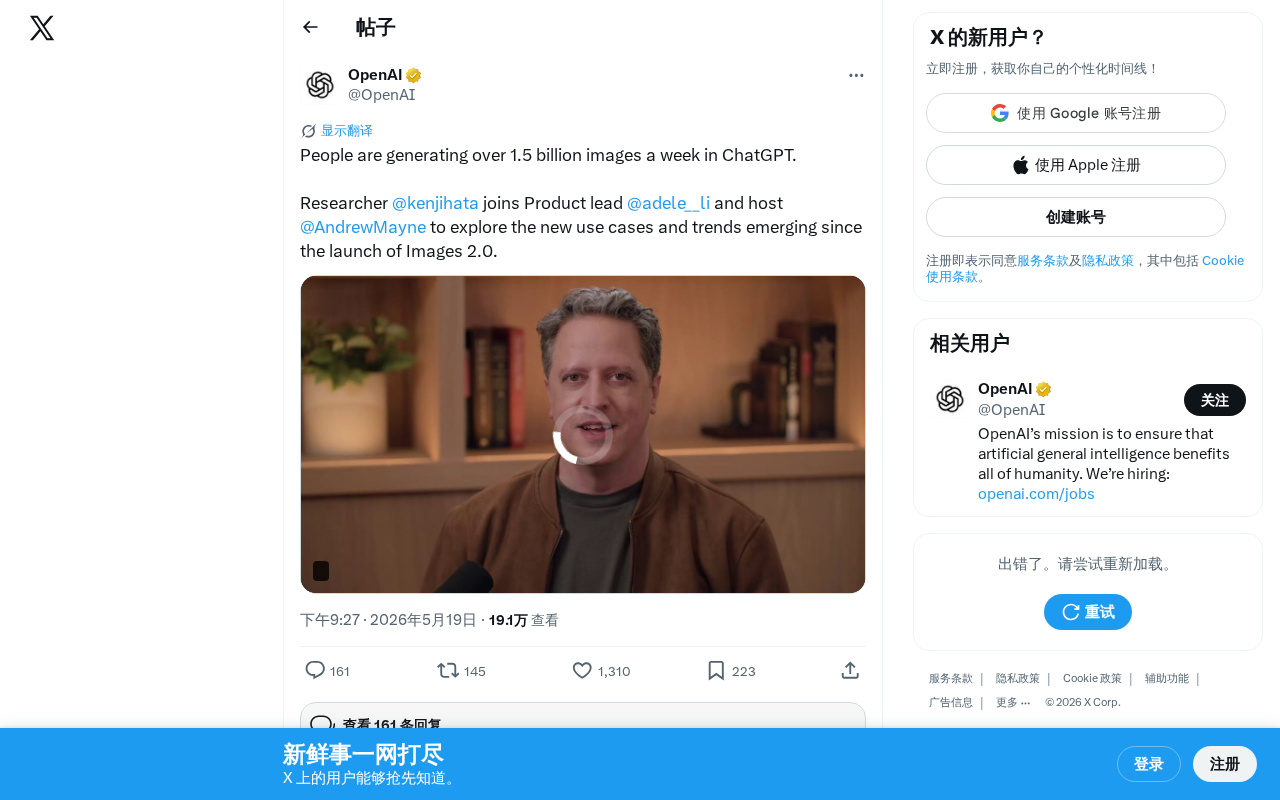
ChatGPT now generates 1.5B+ images weekly as Images 2.0 reshapes visual content creation at scale.
OpenAI disclosed that ChatGPT users generate over 1.5 billion images per week, dwarfing traditional stock photo libraries. Images 2.0, natively integrated into GPT-4o, enables natural conversational image creation, driving adoption across personal branding, commercial design, education, and entertainment. This massive scale raises critical questions about compute costs, content safety, copyright governance, and commercial sustainability for the AI industry.
Staggering Numbers: What 1.5 Billion Images Per Week from ChatGPT Really Means
OpenAI recently disclosed a jaw-dropping statistic: ChatGPT users are now generating more than 1.5 billion images per week. This figure not only showcases the explosive growth of AI image generation technology but also signals that Images 2.0 has deeply embedded itself into users' daily workflows since its launch.
What does 1.5 billion per week actually mean? A quick breakdown: over 200 million per day, nearly 9 million per hour, and roughly 2,500 images being generated by ChatGPT every single second. This scale of content output has far surpassed the capacity of traditional design tools and stock photo platforms — AI is reshaping visual content production at an unprecedented pace.
For comparison, Shutterstock, one of the world's largest commercial stock photo libraries, has accumulated a total inventory of roughly several hundred million images over more than two decades. Getty Images operates at a similar scale. Yet ChatGPT's output in a single week reaches 1.5 billion — equivalent to producing several times the entire historical inventory of these traditional stock libraries in less than a week. While AI-generated images differ from professional photography in quality and use cases, this orders-of-magnitude gap is fundamentally changing the supply economics of visual content.
Key Changes Brought by Images 2.0
From Tool to Creative Partner
OpenAI researcher Kenji Hata and product lead Adele Li discussed the emerging use cases and trends since the launch of Images 2.0 in a recent podcast conversation. The shift from DALL-E as a standalone tool to image generation capabilities deeply integrated into ChatGPT's conversational flow has fundamentally transformed how users interact with the technology.
From a technical architecture perspective, this transformation is profoundly significant. Images 2.0 is a native image generation capability that OpenAI launched alongside the GPT-4o model in late March 2025, and it differs fundamentally from the earlier DALL-E series. DALL-E was a standalone diffusion model that users had to invoke separately, whereas Images 2.0 embeds image generation directly into GPT-4o — an autoregressive multimodal model — achieving end-to-end fusion of text understanding and image generation. This means the model can output images while simultaneously understanding user intent, without switching between different models, resulting in more precise semantic understanding and a more natural multi-turn iteration experience.
Users no longer need to carefully craft complex prompts. Instead, they can iteratively refine and optimize images through natural conversation. This interaction paradigm dramatically lowers the creative barrier, enabling non-designers to easily produce high-quality visual content.
Popular Use Cases for AI Image Generation
Based on observations across social media, Images 2.0 has given rise to several popular application scenarios:
- Personal Branding & Social Content: Users generate personalized avatars, social media graphics, and story illustrations with AI
- Commercial Design: Small businesses and entrepreneurs quickly create product showcase images and marketing materials
- Education & Knowledge Sharing: Teachers and content creators generate instructional diagrams and information visualizations
- Entertainment & Creative Expression: Stylized images, Studio Ghibli-style artwork, and other viral creative trends
Industry Impact and Future Outlook
Profound Impact on the Creative Industry
An output volume of 1.5 billion images per week means AI image generation is no longer a niche tool — it's a large-scale content production infrastructure. This will have far-reaching implications for traditional stock photo services (such as Shutterstock and Getty Images), basic design services, and the illustration industry.
Content Safety and Copyright Governance Challenges
As generation volumes surge, issues around content safety, copyright protection, and misinformation prevention become increasingly urgent. OpenAI employs a multi-layered defense mechanism for AI-generated image safety governance. On the front end, the system performs safety reviews of user prompts, filtering requests involving violence, pornography, hate speech, and other policy violations. On the back end, all AI-generated images are embedded with digital watermarks following the C2PA (Coalition for Content Provenance and Authenticity) metadata standard — a content provenance technology standard jointly promoted by companies like Adobe and Microsoft that records the AI-generated origin in the image's metadata. Additionally, OpenAI has deployed specialized classifier models to detect whether generated content violates usage policies. However, at a scale of 1.5 billion images per week, the accuracy and coverage of automated review systems still face enormous challenges.
How OpenAI maintains product usability while ensuring the safety and traceability of generated content will be a critical issue going forward.
Compute Consumption and Commercial Sustainability
Generating 1.5 billion images per week demands massive computational resources. To understand the compute required at this scale, consider the current computational costs of AI image generation. Taking diffusion models as an example, generating a single 1024×1024 resolution image typically requires dozens of denoising iterations, each involving large-scale matrix operations. Inference time for a single image on a high-end GPU (such as an NVIDIA H100) is approximately several seconds. Even with optimization techniques like distillation acceleration and speculative decoding, sustaining a throughput of 2,500 images per second still requires tens of thousands of GPUs running simultaneously. For reference, OpenAI is reported to operate compute clusters with hundreds of thousands of high-end GPUs, and image generation has become one of its largest compute consumption scenarios.
This also explains why OpenAI has recently imposed limits on image generation for free-tier users. The gradual tightening from initially no explicit cap reflects a core tension in AI inference economics: the per-inference cost of image generation is far higher than that of pure text conversations. Industry estimates suggest the marginal cost of generating a single high-quality AI image is around several cents, while the cost of a text-only response is a fraction of that or even lower. At 1.5 billion images per week, inference costs for image generation alone could reach tens of millions of dollars weekly. This is a key driver behind OpenAI's push to convert users to the $20/month Plus subscription and the $200/month Pro subscription. Finding the balance between commercial sustainability and user experience is a shared challenge for all AI companies.
Conclusion
The explosive growth of ChatGPT's image generation feature confirms a clear trend: when AI capabilities are powerful enough and the interaction is natural enough, users' creative demand is massively unleashed. 1.5 billion images per week is not just a milestone metric — it signals that we are entering a new era of extraordinarily abundant visual content. For creators, businesses, and the industry at large, how well they adapt to and leverage this transformation will determine the competitive landscape of the future.
Related articles
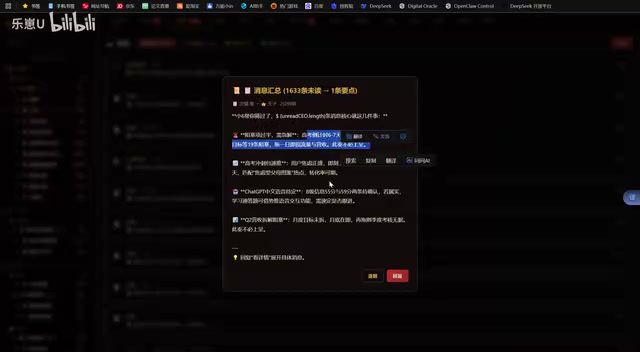
Vibe Coding in Practice: A Junior Student Uses Cursor to Build a Multi-Agent System with 51 AI Officials Based on the Three Departments and Six Ministries Framework
A junior student uses Cursor and Vibe Coding to build a multi-agent system with 51 AI officials modeled on China's Three Departments and Six Ministries, featuring task distribution, approval workflows, and Token cost visualization.
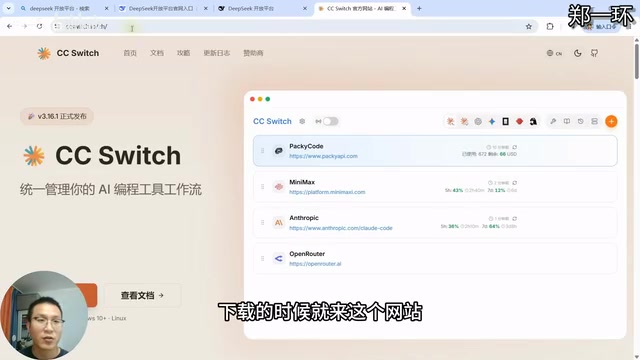
How to Connect Codex to DeepSeek Models: Free Switching via CC Switch
Learn how to connect OpenAI Codex to DeepSeek models via CC Switch, enabling free switching between DeepSeek and GPT with complete setup and routing guide.
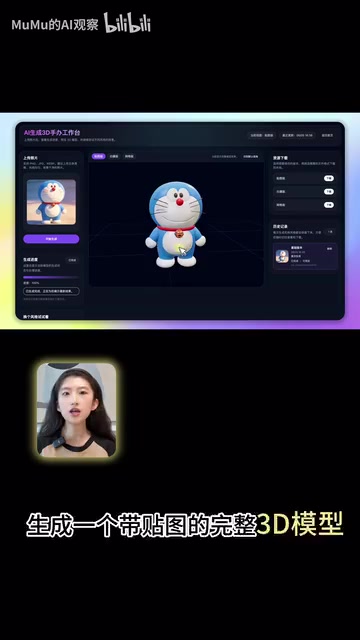
AI Coding Deployment Guide: A Complete Hands-On Workflow from Local Demo to Live Website
Most AI Coding tutorials stop at local demos. This guide walks through 8 key steps to deploy an AI-powered 3D figurine website from Codex coding to live server deployment.