Claude Code Fast Mode Price Cut: Dual-Mode Workflow Reshapes the AI Programming Experience
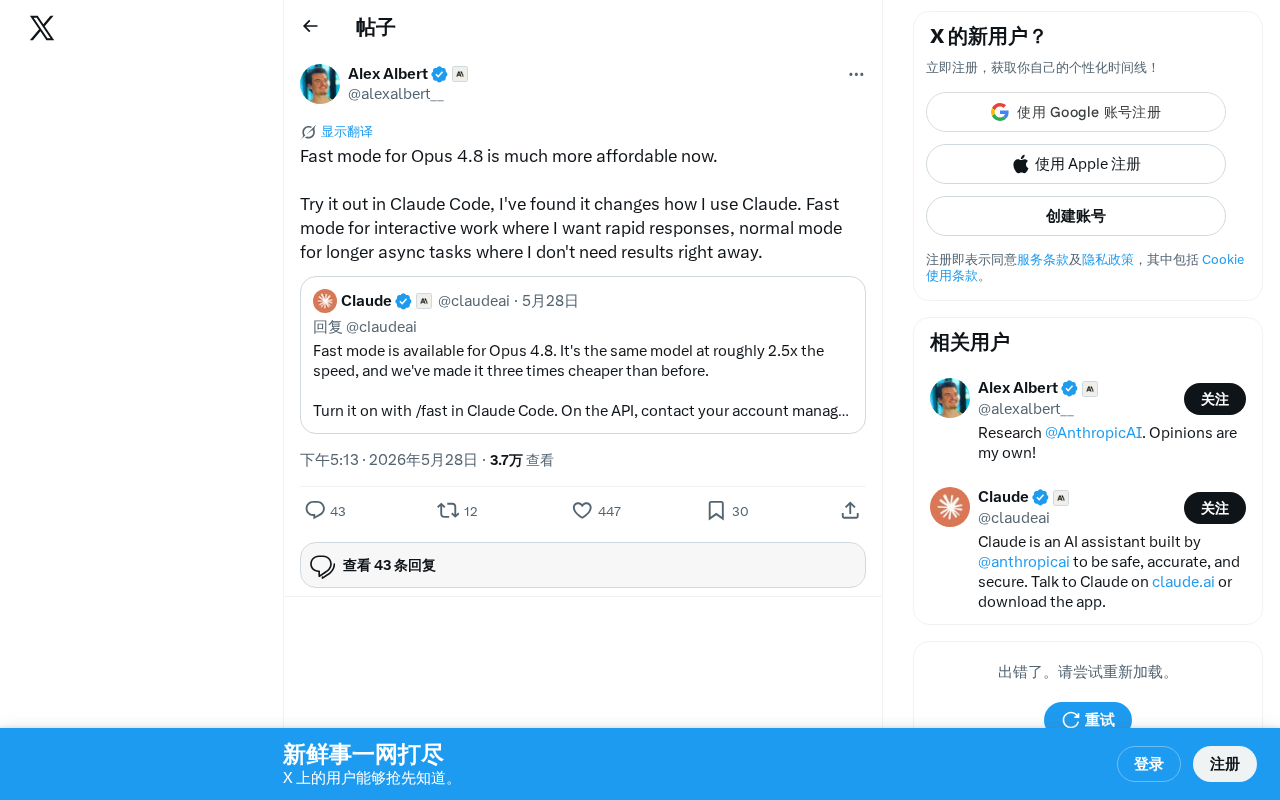
Anthropic cuts Claude Fast mode pricing, enabling a dual-mode AI programming workflow for developers.
Anthropic recently reduced pricing for Claude Opus 4.8 Fast mode, leveraging techniques like speculative decoding and model distillation to achieve low-cost speed improvements. The price cut gives rise to a dual-mode workflow: Fast mode for interactive real-time development to maintain flow state, and Normal mode for async long tasks to control costs. This adjustment marks AI programming tools evolving from "usable" to "excellent," and represents Anthropic's strategic move to capture developers' workflow entry points in the competitive AI coding assistant market.
Anthropic recently quietly adjusted the pricing strategy for Claude Opus 4.8 Fast mode, making it significantly more affordable. While this change may seem minor, it could fundamentally transform how developers use Claude Code.
What the Fast Mode Price Cut Means
Fast mode in Claude Code isn't a new feature, but its previously high usage costs deterred many developers. With this price reduction, the barrier to entry has dropped substantially, allowing developers to freely switch between different modes in their daily programming work without worrying excessively about costs.
The core value of this adjustment lies in: it enables developers to flexibly choose response speeds based on task nature, rather than being forced to compromise between cost and efficiency.
The Technical Implementation of Fast Mode: Why "Fast" Is Possible
Fast mode's speed improvement doesn't simply come from reducing model quality. Instead, it relies on cutting-edge techniques like Speculative Decoding or Model Distillation. Speculative Decoding uses a lightweight "draft model" to pre-generate candidate token sequences, which the main model then batch-verifies, significantly boosting throughput without noticeably sacrificing output quality — a technique already widely deployed in production environments by companies like Google and Meta. Model Distillation transfers the "knowledge" accumulated by large models to smaller, lower-inference-cost student models, achieving even more significant speed improvements but with some capability loss. Each approach has its trade-offs, and Anthropic's decision to reduce Fast mode pricing signals that they've achieved substantial breakthroughs in technical cost control, enough to pass the savings on to developers.
Dual-Mode Workflow: The Optimal Pairing for Interactive and Async Tasks
The most noteworthy change following the price cut is the emergence of an entirely new workflow pattern. As early adopters have shared from their practical experience, Claude Code usage can be clearly divided into two scenarios:
Fast Mode: The Power Tool for Interactive Development
When you're doing real-time coding, debugging, or work that requires rapid iteration, Fast mode is the ideal choice. Typical scenarios include:
- Real-time code review: Quickly getting code improvement suggestions
- Interactive debugging: Getting instant feedback while troubleshooting issues
- Prototyping: Rapidly validating ideas with frequent AI conversations
- Code completion and refactoring: Maintaining a smooth coding experience without waiting interruptions breaking your train of thought
In these scenarios, response speed directly impacts a developer's Flow State. This concept, proposed by psychologist Mihaly Csikszentmihalyi, refers to the state of deep focus when a person is fully immersed in an activity. Research shows that programmers need approximately 15 minutes of warm-up to enter a flow state, and a single response delay exceeding 2 seconds is enough to break it. Microsoft Research surveys further show that developers need an average of 23 minutes to fully regain focus after being interrupted. This is precisely why the response speed of AI programming tools impacts productivity far more than intuition suggests — every extra second of waiting risks scattering attention and breaking the train of thought.
Normal Mode: The Economical Choice for Long Tasks
For async tasks that don't require immediate results, Normal mode is the more reasonable choice:
- Large-scale code generation: Generating complete modules or components
- Complex analysis tasks: Codebase audits, architecture analysis, etc.
- Documentation generation: Batch generation of API docs and technical documentation
- Background refactoring: Large-scope code migration and refactoring tasks
These tasks can typically run in the background while developers handle other work and check back later for results.
The Deeper Impact on Developer Work Habits
The true significance of this dual-mode strategy isn't just about saving money or gaining speed — it's about driving developers to establish more rational AI-assisted programming habits.
In the past, many developers tended to use a single mode for all tasks — either using high-speed mode throughout (leading to high costs) or using normal mode throughout (sacrificing interactive experience). Now, a reasonable cost structure makes "switching on demand" a natural choice.
This actually reflects a signal that AI programming tools are maturing: tools are no longer one-size-fits-all solutions, but are beginning to offer granular usage strategies. Just as IDEs have different run configurations, AI programming assistants are starting to differentiate between usage scenarios and provide differentiated services.
The AI Programming Tool Market Landscape: Differentiated Competition Enters Deep Waters
Looking at the broader AI programming assistant market, Anthropic's adjustment is not an isolated event. Mainstream tools like GitHub Copilot, Cursor, and Codeium have all begun offering Tiered Service Models to meet the varying needs from individual developers to enterprise teams. Tiered pricing strategies have been repeatedly validated in the SaaS industry as an effective means of increasing user stickiness: low-price entry tiers lower the trial barrier, while premium features lock in power users. Anthropic's Fast mode price cut is essentially competing with these rivals for the entry point into developers' daily workflows — once developers deeply embed a tool into their coding habits, migration costs rise dramatically. From this perspective, the price cut is both a manifestation of technical maturity and a carefully designed market positioning move.
Practical Recommendations
If you're currently using Claude Code, here are some strategies worth trying:
- Develop scenario awareness: Before starting a task, first determine whether it's interactive or async in nature
- Leverage Fast mode's immediacy: During development phases requiring high-frequency dialogue, use Fast mode boldly — don't sacrifice development efficiency to save costs
- Batch your async tasks: Accumulate non-urgent tasks and process them in batches using Normal mode
- Monitor your usage: Regularly review the usage ratio between the two modes to find the balance that works best for you
Final Thoughts
The Claude Opus 4.8 Fast mode price cut is, on the surface, a simple pricing adjustment. At a deeper level, it's an important step by Anthropic in pushing AI programming tools from "usable" to "excellent." When cost is no longer the primary obstacle, developers can truly choose the most suitable tool configuration based on their needs, allowing AI programming assistants to deliver maximum value.
For developers who haven't yet tried the dual-mode workflow, now is an excellent time to get started.
Related articles
 Product Reviews
Qoder vs Cursor Real-World Comparison: Which $20/Month AI IDE Is Better?
Hands-on comparison of Qoder vs Cursor AI IDEs: Agent autonomy, human interaction count, and architecture decisions. Qoder needed only 2 interactions vs Cursor's 8.
 Product Reviews
Cursor Cloud Agent Demo: Eliminating Bottlenecks Across the Entire Software Development Lifecycle
Deep analysis of Cursor's Cloud Agent demo showing how cloud VMs, automated test artifacts, and a full-chain control plane systematically eliminate human bottlenecks across the software development lifecycle.
 Product Reviews
Cursor 3.0 Deep Dive: Multi-Agent Parallelism, Design Mode, and Best-of-N Model Comparison
Cursor 3.0 evolves from an AI coding assistant into an Agent fleet command center. Explore multi-agent parallelism, Design Mode, and Best-of-N model comparison.