Claude Code Hands-On: From Typing a Prompt to Launching a Website in Minutes

Claude Code automates full-stack app development and deployment entirely through natural language conversation.
Claude Code's latest demo showcases a breakthrough in AI programming: a developer built a full-stack microblogging app entirely through natural language prompts, covering front-end UI, back-end logic, front-end/back-end integration, incremental feature additions (like an AI image generator), and one-click deployment — all without writing a single line of code. While the demo scenario is relatively simple and enterprise-grade complexity and code security still require scrutiny, the tool already delivers immense practical value for rapid prototyping and MVP development.
From Requirement Description to Website Launch — Zero Handwritten Code
Claude Code's latest demo has once again reshaped perceptions of AI programming capabilities. In a widely circulated demo video, a developer built a complete full-stack application resembling Weibo/Twitter entirely through natural language conversation — covering front-end UI, back-end logic, database configuration, and final deployment — without manually writing a single line of code. It raises a compelling question: has the barrier to full-stack development truly been leveled?
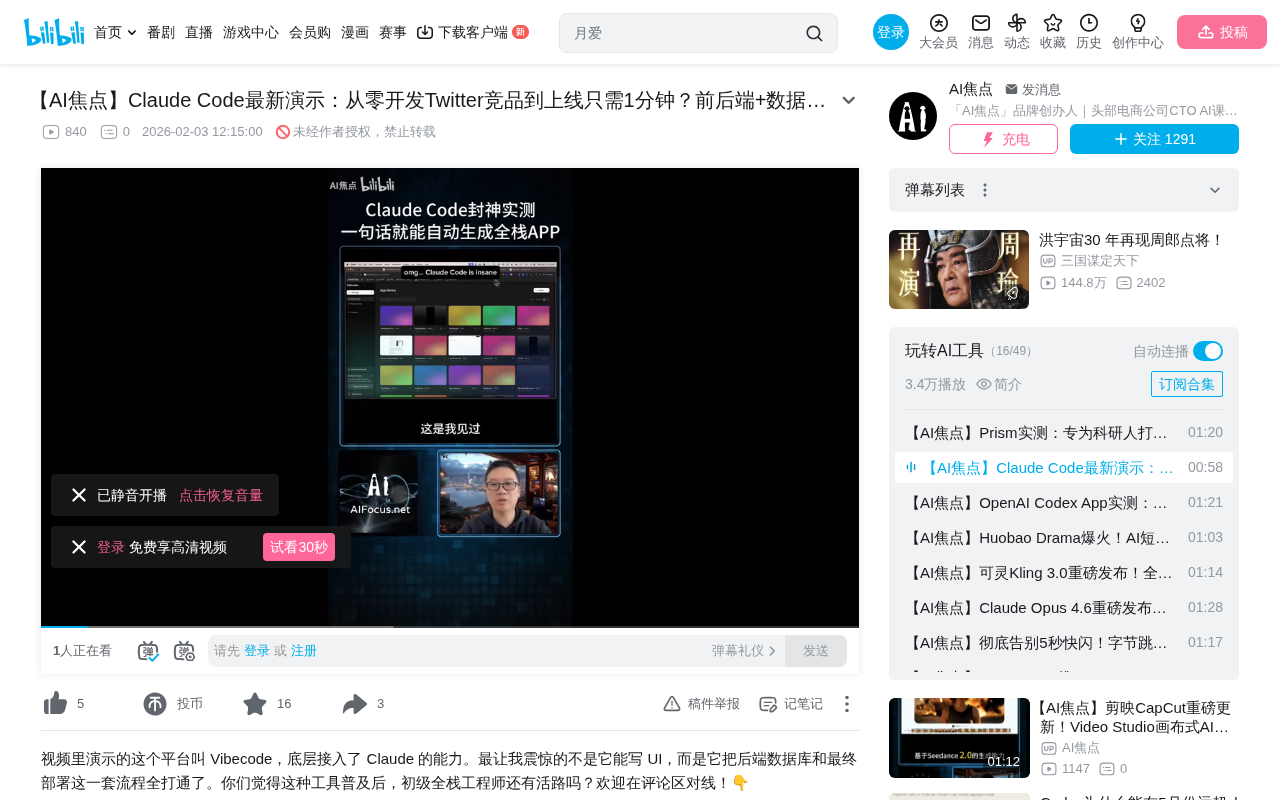
Generating a Full-Stack App with a Single Sentence
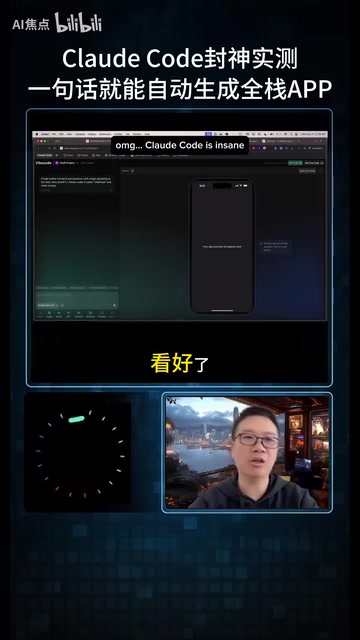
The demo starts remarkably simply: the developer types a natural language request into Claude Code's chat box — "Build me a Weibo-like full-stack app with posting, liking, view feed, and an orange theme."
To appreciate how disruptive this is, you need to understand the traditional barriers to full-stack application development. A full-stack application is a complete software system that includes both a front-end user interface and back-end server logic with a database. In traditional development, the front end is typically built using frameworks like React or Vue, while the back end relies on languages like Node.js, Python, or Java to handle business logic and data storage. A full-stack developer needs to master both sides of the stack — a steep learning curve that usually takes years. Claude Code's breakthrough lies in unifying these disparate technology stacks beneath a natural language interaction layer, where the AI automatically selects appropriate technical solutions and generates the corresponding code.
What's remarkable is that Claude Code didn't just generate a static page template. In a short time, it completed the following:
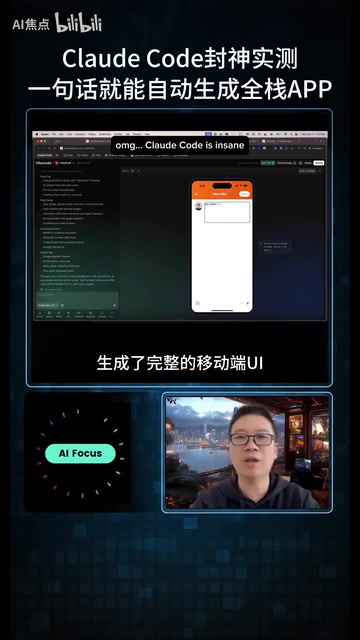
- Front-end UI: A complete page layout with an orange theme, including a post composer, feed stream, like buttons, and other interactive components
- Back-end logic: APIs for posting, liking, and fetching the feed — all auto-generated
- Front-end/back-end integration: The data communication logic between front end and back end was already wired up, requiring no manual integration from the developer
In traditional development workflows, front-end/back-end integration alone can take hours or even days. This integration refers to the process of debugging data communication between front-end pages and back-end API endpoints, involving API documentation alignment, data format negotiation (such as JSON structure definitions), cross-origin request handling (CORS configuration), error status code conventions, and many other details. Since the front end and back end are often handled by different developers or even different teams, communication overhead and integration time are frequently underestimated. The reason Claude Code can skip this step entirely is that it generates both front-end and back-end code simultaneously, inherently guaranteeing interface contract consistency — a unique advantage of having a single AI agent handle full-stack development.
Adding Features: Seamless AI Image Generator Integration
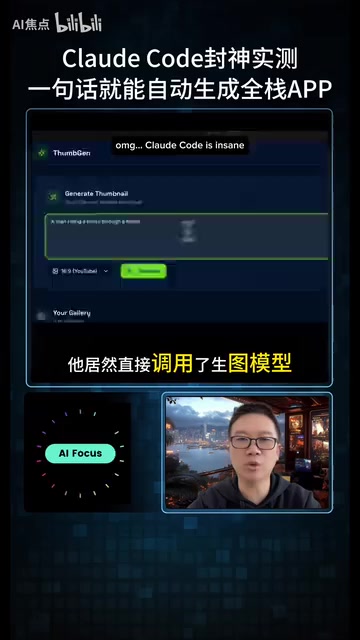
Even more impressive was the follow-up feature request. Building on the existing application, the developer typed: "Add an image generator with a minimalist style."
Claude Code directly leveraged image generation model capabilities, adding an image generation module to the existing application. Users can type a text description within the app, and the AI generates a corresponding image in real time.
This detail deserves special attention — Claude Code can not only build applications from scratch but also perform incremental development on existing projects, automatically integrating third-party AI capabilities (such as image generation models). Incremental development is a core concept in software engineering, referring to the gradual addition of new features on top of an existing codebase rather than starting from zero each time. This requires the development tool to understand the existing project's code architecture, file organization, dependency relationships, and data flow. For AI programming tools, this means having long-context memory and code semantic understanding capabilities. The large language model behind Claude Code features an ultra-long context window (Claude-series models support up to 200K tokens of context), enabling it to "remember" the entire project's code structure and insert new feature modules in the right places without breaking existing logic. This demonstrates that its understanding of project context and control over code architecture has reached a remarkably mature level.
One-Click Deployment: From Code to Production in Seconds
The climax of the entire demo came during deployment. The developer clicked the deploy button, customized a domain name, and Claude Code automatically completed:
- Database configuration: Automatically created and connected the database
- Environment setup: Server environment, dependency installation, and other tasks fully automated
- Domain binding: Custom domain took effect immediately
Seconds later, a real, publicly accessible website was live.
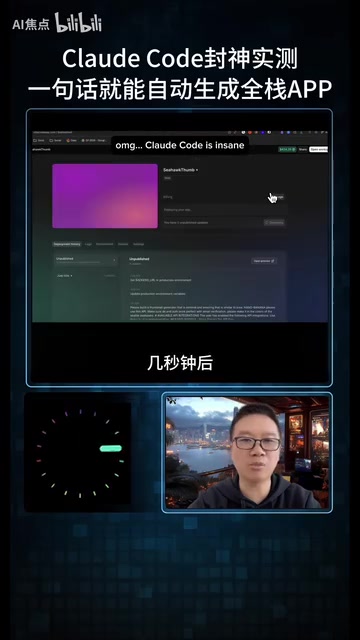
This seemingly simple one-click operation actually involves the automated orchestration of an entire Cloud Native technology stack behind the scenes. Database configuration typically means automatically creating a cloud database instance (such as PostgreSQL or MySQL), generating connection strings, and injecting them into environment variables. Environment setup involves containerized deployment or Serverless function configuration. Domain binding requires DNS resolution and automatic SSL certificate issuance. In traditional development, these steps are usually handled by dedicated DevOps engineers through CI/CD pipelines (such as GitHub Actions or Jenkins), with configuration potentially taking hours. Modern deployment platforms like Vercel, Netlify, and Railway have already greatly simplified this process, and Claude Code takes it a step further by abstracting it into a single click.
From requirement description to production deployment, the entire workflow has been compressed to the extreme. This is no longer "AI-assisted programming" in the traditional sense — it's closer to AI-driven autonomous development.
A Reality Check: The Gap Between Demo and Production
Despite how impressive this demo is, we need to maintain rational judgment:
The Demo Scenario Has Limitations
A Weibo-like CRUD application is a relatively standardized scenario with a simple data model and clear business logic. CRUD stands for Create, Read, Update, and Delete — the four basic data operations that form the core of virtually every web application. The data model for a microblogging app is relatively simple — users, posts, and likes as three core entities with clear relationships. But enterprise-grade applications face far greater challenges: distributed transaction consistency, multi-tenant data isolation, fine-grained access control (RBAC/ABAC), caching strategies under high concurrency, database read-write splitting, API rate limiting and circuit breaking, GDPR compliance requirements — these complexities grow exponentially and remain significant challenges for AI-generated code.
Code Quality Still Needs Scrutiny
Does the auto-generated code follow best practices? Is error handling comprehensive? How is security ensured? These dimensions — impossible to fully demonstrate in a demo — are precisely what matter most in production environments. For example, whether security measures such as SQL injection prevention, XSS cross-site scripting defense, authentication and authorization mechanisms (like JWT token management), and encrypted storage of sensitive data have been adequately addressed in rapidly generated code still requires line-by-line review by professional developers.
The Developer's Role Is Evolving
Rather than saying AI will replace programmers, it's more accurate to say it's redefining where developers focus their efforts. Future developers may increasingly serve as "requirement architects" and "code reviewers" rather than line-by-line code writers. This trend is consistent with the historical evolution of software engineering — from assembly language to high-level languages, from hand-written HTML to front-end frameworks — each increase in abstraction level has allowed developers to focus on higher-level problems while delegating low-level implementation to tools.
Conclusion
Claude Code's demo truly showcases the enormous potential of AI programming tools. From natural language requirements to an accessible live application, the fully automated end-to-end experience is nothing short of impressive. While it's still some distance from completely replacing professional development, for scenarios like rapid prototyping, MVP development, and personal project building, these tools already offer tremendous practical value. MVP (Minimum Viable Product) is a core concept in lean startup methodology, systematically articulated by Eric Ries in The Lean Startup. The core idea is to build a product version that can validate key hypotheses with minimal development cost, then quickly release it to gather user feedback. Traditional MVP development typically takes 2–4 weeks, but AI programming tools compress this cycle to hours or even minutes — a game-changer for entrepreneurs and product managers who can now validate multiple product ideas in a single day, dramatically reducing the cost of experimentation.
The barrier to full-stack development may not have been "completely leveled," but it has undeniably been lowered significantly. For developers, getting familiar with and mastering these AI programming tools early on will be an important step toward boosting personal competitiveness.
Related articles
 Product Reviews
Qoder vs Cursor Real-World Comparison: Which $20/Month AI IDE Is Better?
Hands-on comparison of Qoder vs Cursor AI IDEs: Agent autonomy, human interaction count, and architecture decisions. Qoder needed only 2 interactions vs Cursor's 8.
 Product Reviews
Cursor Cloud Agent Demo: Eliminating Bottlenecks Across the Entire Software Development Lifecycle
Deep analysis of Cursor's Cloud Agent demo showing how cloud VMs, automated test artifacts, and a full-chain control plane systematically eliminate human bottlenecks across the software development lifecycle.
 Product Reviews
Cursor 3.0 Deep Dive: Multi-Agent Parallelism, Design Mode, and Best-of-N Model Comparison
Cursor 3.0 evolves from an AI coding assistant into an Agent fleet command center. Explore multi-agent parallelism, Design Mode, and Best-of-N model comparison.