Claude Has Written 80% of Its Own Code: Anthropic's Internal Data Reveals the State of AI Self-Development

Anthropic reveals Claude now writes 80% of its own code, with engineer output up 8x in one year.
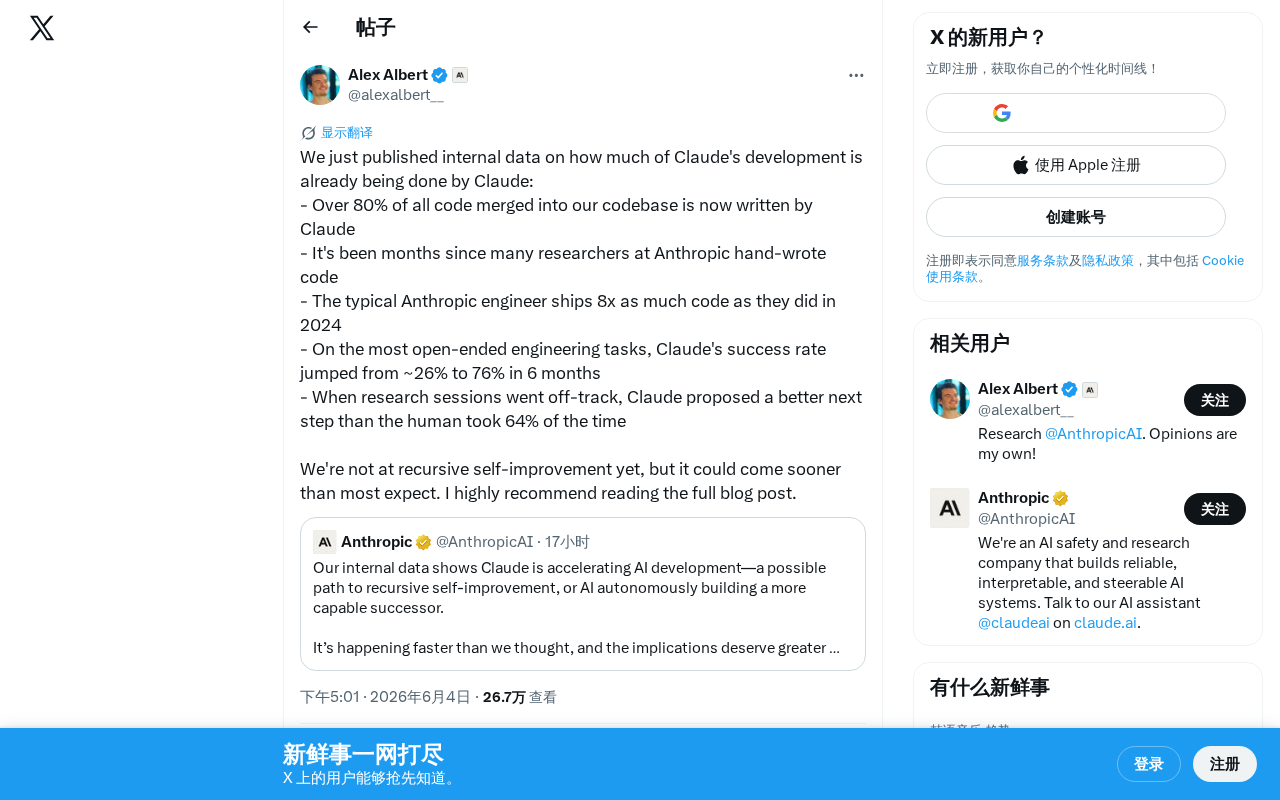
Anthropic's latest internal data reveals that Claude writes over 80% of its own codebase, engineers produce 8x more output than in 2024, and open-ended task success rates jumped from 26% to 76% in six months. Claude's proposed next steps outperform human researchers' choices 64% of the time. While true recursive self-improvement hasn't been achieved, Anthropic warns it may arrive sooner than expected.
Core Finding: AI Is Developing AI
Anthopic recently released a set of stunning internal data revealing the depth of Claude's involvement in its own development process. These figures show that AI-assisted development is no longer a future vision—it's happening now. Claude is becoming its own most important developer.
According to Anthropic's official disclosure, over 80% of all code merged into its codebase is written by Claude. This means the vast majority of code powering Claude as a product is no longer written by human engineers—it's produced by the AI itself.
From a technical perspective, Claude's participation in its own code development represents an advanced form of "bootstrapping." The traditional bootstrapping concept originates from compiler theory—using a compiler written in a programming language to compile itself. Claude's situation is far more complex: it's not merely compiling itself, but participating across the entire pipeline of understanding requirements, designing solutions, and writing implementation code. This deep involvement is likely achieved through command-line tools like Claude Code, enabling Claude to directly access the codebase, understand project context, and generate code that meets specifications.
Exponential Engineering Efficiency: 8x Output Growth
The data shows that a typical Anthropic engineer now produces 8 times the code output compared to 2024. Behind this number lies a deep reshaping of the development workflow by AI tools. In fact, many researchers at Anthropic haven't written code by hand in months—their role is shifting from "coder" to "director" and "reviewer."
Placing this figure in the historical context of software engineering makes its significance even more striking. Over the past few decades, each paradigm shift—from assembly to high-level languages, from waterfall to agile, from manual deployment to CI/CD pipelines—typically delivered 2-3x efficiency gains. AI-assisted development achieving 8x growth within a single year is unprecedented in software engineering history. GitHub Copilot's early research showed AI assistance could boost development efficiency by about 55%, while Anthropic's deep internal integration clearly far exceeds that level—likely thanks to Claude's deep understanding of its own codebase and contextual awareness capabilities.
This transformation isn't simply an efficiency improvement—it's a fundamental shift in how work gets done. Engineers no longer need to write code line by line. Instead, they increasingly take on roles in architecture design, requirements definition, and quality control, delegating the actual implementation work to Claude.
Capability Leap: Open-Ended Task Success Rate Jumps from 26% to 76%
On the most challenging open-ended engineering tasks, Claude's success rate surged from approximately 26% to 76% in just six months. This nearly threefold improvement is remarkable, demonstrating that AI's ability to handle complex, unstructured problems is evolving rapidly.
Understanding this data requires clarifying what "open-ended engineering tasks" means. Unlike structured tasks (such as "implement a sorting algorithm"), open-ended tasks might be "optimize system response latency" or "design a new caching strategy"—requiring understanding of ambiguous requirements, weighing multiple approaches, and making creative decisions. The leap from 26% to 76% success rate means Claude has achieved qualitative improvements in both the length and quality of its reasoning chains—it can decompose complex problems into sub-problems, evaluate multiple solution paths, and make reasonable judgments under uncertainty. This capability improvement is likely closely tied to advances in Chain-of-Thought reasoning, tool-use capabilities, and long-context understanding.
Even more noteworthy is another data point: when research goes off track, Claude's proposed next steps outperform the actual choices made by human researchers 64% of the time. This means that in certain decision-making scenarios, AI has already demonstrated judgment that surpasses human intuition.
From a cognitive science perspective, this phenomenon makes sense: human decision-making is affected by multiple cognitive biases—anchoring effects cause researchers to continue along existing lines of thinking, the sunk cost fallacy makes people reluctant to abandon invested directions, and confirmation bias causes people to ignore contradicting evidence. An AI system can relatively objectively reassess all possibilities at each evaluation point, unaffected by emotions and cognitive inertia. Furthermore, through training on massive amounts of code and research literature, Claude has accumulated broader pattern recognition capabilities than any individual researcher, able to extract optimal strategies from a much larger set of historical cases.
Recursive Self-Improvement: Closer Than Expected to a Technological Singularity
These data points raise a profound question: how far are we from "recursive self-improvement"? Recursive self-improvement refers to AI autonomously improving its own capabilities, forming a positive feedback loop that leads to accelerating capability growth.
This concept was first proposed by mathematician I.J. Good in 1965, who called it an "intelligence explosion": an ultraintelligent machine could design even better machines, triggering a chain reaction of capability growth. This concept was later developed into the "technological singularity" theory by futurists like Ray Kurzweil. In practical terms, recursive self-improvement requires several conditions: AI must understand its own architecture and training process, identify directions for improvement, implement improvements, and verify results. Currently, Claude writing 80% of the code is primarily concentrated at the application and infrastructure layers, rather than fundamental improvements to core model architecture. True recursive self-improvement requires AI to improve its own reasoning capabilities, training methods, and architecture design—a much higher bar.
Anthopic acknowledges that true recursive self-improvement hasn't been achieved yet, but warns: this moment may arrive sooner than most people expect. Considering that Claude is already writing 80% of its own code and its success rate on open-ended tasks continues to climb rapidly, this assessment is far from alarmist.
Industry Implications: The Deep Impact of the AI-Developing-AI Era
The significance of this data extends far beyond a single company. It reveals several important trends:
First, AI developing AI is now reality. When an AI system can complete the vast majority of its own development work, traditional software engineering paradigms are being disrupted. This changes not only how code is produced, but also how software quality assurance, version control, and technical debt management work. When AI-generated code exceeds human-written code, the focus of code review shifts from "is this code correct" to "is the AI understanding the requirements correctly."
Second, human roles are being redefined. Engineers transitioning from "executors" to "supervisors" is a shift that will gradually extend to more knowledge work domains. This parallels the Industrial Revolution's transformation of manual laborers into machine operators—but may happen much faster.
Third, the capability growth curve is steep. The leap from 26% to 76% success rate within six months suggests that AI capabilities may be in the early stages of exponential growth. If this growth trend continues, AI performance on complex engineering tasks could further approach or even surpass senior engineer levels within the next 6-12 months.
For the entire AI industry, Anthropic's data serves both as a milestone achievement and a sobering reminder about the pace of AI development. As AI begins to deeply participate in its own evolution, we may be standing at the threshold of a technological singularity.
Related articles
Deep Dive into the Three AI Programmin…
Deep Dive into the Three AI Programming Frameworks: The Right Way to Do Specification-Driven Development
Deep dive into the three frameworks of Specification-Driven Development (SDD) for AI programming: Blueprint, Execution Flow, and Change Records — solving the problem of AI code going off the rails.

AI Aggregator Platforms Tested: A Complete Guide to Using GPT 5.5 and Other Top Models for Free
A hands-on guide to using GPT 5.5, Gemini 3.1 Pro, and Grok 4.2 for free via AI aggregator platforms, covering cross-model context memory, account pool mechanisms, and key security risks.
Vibe Coding in Practice: A Junior Student Uses Cursor to Build a Multi-Agent System with 51 AI Officials Based on the Three Departments and Six Ministries Framework
A junior student uses Cursor and Vibe Coding to build a multi-agent system with 51 AI officials modeled on China's Three Departments and Six Ministries, featuring task distribution, approval workflows, and Token cost visualization.