AI Aggregator Platforms Tested: A Complete Guide to Using GPT 5.5 and Other Top Models for Free

How AI aggregator platforms offer free access to GPT 5.5 and other top models — with caveats.
This article examines AI aggregator platforms that let users access GPT 5.5, Gemini 3.1 Pro, Grok 4.2, and other top-tier models for free without network restrictions. It explains how cross-model context memory and account pool mechanisms work technically, compares real-world model performance, and provides critical warnings about data security, compliance risks, and service reliability.
GPT 5.5 Instant's Core Upgrade: From Verbose to Concise
Recently, OpenAI quietly launched GPT 5.5 Instant, replacing GPT 5.3 Instant as ChatGPT's default model and making it available to all users. The core of this upgrade isn't about making the model "smarter" — it's about teaching it to be more concise. OpenAI claims output length has been reduced by approximately 30%, with responses that cut straight to the point.
OpenAI's model naming system has evolved multiple times. From GPT-3 to GPT-4, each major version number represents a significant leap in architecture or training scale, while minor versions (like 5.3 to 5.5) typically represent fine-tuning optimizations on the same architecture — including RLHF strategy adjustments, inference efficiency improvements, or output style calibration. The "Instant" suffix usually denotes a lightweight version optimized for response speed and conciseness, complementing the "Thinking" (deep reasoning) variant. This multi-version parallel strategy allows OpenAI to offer differentiated services for different use cases.
As one Bilibili creator put it: "The old AI was like an overly eager intern — ask how to decline when a coworker tries to dump their work on you, and it'd write five pages of slides. Now it's more like that no-nonsense colleague who gets things done — if it's not your problem, just say you're busy."
From a technical implementation perspective, controlling model output length involves multiple layers. First, there's reward model adjustment during the RLHF (Reinforcement Learning from Human Feedback) stage — annotators give higher scores to concise answers, guiding the model to learn a "less is more" expression strategy. Second, system prompt optimization injects instructions to maintain brevity before model inference. Additionally, decoding strategy adjustments may be involved, such as lowering repetition penalty thresholds or adjusting temperature parameters. The challenge lies in reducing word count without losing critical information, which requires the model to have stronger information compression and prioritization capabilities.
This shift from "universal answer machine" to "digital assistant" signals that AI products are moving from pursuing capability ceilings toward optimizing user experience. For users in China, the more practical question is how to experience these latest models with zero barriers.
Core Features of AI Aggregator Platforms Explained
Multi-Model Free Access: One-Stop Gateway to Global Top AI
According to Bilibili creator "Apu," there exists a category of specialized AI aggregator sites whose core selling point is: direct access to conversation pages of major global AI services without needing to change your network environment. Supported models include:
- OpenAI Series: GPT 5.5 Thinking, full GPT model lineup, AMG2 image generation model
- xAI Series: Full Grok 4.2 lineup
- Anthropic Series: Claude 4.7 (Office version)
- Google Series: Gemini 3.1 Pro
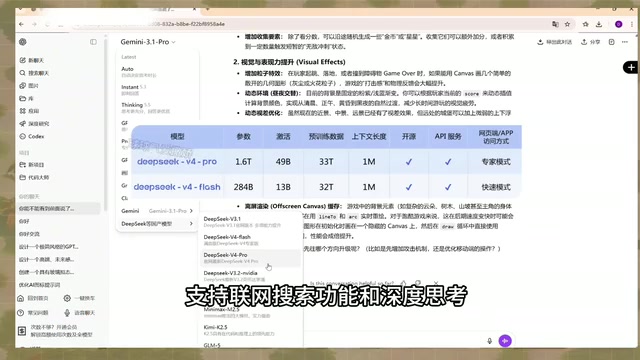
- Domestic Models: DeepSeek V4 (with web search and deep thinking support)
These AI aggregator platforms typically use one of two technical approaches: API forwarding mode, where the platform purchases API quota from AI service providers and forwards user requests to official endpoints; or account pool mode, where accounts are batch-registered or purchased, and automated scripts simulate user logins to relay conversations. The latter provides an experience identical to the official site (including advanced features like Canvas), but carries greater compliance risks. The "free" business model of such platforms typically relies on advertising revenue, paid premium services, or user data monetization to sustain operations.
Users simply select the "Free Zone" on the homepage to start using any model, all advertised as unlimited free access.
Cross-Model Context Memory: A New Experience in Multi-AI Collaboration
One of the platform's most distinctive features is switching models within a single conversation while maintaining context memory. The workflow looks like this:
- User generates content with GPT 5.5 Thinking
- Switches to the Gemini model within the same conversation
- Gemini can "see" the previous conversation with GPT and provide supplementary suggestions based on it
Achieving cross-model context persistence requires solving several core technical challenges: different models use different token encoding methods (e.g., GPT uses tiktoken, Gemini uses SentencePiece), context window sizes vary (from 128K to millions of tokens), and each model has different formatting requirements for conversation history. Aggregator platforms typically concatenate previous conversation content as plain text into the new model's input as "background information." While effective, this approach consumes significant token quota and may lose some semantic information due to format conversion.
This "seamless switching" design philosophy essentially chains multiple models' capabilities together, giving users multi-perspective AI feedback within a single conversation flow, significantly boosting work efficiency.
Official Account Pool Mechanism: Eliminating Usage Limits Entirely
To solve official usage limits, the platform employs an "account pool" mechanism — hundreds of built-in official accounts. When one account reaches its usage cap, users can switch to another account with a single click to continue the conversation. This design completely eliminates so-called "range anxiety."
Hands-On Comparison of Model Performance
GPT 5.5 Thinking's Code Generation Capabilities
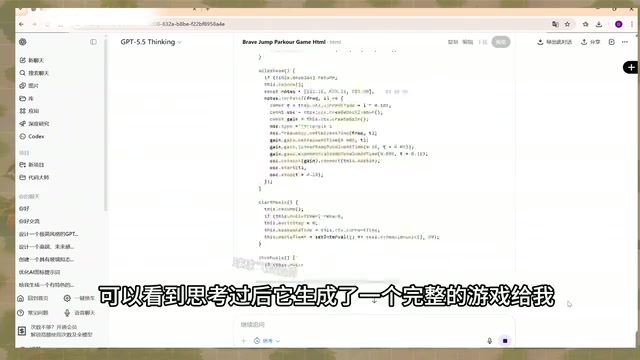
In the demonstration, the creator had GPT 5.5 Thinking generate an interactive mini-game. After a thinking phase, the model output complete game code that could be played directly in the right-side panel — this is the Canvas/Artifacts functionality only available in the full-featured version of ChatGPT, confirming the platform provides access to the complete version.
Canvas (OpenAI) and Artifacts (Anthropic) represent an important evolutionary direction for AI conversation products — moving from pure text interaction to a hybrid "conversation + workspace" interface. These features allow AI-generated code, documents, or visualizations to be rendered and interacted with in real-time in a separate panel, where users can directly edit, run, or iterate on generated results. This design upgrades AI from a "question-answering tool" to a "collaborative creation partner," dramatically reducing the friction between AI output and practical application.
Gemini 3.1 Pro's Response Speed and Multimodal Capabilities
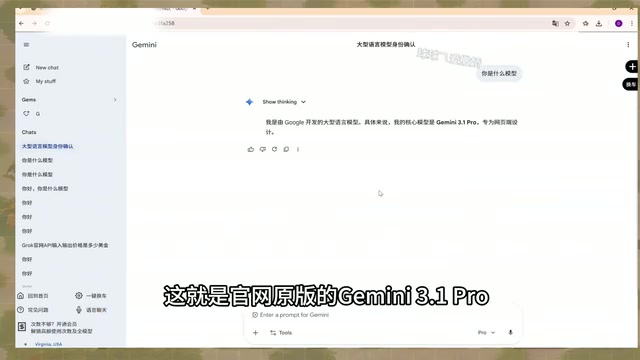
After switching to the Gemini official entry point, selecting an Ultra account and using the 3.1 Pro model, response speed was very fast, with full support for image generation, web search, and all other official features.
Grok's Differentiated Positioning: The Most Human-Like AI Assistant
Elon Musk's Grok is described as "the most human-like AI," particularly suited for handling daily tasks and creative writing needs, with a more natural and casual response style.
Risk Warnings and Safety Recommendations
While these aggregator platforms offer convenient access, users should be aware of the following:
- Data Security Risks: Using AI services through third-party platforms means your conversations may be logged by intermediaries — avoid inputting sensitive information
- Compliance Issues: The shared account pool model likely violates the terms of service of various AI platforms, carrying the risk of being banned at any time
- Service Stability: The sustainability of free services is questionable — don't rely on them as your sole productivity tool
- Version Authenticity: While demos appear to show official versions, users should independently verify the actual model versions being served
Conclusion: Experience Tool or Productivity Tool?
From a product trend perspective, GPT 5.5 Instant's "streamlining" upgrade represents an important direction in the AI industry: model capability ceilings are already high enough — user experience optimization is the competitive focus of the next phase.
Since 2024, gaps between mainstream large models on standardized benchmarks have narrowed significantly, with scores on MMLU, HumanEval, and other leaderboards approaching saturation. This means simply being "a stronger model" can no longer constitute a differentiated competitive advantage. Industry focus has therefore shifted to: response latency optimization (such as Groq's LPU inference chips reducing latency to millisecond-level), personalized memory (like ChatGPT's Memory feature), multimodal fusion experiences, and the output style optimization discussed in this article. This transition resembles the smartphone industry's maturation from "stacking hardware specs" to "optimizing user experience."
The emergence of aggregator platforms reflects the tension between strong demand for top-tier AI models among Chinese users and the access barriers they face.
For everyday users, these platforms genuinely provide a low-cost window to experience the world's best AI, but they should be positioned as "experience tools" rather than "productivity tools" — enjoy the convenience while remaining vigilant about data security and service stability.
Related articles
Anthropic London Developer Conference: Claude Model Upgrades, Enterprise Agent Platform, and Developer Tools Fully Evolved
Anthropic's first London Code with Claude event unveiled Opus 4.7, Mythos, Cloud Managed Agents, Claude Code Routines, and more for AI-assisted development.
Claude Code Desktop Status Capsule: An Open-Source Widget for Real-Time AI Coding Status Monitoring
An open-source desktop status capsule that monitors Claude Code's idle, working, and completed states in real time, with multi-conversation management, memos, and music control for developers.
GPT-5.2 Codex vs Opus 4.5 Hands-On: A Comprehensive Comparison of Coding Ability, Speed, and Developer Experience
Hands-on comparison of GPT-5.2 Codex vs Opus 4.5 across frontend generation, physics simulation, 3D scenes, and code refactoring, with practical selection advice.