Decoding Claude's New Policy: Dedicated Monthly Quota Is Actually a Massive Cut to AFK Use Cases

Anthropic limits Claude programmatic access quotas, heavy automation users face 96% usage reduction
Anthropic announced that starting June 15, Claude subscription quotas will be split into Human-in-the-Loop (interactive) and AFK (automated programmatic access) portions. The dedicated AFK quota equals only the subscription fee itself, while users previously enjoyed roughly 10x subsidized rates—resulting in approximately 96% capacity reduction for heavy automation users (those using Agent SDK, Claude P, GitHub Actions). While rules are now clearer, developers should consider diversifying across multiple platforms to mitigate risk.
Background: Anthropic Announces New Programmatic Access Rules
Just hours ago, the Anthropic developer team released a major update: starting June 15, paid Claude subscribers can claim a dedicated monthly quota for programmatic access. This quota covers Claude Code, Agent SDK, Claude P (CLI tool), GitHub Actions, and third-party applications built on the Agent SDK.
Programmatic access refers to automatically triggering AI services through code scripts, API interfaces, or command-line tools—in stark contrast to users manually typing conversations in a web interface. In software engineering practice, this pattern is widely used in CI/CD pipelines, automated testing, batch data processing, and similar scenarios. The core characteristics of programmatic access are unattended operation, concurrent request support, and the ability to be orchestrated into more complex workflows. For AI service providers, programmatic access generates far higher compute consumption than interactive use, because there's no human reading and thinking interval—requests can be sent continuously without pause. This is one of the underlying drivers behind Anthropic's policy adjustment.
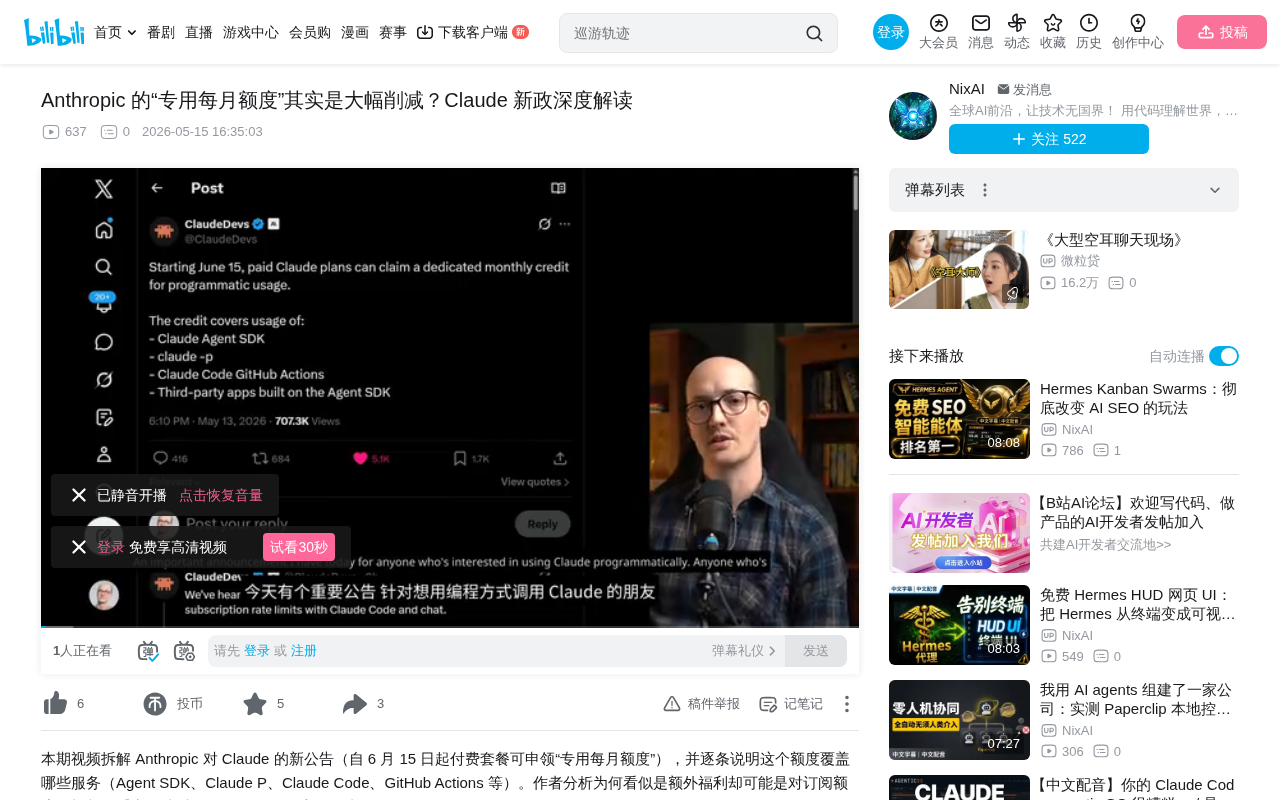
On the surface, this looks like an extra benefit—users get a dedicated quota they didn't have before. But upon deeper analysis, for users heavily dependent on AFK (Away From Keyboard, automated unattended operation) workflows, this is actually a massive usage quota reduction.
Three Core Tools: Prerequisites for Understanding the Announcement
Claude Agent SDK
The Agent SDK is a development toolkit written in TypeScript and Python, essentially the core component powering Claude Code's backend. By running scripts, users can have Claude automatically build projects. Many third-party applications (such as Conductor, OpenCloud, etc.) are built on the Agent SDK.
The Agent SDK represents an important paradigm in current AI application development—the AI Agent framework. Unlike simple API calls, Agent frameworks provide advanced capabilities like task decomposition, tool calling, memory management, and error recovery. Dual TypeScript and Python language support covers both frontend/full-stack developers and data science/backend developers. The core value of the Agent SDK lies in abstracting Claude Code's capabilities into programmable interfaces, enabling developers to build custom AI coding agents without being limited to Anthropic's standard interface. This SDK model has become an industry trend—OpenAI's Agents SDK and Google's ADK (Agent Development Kit) have adopted similar technical approaches.
Claude P (CLI Tool)
Functionally similar to the Agent SDK, but invoked through a command-line interface. It's a complete Claude Code instance that can read/write files, run Bash scripts, and do everything Claude Code can do. The key difference: it runs entirely programmatically, without requiring the user to be present. Some developers have built complete software factories (like Sancastle) on top of it, orchestrating AI coding agents in isolated sandboxes.
AFK workflows represent an emerging development paradigm in AI programming: developers define task specifications and acceptance criteria, then walk away while the AI agent autonomously completes the full cycle of coding, testing, and debugging. "Software factory" projects like Sancastle mentioned here typically use isolated sandboxes (such as Docker containers or virtual machines) to ensure AI agent operations don't compromise host system security. The theoretical upper limit of this model is achieving 24/7 uninterrupted software production, but it also brings enormous compute consumption—an AFK agent might consume in a few hours the equivalent Token volume of weeks of interactive use by a human developer. This is precisely why Anthropic needs to meter it separately.
Claude GitHub Actions
Allows running Claude within GitHub Actions. When you tag @Claude in an Issue or PR, it automatically executes the corresponding operation. This is another typical programmatic usage scenario.
GitHub Actions is GitHub's CI/CD (Continuous Integration/Continuous Deployment) automation platform, allowing developers to define workflows in code repositories that automatically execute tasks in response to events like pushes, pull requests, and issue creation. Integrating Claude into GitHub Actions means AI can automatically perform code reviews, bug fixes, documentation generation, test writing, and more. This integration is especially valuable in open-source project maintenance—maintainers can let AI handle large volumes of routine issues and PRs, only intervening for complex decisions. But this is also a typical high-Token-consumption scenario: an active open-source project might trigger dozens of AI calls per day, with cumulative Token consumption being quite substantial.
The Core Conflict: Human-in-the-Loop vs. AFK Use Cases
Anthropic clearly delineated two categories of use cases in this announcement:
Human-in-the-Loop:
- Claude conversations (web, desktop, mobile)
- Claude Code used in terminal or IDE
- Interactions requiring real-time user participation
AFK (Away From Keyboard, automated unattended operation):
- Agent SDK (Python/TypeScript)
- Claude P command line
- GitHub Actions
- Third-party tools built on Agent SDK
Anthropic's stance is crystal clear: they prioritize Human-in-the-Loop use cases far above AFK use cases. The logic behind this division is that in Human-in-the-Loop scenarios, human thinking time naturally limits request frequency, while AFK scenarios can continuously consume compute at machine speed—the resource consumption patterns differ by orders of magnitude.
Why This Is a "Cut" Rather Than a "Benefit"
The Previous Situation
Before the new rules, users could use a single subscription (such as Pro 5X or 20X Max) to support both Human-in-the-Loop and AFK use cases simultaneously. While some workarounds were needed, Anthropic did allow this. According to third-party estimates, the 20X Max subscription was equivalent to up to $5,000 in API Credits per month in raw Token volume—roughly a 10x subsidy multiplier.
Understanding this subsidy multiplier requires knowledge of AI service Token economics. Taking Claude 3.5 Sonnet as an example, API pricing is approximately $3/million Tokens for input and $15/million Tokens for output. A complex coding task might involve hundreds of thousands of Tokens in context and output. When a 20X Max subscription ($200/month) provides usage equivalent to $5,000 in API credits, it means Anthropic is providing service to subscribers at roughly 4% of the price. This aggressive subsidy strategy is typically used for rapid user acquisition and market share growth, but in AFK scenarios it gets "arbitraged"—automated scripts can exhaust the subsidized quota in short periods, causing actual per-user service costs to far exceed subscription revenue.
The Current Situation
The new rules split the quota into two parts:
- Human-in-the-Loop quota: remains unchanged
- AFK dedicated quota: allocated by subscription tier (Pro $20, Max 5X $100, Max 20X $200)
Note the critical issue here: the AFK dedicated quota amount equals only the subscription fee itself, whereas previously users enjoyed approximately 10x the subsidy. This means actual available capacity for AFK scenarios has been dramatically compressed. For a 20X Max user, this represents a drop from an equivalent $5,000 in AFK capacity to $200—a reduction of up to 96%.
Quota Rule Limitations
- Once the quota is exhausted, usage is suspended until the next monthly reset
- No rollover across months
- Third-party tools (like OpenCloud) also deduct from the same quota
The Positive Side of Rule Clarification
Despite being a cut, this announcement has a positive aspect. Previously, Claude's usage rules had extensive gray areas:
- Agent SDK running on personal software? Basically fine
- Agent SDK running on commercial software? No
- Claude Code running in CI? Uncertain
- Claude P running on open-source software but on a personal computer? Unclear
The new announcement cuts through all these ambiguous rules at once, providing clear classification standards. For developers, knowing where the boundaries are is far better than ambiguous tacit permission. In commercial software development practice, rule uncertainty is often more destructive than strict limitations—developers cannot build production-grade workflows based on tacit permissions that might be revoked at any time.
Real-World Impact on Developers and Coping Strategies
Anthropic's Strategic Intent
From a business perspective, Anthropic's strategy is clear:
- Vendor Lock-in: Pull users more toward Human-in-the-Loop scenarios, increasing platform stickiness
- Compute Control: Limit unattended consumption in AFK scenarios, reducing server pressure
- Differentiated Pricing: Pave the way for potential future AFK-specific subscription tiers
Vendor Lock-in is a classic business strategy in cloud computing and SaaS industries, referring to making it difficult for users to switch to competitors through technical dependencies, data migration costs, or ecosystem binding. In the AI programming tools space, lock-in is primarily achieved through: custom configuration files (like Claude's CLAUDE.md project specifications), accumulated prompt engineering, and workflows deeply integrated with the platform. Anthropic's strategy of promoting Human-in-the-Loop usage essentially gets users to develop deep understanding of Claude's thinking patterns and capability boundaries through daily interaction. This tacit knowledge constitutes powerful switching costs—once developers have become accustomed to Claude's code style, reasoning approach, and interaction patterns, migrating to another platform means rebuilding these cognitive models from scratch.
Developer Coping Strategies
For heavy AFK users, considerations may include:
- Diversify platform risk: OpenAI's Codex doesn't distinguish between AFK and Human-in-the-Loop—subscriptions can be used for any scenario
- Retain Claude for planning: Claude still excels at architecture planning, code review, and other tasks requiring human involvement
- Migrate AFK workflows: Move automated builds, CI/CD, and similar scenarios to other platforms
- Watch for the June 8 email: You'll receive a quota claim notification then, with the policy taking effect June 15
It's worth noting that a multi-platform strategy itself has costs. Different AI models have significant differences in code generation style, context understanding capability, and tool-calling reliability. Developers need to maintain different prompt templates and workflow configurations for each platform. The ideal strategy is to choose the most suitable platform based on task characteristics: keep tasks requiring deep reasoning and architectural decisions on Claude, while assigning batch, pattern-based coding tasks to platforms with more controllable costs.
Conclusion
This Claude policy change is essentially a major adjustment to Anthropic's resource allocation strategy. For users who primarily use conversations and interactive programming, the impact is minimal. But for developers relying on AFK workflows, this is a change that demands serious attention. The rules are clearer now, but available AFK compute has indeed been drastically reduced. In an era of increasingly fierce AI tool competition, developers need to be more flexible in distributing workloads across multiple platforms.
From a broader perspective, this policy adjustment reflects a key inflection point the AI industry is experiencing: transitioning from a "acquire users at all costs" growth phase to a "sustainable business model" maturity phase. When AI programming tool usage evolves from exploratory interactive conversations to industrialized automated production, service providers must reassess their pricing models and resource allocation strategies. Anthropic won't be the last company to make a similar adjustment.
Related articles
 Industry Insights
AI Product Development in Practice: Model Selection, Building Moats, and Paths to Commercialization
Practical strategies for AI product development: why not to train models from scratch, when to use APIs vs. fine-tuning, building product moats, and the full path from evaluation systems to commercialization.
 Industry Insights
No Product Fits Your Needs? Building It Yourself Is the Best Starting Point for Indie Developers
Can't find a product that fits? Building from personal pain points is the best entry for indie developers. Niche needs + AI tools = rapid product creation.
 Industry Insights
OpenAI Codex Tutorials Mass-Copied on Bilibili, Highlighting AI Content Farm Problem
At least 9 Bilibili accounts mass-published identical OpenAI Codex tutorial videos, exposing content farm operations in the AI tools space.